

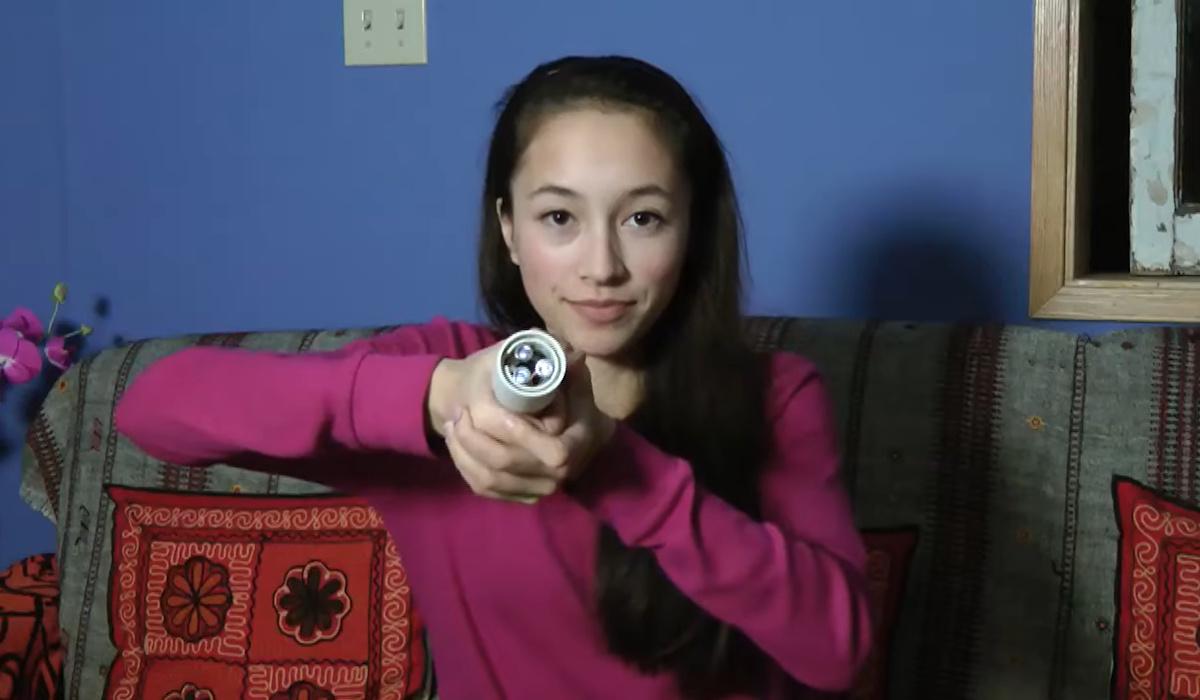
A Canadian teenager built a flashlight that needs no batteries and no solar panel, generating electricity instead from the difference in temperature between a person's warm palm and the cooler air around it. The invention, reported on by ScienceBlog, dates back to 2013 and belongs to Ann Makosinski, who was then a 15-year-old 10th grade student in British Columbia.
Makosinski called her device the Hollow Flashlight. Its defining feature was simplicity: a user only had to hold it in their hand for it to produce enough energy to light up.
How the Hollow Flashlight works
The device relies on the Seebeck effect, a physical phenomenon in which a temperature difference across a thermoelectric element generates electric voltage. Makosinski's flashlight used four Peltier elements arranged around a hollow aluminum tube.
According to ScienceBlog, Peltier elements are more commonly found in portable coolers, where they typically work in reverse, using electricity to move heat. Wired the other way, the same component becomes a small electricity generator.
When a person squeezes the tube, the heat from their palm warms the outer surface of the elements. At the same time, air passing through the hollow center of the tube cools their inner side. That temperature gap produces an electric current. The output is tiny, but enough to run a low-power LED.
Colder air, brighter light
One quirk of the design was that its performance depended directly on the surrounding temperature. The colder the air, the bigger the gap between it and the hand's warmth, and the brighter the flashlight glowed as a result.
Makosinski built two versions of the device. In one, the aluminum tube sat inside a PVC pipe. Materials for each version cost roughly $26. Both prototypes could keep an LED lit for more than 20 minutes as long as the user kept holding the flashlight.
Makosinski said her real interest was not the flashlight itself but the idea of capturing energy that normally goes to waste. She said she was genuinely interested in harvesting excess energy, energy that surrounds us but that we never use, according to comments she gave journalists at the time.
Google Science Fair win and real-world limits
The project won Makosinski first place in her age category at the 2013 Google Science Fair, an international competition that invites teenagers to submit original science projects. ScienceBlog notes, however, that the invention has clear limits as an everyday flashlight: its power is modest, the light is not especially bright, and it stops working the moment it is set down.
From a school project to spacecraft
The significance of the experiment goes beyond a school assignment, according to ScienceBlog. The same physical principle underpins far more advanced systems, including the radioisotope thermoelectric generators that NASA uses to power spacecraft.
Researchers are now trying to apply a similar approach to wearable devices, developing thermoelectric generators that could run on body heat. Jianliang Xiao, a senior author on one such study, said the goal was eventually to power wearable electronics without needing a battery at all.


