

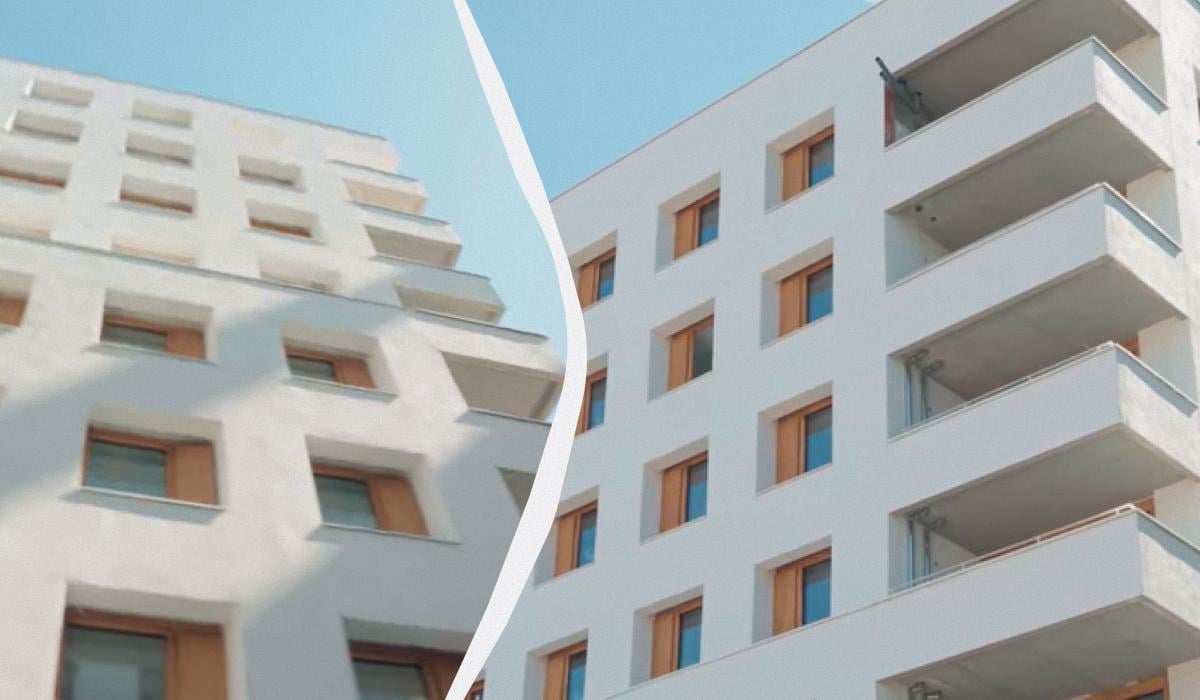
A newly unveiled apartment building in Lyon, France, has been designed so that residents barely need to turn on heating in winter or air conditioning in summer. The building, called Essentiel, was presented in the city's Confluence district, according to N1.
Essentiel has seven floors and 23 apartments. It was formally unveiled on November 17, 2026, and is described as the first residential building of its kind in France.
The idea is that the building maintains a comfortable temperature on its own for most of the year, without relying on conventional heating or cooling systems. According to the investor, indoor temperatures are expected to range between 20 and 26 degrees Celsius. In winter, the figure is expected to stay between 20 and 22 degrees, while during extreme summer heat it could reach 28 degrees.
How the Walls Trap Heat
The secret to the building lies not in advanced equipment but in its construction. Its walls are around 60 centimetres thick, roughly twice as thick as those in many modern French buildings. They were built using special hollow bricks combined with insulation materials, and the windows are triple glazed.
This design allows the structure to store heat and release it gradually, a property known in construction as thermal inertia. In winter, the thick walls slow the loss of heat, while in summer they stop rooms from heating up quickly. The building's compact shape and the careful placement of its windows provide additional protection.
The building also gains warmth from its own residents and household appliances. Cooking, showering, using a computer and running home appliances all generate heat, which in ordinary apartments usually escapes quickly through walls, windows and ventilation. In Essentiel, much more of that heat is kept inside. Because of the high level of insulation, even relatively small heat sources help keep the temperature comfortable.
Automatic Ventilation System
An automatic ventilation system also plays a key role in maintaining a comfortable indoor climate. Sensors installed in the apartments track temperature, humidity, air quality and outdoor weather conditions. Based on this data, the system controls specially designed wooden ventilation openings that open and close automatically.
During summer heat, for example, the system can keep the openings shut if the outside air is warmer than the air inside. When temperatures drop at night, it lets in cooler air, helping the rooms cool down and reducing the need for air conditioning.
Astrid Lampl, an architect and project manager at the firm Baumschlager Eberle, said the main advantage of the approach lies not in complex technology but in the building's construction itself. She said the thick walls keep the indoor temperature stable, while the carefully designed automatic ventilation helps maintain it across the different seasons.
The apartments also have ceiling fans installed, which help create a sense of coolness during hot weather without using a conventional air conditioning system.
Energy Savings Claims
The investor says the construction method could significantly cut residents' utility bills, with electricity costs potentially falling by as much as 80%. The company also predicts that energy consumption needed to maintain a comfortable temperature will be 73% lower than in standard new buildings.
According to the investor's calculations, the building could also cut carbon emissions by 65% over 50 years of operation, compared with a standard new building.
There is an important caveat, however. Despite being presented as a building that does not need heating or air conditioning, the apartments still have auxiliary radiators and mechanical ventilation. The backup heating is meant for periods of severe frost or for times when an apartment is left unoccupied for a long stretch.
Other Unusual Housing Designs
Unusual housing concepts are not new in Europe. In 1984, the Dutch city of 's-Hertogenbosch built an unusual residential area made up of 50 white, ball-shaped houses resembling giant golf balls. The spherical structures sit on concrete bases and feature round windows.
They were designed as affordable housing to address a shortage of homes at the time. The houses are still lived in today and the district has become one of the Netherlands' best-known architectural curiosities.
Test yourself
What is the name of the new building unveiled in Lyon?
Roughly how thick are the building's walls?
By how much could residents' electricity bills fall, according to the investor?
Have your say
Would you want to live in a building designed to need almost no heating or air conditioning?
Where it happened
Lyon, France


