


As millions of drivers head back from summer holidays on Spain's A-3 and AP-7 motorways, a fender-bender where both drivers disagree on who braked first becomes far more common. A dashcam will not stop the crash, but it can stop the argument from coming down to one driver's word against the other's. Of five cameras built for exactly that job, the REDTIGER F7N Touch offers the most complete record.
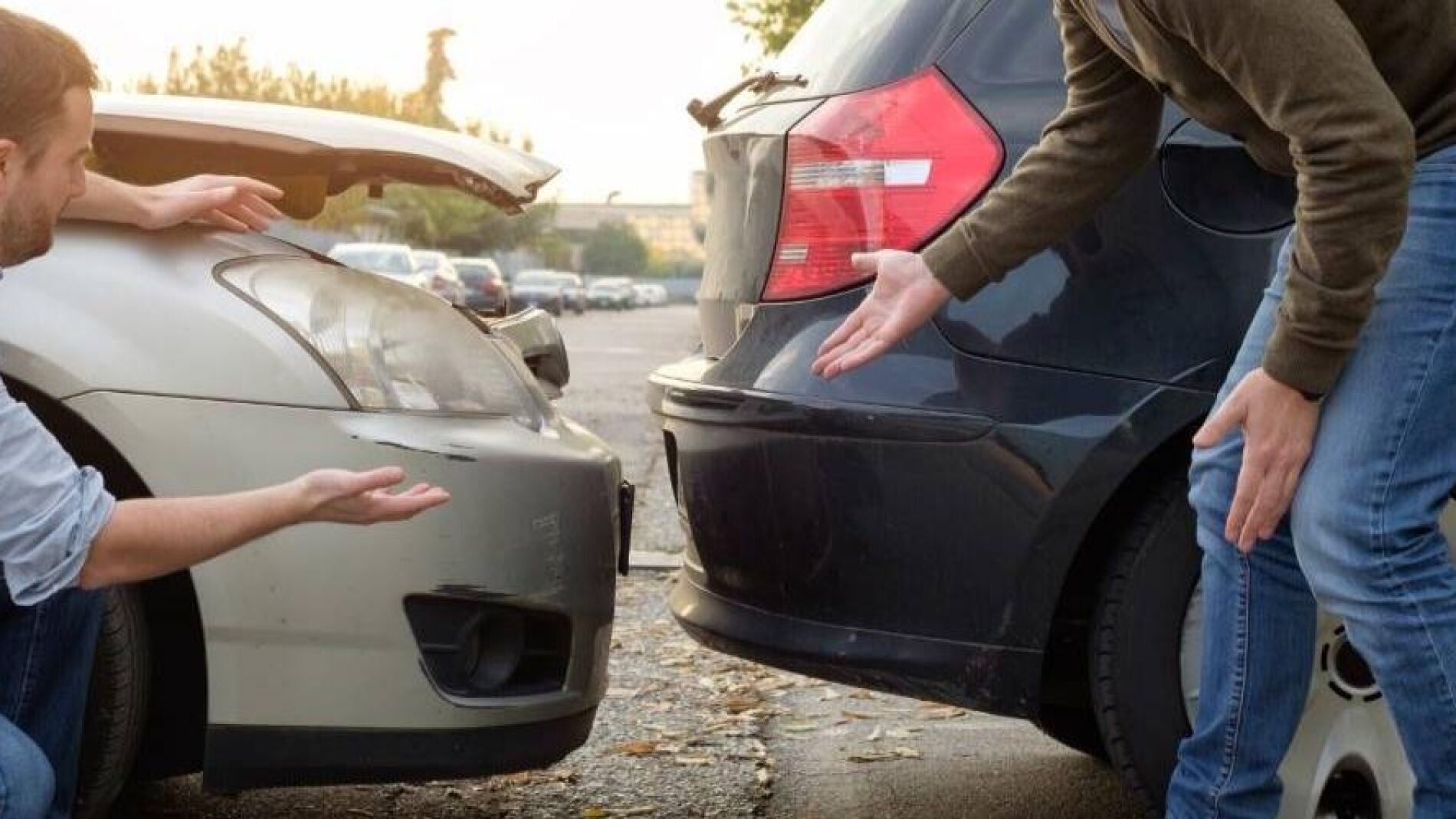
Only three or four seconds out of the thirty around any impact actually matter: the other car's path just before contact, and a number plate clear enough to write down without hesitating. That is where resolution counts. Four of the five cameras record in 4K at the front and 1080p at the back, which matters most when a plate has to be read at twenty metres, at night, in the rain.
The second factor is the GPS stamp. Three of the cameras, the F7N Touch, the GKU and the F7NP, embed the time, date and speed directly into the file, settling the duller but decisive questions of exactly when and where an incident happened, and who was braking. The other two record just as well but without coordinates.
None of the five cameras wins an insurance claim by itself. What they provide is a version of events with some backing, not a verdict. The insurer's assessor or a judge still decides; the footage only stops a driver's account depending on what they thought they saw while braking.
REDTIGER F7N Touch: control it without letting go of the wheel
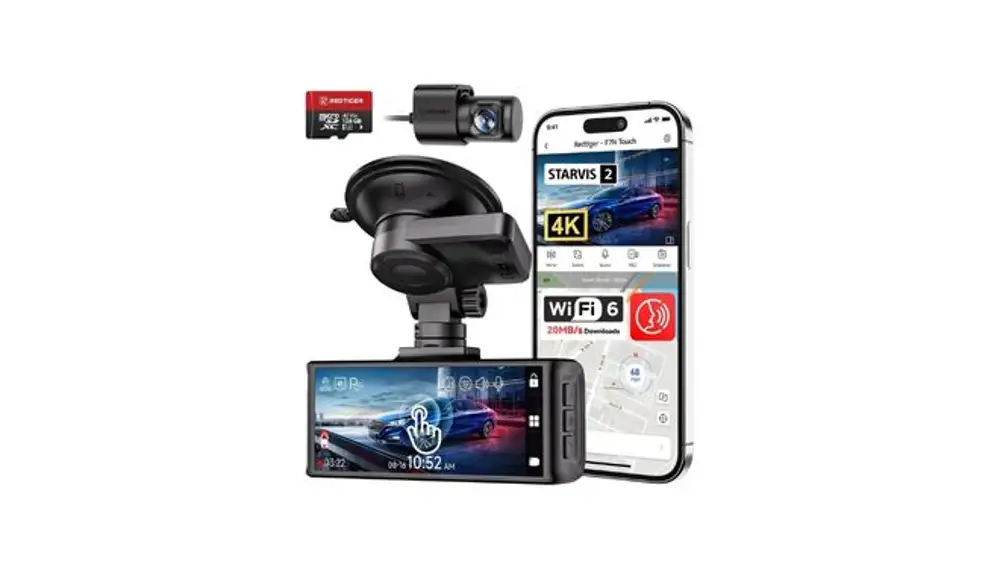
This is the standout of the group and the one that demands the least attention away from the road. It has a 3.18-inch touchscreen, the only one in the lineup that responds to a finger, plus voice control, so locking a clip immediately after a scare, before the loop overwrites it, can be done by speaking aloud with both hands on the wheel.
Inside, it runs a Sony STARVIS 2 sensor at the front with a 170-degree field of view, a 1080p rear camera at 140 degrees, GPS, 5.8GHz WiFi to transfer footage to a phone, and a 128GB memory card included in the box, expandable to 512GB. Having the card included matters, since it is the one accessory most buyers forget and the thing that decides whether the camera starts recording the day it arrives or a week later.
It has one quirk worth knowing: when it wakes from parking mode, it takes a few seconds to start recording, so a scrape from a car pulling in quickly next door can begin appearing on video only after the damage is done. It is the most expensive of the five, and is currently discounted.
GKU D600Pro: built for a windscreen in August heat
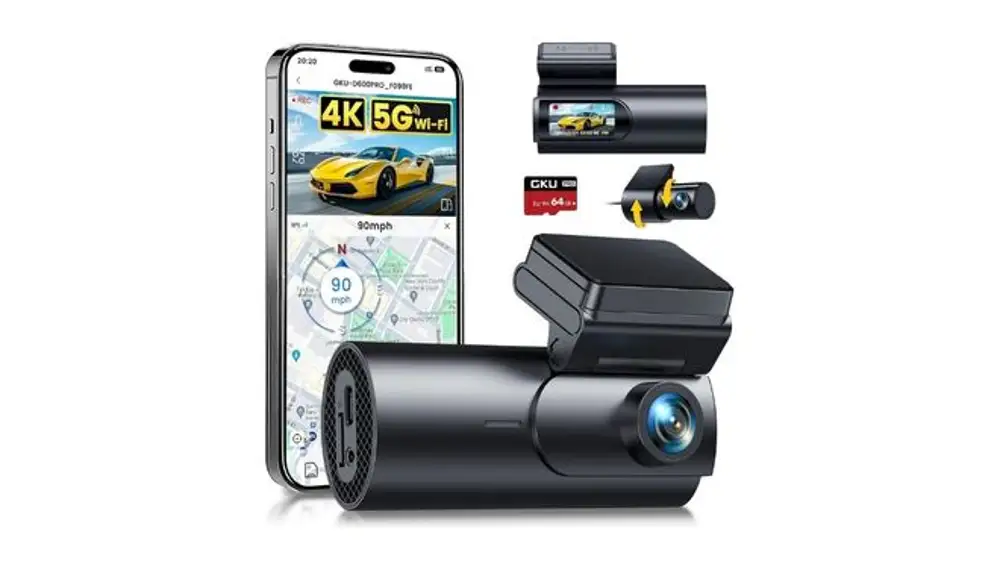
Leave a car parked for four hours in the sun at a coastal car park and the dashboard is scalding on return. That is the real environment a camera stuck to the glass has to survive, and it is why the GKU uses a supercapacitor instead of an internal lithium battery. It withstands heat without swelling or degrading, the typical failure for these devices by their second summer, and copes far better with repeated power cycles.
Its job is not to record for hours unaided but something smaller and more useful: when the car cuts power, it has enough energy left to close the file being recorded. A badly closed video file is a corrupted one, and a corrupted file is not a version of anything.
Otherwise it matches the bigger names: a dual camera at 170 degrees with an F1.8 aperture, GPS, 5GHz WiFi, WDR for tunnel entrances and exits, a G-sensor and a 64GB card included. It gives ground on the screen, a 1.47-inch, non-touch display, the smallest of the group, and is mostly operated through its phone app after the first week.
iZEEKER GD100: front camera only, nothing else
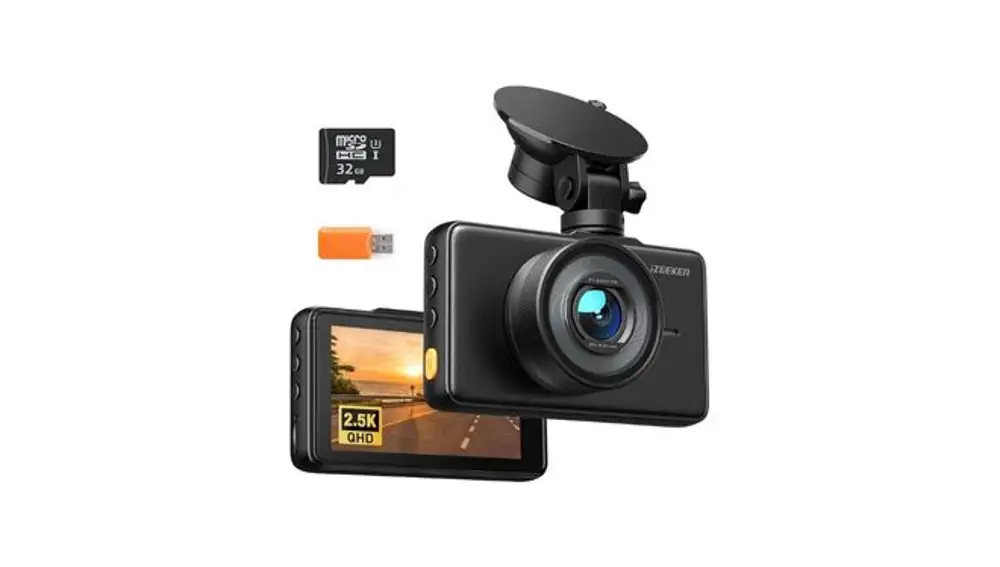
For drivers who do not want to run a cable across the roof to the rear window, this is the only camera in the group that takes a different approach entirely. It has a single forward-facing camera, 2.5K resolution at 1440p, a 170-degree angle and a 3-inch screen for framing the shot. It has no GPS and no WiFi; footage comes off via the memory card and a reader, the old-fashioned way.
It is not a scaled-down version of the others, it is a different decision altogether. Installation finishes the moment the mount is stuck on, with no rear cable to hide through the roof trim or tailgate moulding, and no dependence on an app that may or may not still be updated in two years. For a car doing mostly city and short trips, where any dispute usually happens at the front, it covers exactly what is asked of it.
It includes night vision with WDR, a 32GB card, a G-sensor to lock a file when it detects an impact, and a 24-hour parking mode if given a permanent power supply. It is the least demanding camera of the group, and the saving comes from cutting features many drivers will never use, not from the front-facing image quality.
REDTIGER F7NP: buttons instead of a touchscreen
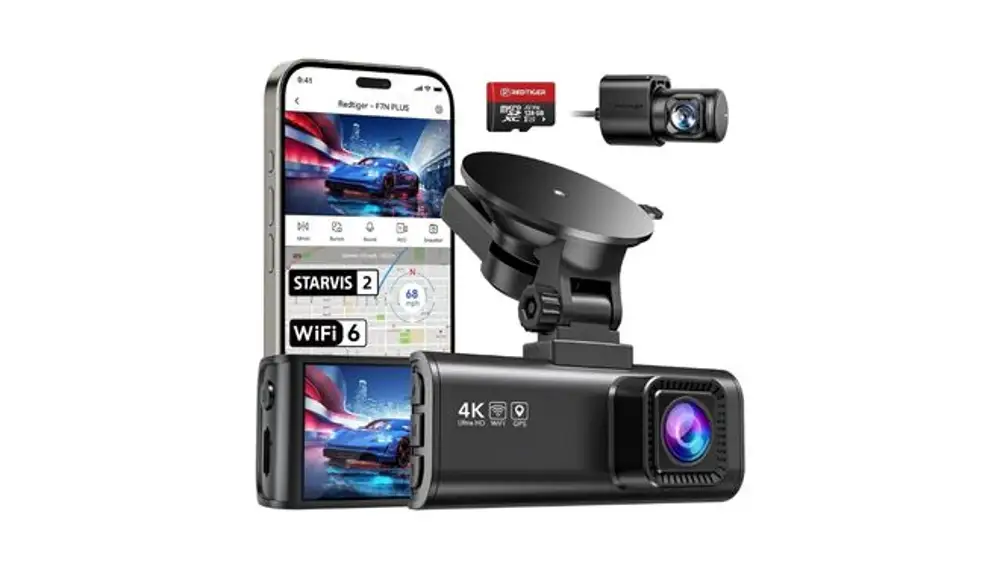
Back to REDTIGER, but a different camera. The F7NP is the veteran of the lineup: the same 3.18-inch screen as the Touch model, but without touch controls, using physical buttons instead. The change sounds like a step down until the first cold winter morning, when a button can be found by feel, with gloves on and a wet finger, and does not trigger by itself when the glass is being wiped down. It suits a driver who mounts it once and does not plan to touch it again.
The front camera records at 3840x2160 with an F1.5 aperture and a 170-degree angle; the rear records 1080p at 140 degrees. It has GPS, 5.8GHz WiFi and a 128GB card included, expandable to 512GB. It is also the model that has been on the market longest, which for a device stuck to a windscreen mainly means one thing: buyers know how it ages. One buyer wrote that the picture looked very sharp and the camera was easy to install, and said they would fully recommend it.
Its parking mode requires a separate wiring kit, as with almost every camera on this list, an issue covered further below, since it is where half of all installations go wrong.
WOLFANG WD03: two cameras, two trade-offs
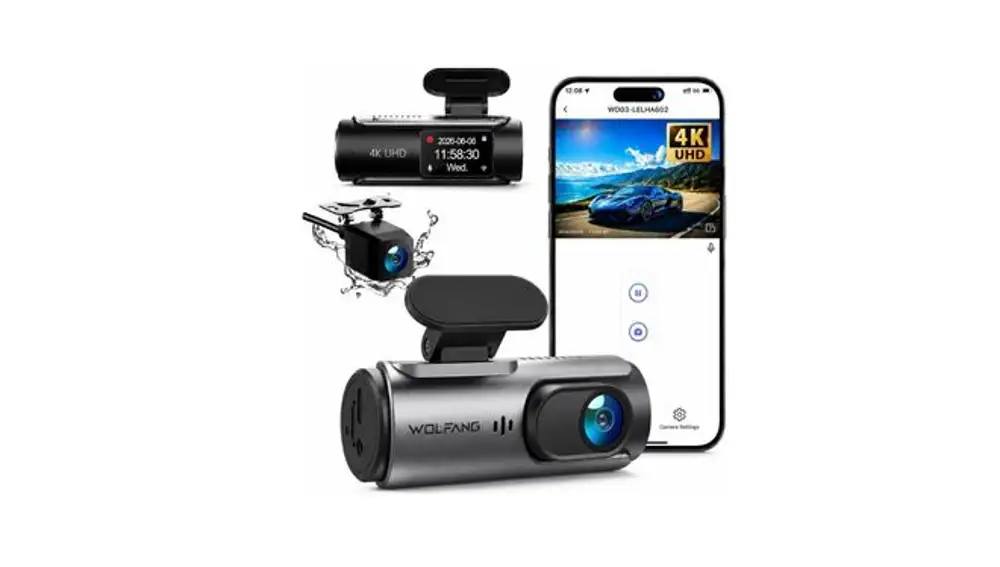
For a household's second car, the one that does short runs and would never get a premium camera, this is the entry point into dual-angle recording. It records at 2160p and 30fps at the front and 1080p at the rear, with a 170-degree angle, WDR, night vision and loop recording. It is the cheapest dual-camera model in the lineup, and is currently discounted.
Two trade-offs need to be flagged before buying. It has no GPS, so footage carries no time stamp or location. And it does not include a microSD card, meaning a heavy-duty card has to be bought separately or the loop will wear it out within months. Its WiFi only works at short range, between three and five metres, just enough to pull a clip off the camera without removing the card.
One detail comes up repeatedly among existing owners: some buyers say the night-time sharpness does not match what the 2160p spec promises, particularly when trying to read plates in darkness. By day and at dusk it performs well, and one buyer said they bought three, one for each of their cars, and were happy with the value, adding that the footage looked good.
Which socket your parking mode actually depends on
This is where these cameras disappoint a lot of buyers, and it is almost never the camera's fault. Parking mode, which records with the engine off if it detects an impact or movement, needs power once the engine is no longer running, and a cigarette lighter socket rarely provides it.
The check takes half a minute and is worth doing before buying anything: leave a phone charging in the 12V socket, turn off the ignition and get out of the car. If the phone keeps charging, that socket is permanent. If it cuts out, the camera will switch off with the engine no matter how well it records while driving, leaving two options.
The first is a permanent wiring kit, which connects to the fuse box with a constant live feed, a switched feed and an earth. What matters about that kit is not the cable itself but that it cuts power automatically once the car battery drops below a safe voltage, so it will not leave a driver stranded on a Monday morning. The second is an OBD2 adapter, which plugs into the diagnostic port under the steering wheel and avoids touching the fuse box, provided that port stays powered with the engine off, which is the case in a good number of models. The F7N Touch, the F7NP, the iZEEKER and the WOLFANG all need that accessory bought separately for parking mode, and the GKU also depends on a power supply that does not cut out.
Two more installation notes. In cars with start-stop technology, every restart causes a brief voltage dip, exactly the moment a camera without a capacitor or backup battery closes a file badly. And the rear camera cable comes in a fixed length that is too long for a small hatchback and can fall just short in a large estate, a seven-seat SUV or a people carrier, so it is worth measuring the run with a tape measure first, from the rear-view mirror along the roof trim and down the rear pillar, which always turns out longer than it looks.
What Spanish law allows drivers to record on public roads
The camera itself is not illegal. What the law looks at is where it is mounted and what is done with the footage afterwards.
On mounting, Article 18 of Spain's General Traffic Regulation, approved by Royal Decree 1428/2003, requires drivers to keep the freedom of movement and field of vision they need to drive. That is why these cameras belong behind the rear-view mirror, in the upper strip of the windscreen swept by the wiper, rather than in the middle of the glass or hanging in the driver's line of sight.
The second point carries more weight and is often overlooked. The "personal or household" exception under Article 2.2.c of the General Data Protection Regulation does not automatically cover recording a public road: the Court of Justice of the European Union made that clear in its ruling of 11 December 2014 in case C-212/13, Ryneš, where a home camera that also captured the street was found to fall outside that exception. Applied to a car, the practical consequence is straightforward: footage should record in a loop, overwrite itself automatically, and only the clip of an actual incident should be kept, to hand to an insurer or include in a police report. Posting that footage on social media with visible plates and identifiable faces is a different matter, and the one that tends to cause problems.
It is also why the GPS stamp and loop recording go hand in hand: the camera exists to document one specific moment, not to build a permanent archive of everything that passes in front of the car.
None of these five cameras hands a driver an automatic win. What they preserve is the three seconds before impact, which is exactly the stretch that any driver's memory, without any bad intent, tends to rebuild in their own favour.


