

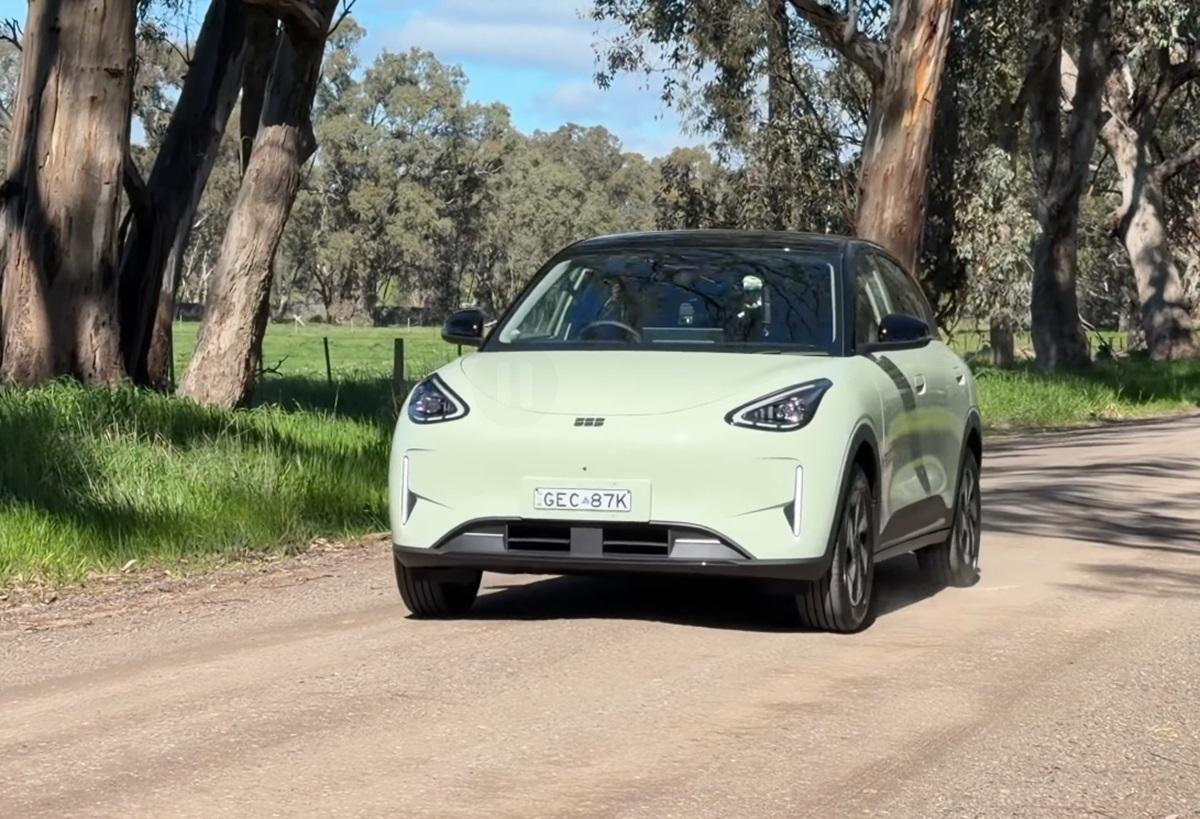
Two Australian content creators from the CarSauce YouTube channel have driven a budget Geely EX3 electric vehicle on a 671-kilometer road trip from Melbourne.
The test aimed to cross the state border into New South Wales before returning home, taking roughly 11.5 hours to complete including charging stops, meals, and delays.
Supercar Blondie reported that the budget Chinese crossover performed better on the highway than expected, though faulty public charging infrastructure severely hampered the journey.
Geely EX3 Highway Efficiency and Performance
The Geely EX3 comes equipped with a 47.1 kilowatt-hour lithium iron phosphate battery pack. This battery chemistry, commonly known as LFP, is widely used in modern electric vehicles for its safety and longevity.
The vehicle carries an official driving range rating of 345 kilometers under the Worldwide Harmonised Light Vehicles Test Procedure, the international laboratory standard used to evaluate vehicle efficiency.
While the testers anticipated significantly worse efficiency at highway speeds, the car initially consumed roughly 15.6 kilowatt-hours per 100 kilometers while cruising at speeds around 110 kilometers per hour.
During the final 50 kilometers of the first leg, energy consumption dropped even further to just 14.3 kilowatt-hours per 100 kilometers.
One of the presenters noted during the trip that he was genuinely impressed with the car's initial performance, though he cautioned that a long way remained and conditions could worsen.
The drivers also reported that the crossover provided a comfortable ride along the freeway. They noted that both the adaptive cruise control and the lane-keeping assistance systems operated effectively throughout the drive.
Public Charging Infrastructure Challenges
The primary difficulty during the expedition stemmed not from the automobile itself, but from the public charger network in regional Australia.
At their initial plug-in location, the charging station capped output power at approximately 40 kilowatts. This occurred even though the EX3 is engineered to accept fast charging rates of up to 80 kilowatts.
Network connectivity faults at that same station caused the charging session to start and interrupt repeatedly.
Conditions improved at their second station, where the EV drew power at a steady rate between 79 and 80 kilowatts. That allowed the battery to charge from just under 30 percent to 100 percent capacity in approximately 40 minutes.
The return trip brought renewed frustration as occupied charging points, confusing station power ratings, and another failed charging attempt left the duo questioning whether they could reach home.
After successfully replenishing the battery to 82 percent at a working charger, they embarked on the final leg of their journey.
Total Trip Costs and Urban Efficiency
By the time they arrived back home, total energy consumption reached 127.77 kilowatt-hours. Real-world highway consumption averaged approximately 19 kilowatt-hours per 100 kilometers across the full journey.
Several environmental factors influenced energy use on the return leg, including winter temperatures that dropped to between 8 and 9 degrees Celsius, highway cruising speeds, and an apparent headwind.
In contrast, the Geely EX3 proved significantly more efficient in city driving environments, consuming just 11.6 kilowatt-hours per 100 kilometers.
The total expense for public charging during the trip came to 67.57 Australian dollars, equivalent to 48.22 US dollars. The creators estimated that driving a petrol-powered Geely over the same route would have cost approximately 105 Australian dollars, or 75 US dollars.
Budget Chinese EV Market Developments
Geely Auto, headquartered in Hangzhou, China, is one of several Chinese manufacturers expanding affordable electric vehicles into global markets.
In a separate evaluation, the host of the YouTube channel Everything Electric APAC traveled to China to test the Astraux AL7 Pro, a micro electric car priced at 8,000 US dollars.
That compact model is set to launch soon in Europe, where it will compete against lightweight urban micro-EVs such as the Citroën Ami, the Fiat Topolino, and the Opel Rocks-e.
Despite its minimal dimensions and low purchase price, the reviewer reported that the Astraux AL7 Pro features several standard amenities. These include electric power windows, multiple cameras, parking sensors, an interior touchscreen display, USB gadget charging ports, storage cubbies, and standard air conditioning.


