

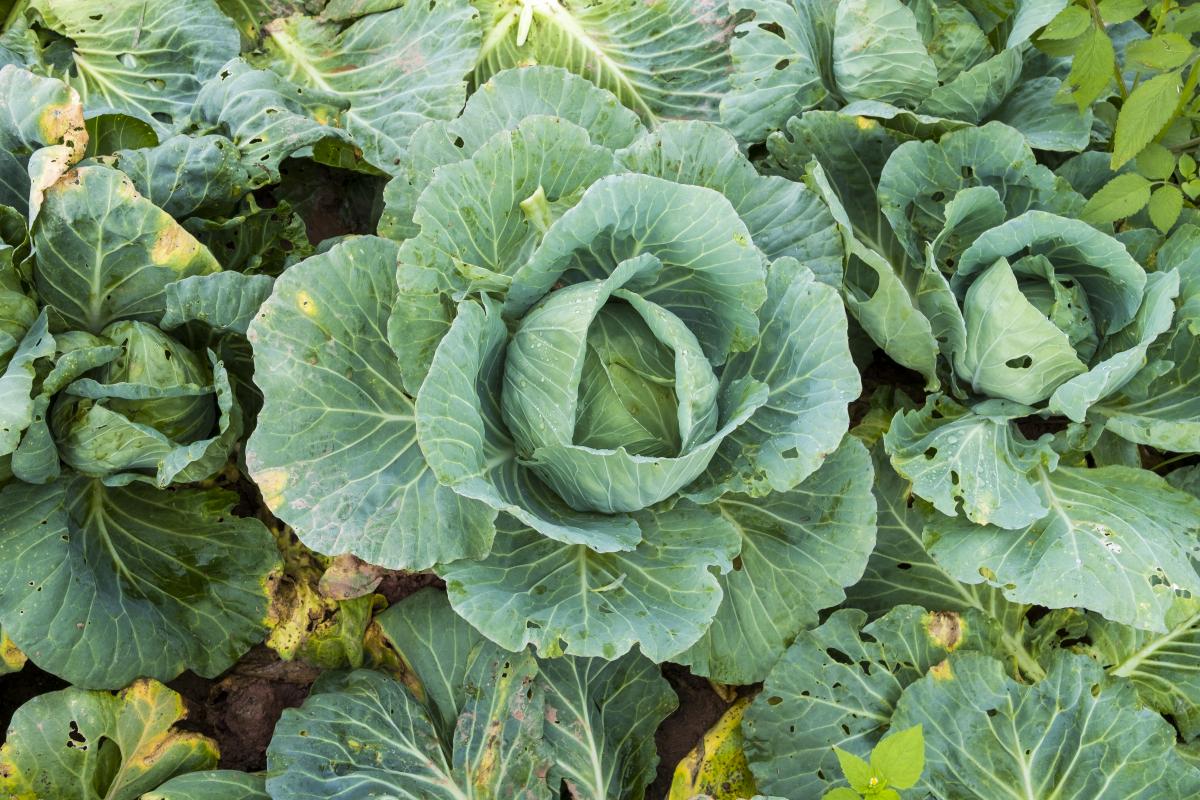
Caterpillars can strip cabbage leaves bare within days, so gardeners are being advised to act before the damage becomes severe rather than waiting until plants are badly eaten. Where infestations are still small, simple home remedies can be enough to bring the problem under control.
Types of Caterpillars Found on Cabbage
Four pests most commonly damage cabbage crops, and telling them apart matters because they behave differently. The large white butterfly, or cabbage white, produces a large yellow-green caterpillar with black spots and yellow stripes that usually feeds in groups, stripping leaves down to the large veins.
The small white butterfly is smaller and pale green, with caterpillars that tend to hide alone and can bore inside the head of the cabbage. The cabbage moth caterpillar is larger and grey-green or brown; young larvae eat the leaves while mature ones can burrow into the cabbage head and leave droppings inside it. The diamondback moth caterpillar is small and green, damaging leaves from the inside at first before going on to destroy the growing point, which stops the head from forming properly.
When inspecting plants, gardeners are advised to check not just the top of the leaves but the underside too, since that is where eggs and young larvae are most often found.
How to Protect Cabbage From Caterpillars
The simplest form of prevention is stopping the butterflies from laying eggs on the leaves in the first place. Young seedlings can be covered with a thin layer of garden fleece or fine mesh straight after planting, with the edges secured well so insects cannot get underneath. Plants should also be checked regularly, with any egg clusters or caterpillars removed as soon as they are spotted.
Strong-smelling plants such as dill, fennel, parsley, mint, coriander, celery, calendula, marigolds or nasturtiums can be planted alongside cabbage. These do not guarantee protection but can make the bed less attractive to egg-laying butterflies.
Home Remedies to Get Rid of Caterpillars
Where only a few pests are present, gardeners are advised against reaching straight for chemical products. Instead, caterpillars can be picked off by hand and the plants treated with one of several home-made solutions.
Wood ash and tobacco dust can be mixed in roughly equal amounts and dusted onto damp leaves, with treatment repeated after rain. A garlic infusion can be made using about 200 grams of garlic cloves or 300 grams of garlic scapes, chopped and steeped in 10 litres of water for a day before straining and spraying onto plants.
Onion skins offer another option: a third of a three-litre jar of skins is soaked in 2 litres of water for around two days, then strained, topped up to 4 litres with water and mixed with a little soap. A tomato leaf infusion can be made from 4 kilograms of fresh leaves or 2 kilograms of dried leaves boiled in 10 litres of water for about 30 minutes, then cooled and diluted with water at a ratio of 1:3, with soap added to help the mixture stick to leaves.
Wormwood can also be used: the chopped plant is soaked in water for about three days, then boiled for around 30 minutes and strained. Mustard powder, at about 100 grams steeped in 10 litres of water, and hot pepper, using around 100 grams of fresh or 50 grams of dried pods per litre of water before dilution, are other options. Infusions of yarrow or chamomile can also be sprayed, and a mixture of baking soda and flour can be dusted onto leaves.
Spraying is best done in dry, overcast weather or in the evening when the sun is not strong, and solutions need to reach the underside of leaves as well as the top, since that is where pests most often hide. Home remedies need to be applied regularly, and if caterpillar numbers do not fall and damage keeps increasing after several treatments, it is better to move on to more effective products.
When to Use Stronger Treatments
Biological products based on the bacterium Bacillus thuringiensis, such as Lepidocide and Bitoxibacillin, are recommended once folk remedies stop working. Fitoverm is also used against caterpillars; it works once ingested by the pest and has a comparatively short waiting period before harvest.
Whichever product is used, gardeners are advised to follow the instructions on the specific packaging closely, since concentration, number of treatments and waiting periods can vary depending on the product's formulation and the crop being treated.
To prevent caterpillars appearing in the first place, cabbage should be checked regularly, especially on the underside of leaves, with any pests removed as soon as they are seen. Plant residues should be cleared away after harvest, and cruciferous weeds, where the pests live, should not be left on the beds.


