

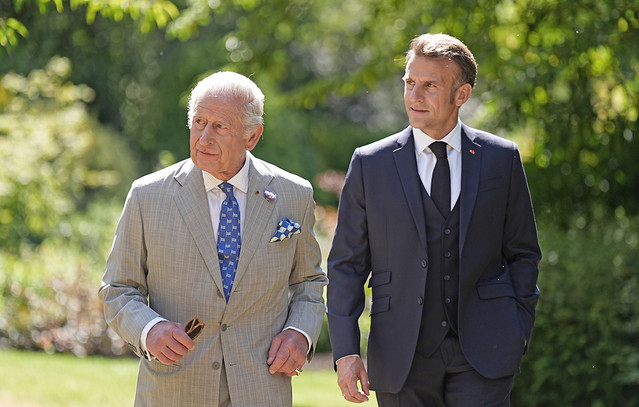
King Charles and French President Emmanuel Macron stand together today before the Bayeux Tapestry at the British Museum in London for a historic exhibition. The visit marks the first time the nearly 1,000-year-old masterpiece has been displayed in England since its creation in the 11th century.
France agreed to temporarily loan the medieval embroidery while the Bayeux Museum in Normandy undergoes extensive structural renovations. In return, the British Museum will send high-profile national treasures across the English Channel, establishing a model for reciprocal cultural exchange between the two nations.
The temporary transfer brings one of Europe's premier historical relics back to the country whose history it depicts. The French President handed over the artwork for display in London, where the exhibition will open to the public on 10 September and remain on view until July 2027 before returning to France.
Under the terms of the bilateral cultural agreement, key British historical artifacts will travel to France. Among the items scheduled for loan to French cultural institutions are pieces from the Sutton Hoo ship burial and the famous Lewis Chessmen.
Sutton Hoo is a renowned Anglo-Saxon royal burial site near Woodbridge in Suffolk, England, discovered in 1939 and famous for its early seventh-century ship grave filled with ceremonial armor and gold jewelry. The Lewis Chessmen are a distinctive collection of 12th-century gaming pieces carved primarily from walrus ivory, uncovered in 1831 on the Isle of Lewis in Scotland. Both collections rank among the most celebrated holdings housed at the British Museum in London, which was founded in 1753 and remains one of the world's largest cultural history institutions.
Norman Conquest and Medieval Craftsmanship
The Bayeux Tapestry records the dramatic political and military events that culminated in the Norman conquest of England in 1066. The narrative artwork opens with scenes depicting events from 1064 and leads directly to the Battle of Hastings on 14 October 1066, where William, Duke of Normandy, defeated King Harold Godwinson.
Following his victory at Hastings on the southern coast of England, William marched to London and was crowned King of England at Westminster Abbey on 25 December 1066, two months after the battle. Located in central London, Westminster Abbey has served as the traditional venue for English and British royal coronations for nearly a millennium.
Despite its traditional name, the historic object is not a woven tapestry in the technical sense. It is a continuous embroidery executed with colored woollen yarns on a linen fabric backing, measuring approximately 70 metres in length and 50 centimetres in height.
Across its vast length, the embroidery features 58 distinct scenes populated by hundreds of individual human figures, horses, ships, and animals. Historical scholars believe it was created in England during the 11th century, likely commissioned by Bishop Odo of Bayeux, who was the half-brother of William the Conqueror.
The display in London represents a symbolic return for the textile. Almost 1,000 years after English craftspeople depicted how a Norman ruler conquered England, the artwork returns temporarily to the nation that serves as the main protagonist of its narrative.
Bayeux is a historic cathedral town located in the Normandy region of northwestern France. Normandy was established as a duchy in the tenth century and maintained close political and cultural ties with England following the 1066 conquest.
Diplomatic Contrast with the Parthenon Sculptures
The arrival of the French relic at the British Museum highlights a sharp diplomatic contrast within the institution's galleries. While France agreed to lend a major piece of medieval heritage to London, the British Museum continues to display the Parthenon Sculptures despite decades of official requests from Greece for their return to Athens.
The British Museum maintains a collection of 15 metopes, 17 pediment sculptures, and approximately 75 metres of the original marble frieze from the Parthenon. Greece officially submitted a formal request for the permanent return of the ancient marble sculptures in 1983, maintaining an open claim for their restitution.
The Parthenon is an ancient temple dedicated to the goddess Athena, built on the Acropolis of Athens in the fifth century BC during the golden age of classical Greece. The sculptures were removed from the ancient monument in the early 19th century by Thomas Bruce, 7th Earl of Elgin, and subsequently acquired by the British government before being placed in the British Museum.
The British Museum has consistently advocated for keeping the sculptures in London, arguing that negotiations remain ongoing and asserting that their presence within the global collection provides significant educational and cultural value to millions of international visitors.
However, British Museum director Nicholas Cullinan hinted that the loan agreement for the Bayeux Tapestry could serve as a model for a future agreement concerning the Parthenon Sculptures. Cullinan indicated that successful bilateral loans might provide a framework for future arrangements, although current discussions center on a potential loan while authorities in Athens insist on permanent return.
Renovation Timeline and Future Exhibitions
The loan of the Bayeux Tapestry was made possible because the dedicated Bayeux Museum in northwestern France remains closed for extensive renovation work until the autumn of 2027. The temporary closure allowed French authorities to loan the delicate medieval artwork abroad without disrupting visitors to its home region during construction.
The public exhibition at the British Museum in London will open on 10 September and run through July 2027. Following the conclusion of the London exhibition in July 2027, plans call for the tapestry to be transported back to France in time for the reopening of the renovated museum facility.
The British Museum has framed the exchange as an exemplary model of international museum cooperation. The reciprocal move allows British heritage objects to be appreciated by audiences in France while bringing the Bayeux Tapestry back to British soil for the first time in centuries.
The presence of King Charles and President Macron at the museum draws attention to the question facing international cultural institutions. While the 1,000-year-old embroidery crossed the English Channel to return temporarily to the place tied to its history, no resolution has been reached regarding the Parthenon Sculptures, which remain on display in London while Greece continues to pursue their permanent return.


