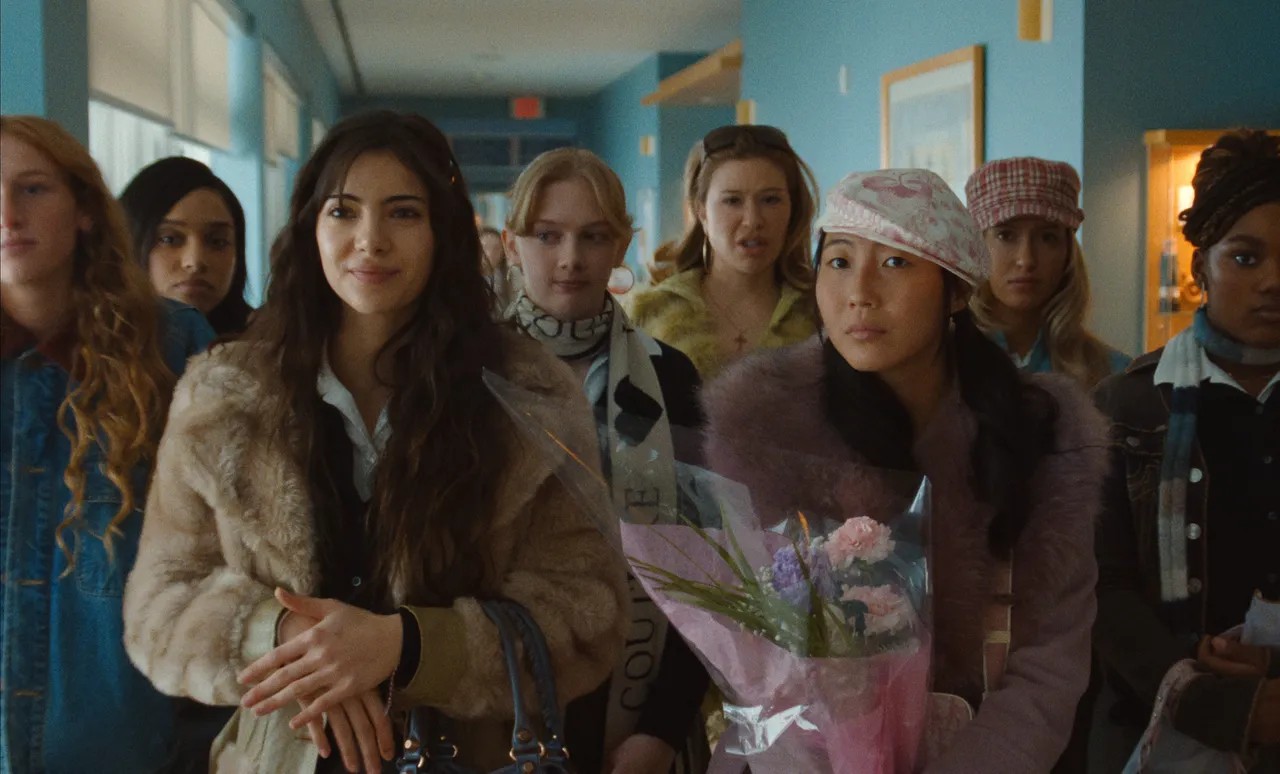
Netflix has released O Corpo, Portuguese for The Body, an eight-episode teen drama created by Quinn Shephard that trades the gentle heartbreak of recent youth series for satanic rituals, drugs and dark comedy.
Shows such as Off Campus, Sterling Point, The Summer I Turned Pretty and Heartstopper have dominated the genre in recent years, offering comforting stories about young people discovering love and navigating their first relationships, usually without anything truly terrible happening. O Corpo belongs to the same world of teen drama but follows a very different formula. The series has drawn comparisons to Mean Girls and Cruel Intentions, with touches of Carrie and The Crucible, rather than the delicate school romances that have defined the genre lately. A Christian petition calling for the show to be cancelled has already gathered more than 90,000 signatures.
A Halloween party at an abandoned convent
The story opens on Halloween in 2004 at a Catholic school in a small town whose location is never revealed, though the series was actually filmed in Ontario, Canada. The setting leans into the look of the era, with Juicy Couture velour sets, heavy lip gloss, and Chloe Paddington and Balenciaga Le City bags slung over the students' shoulders, even though the Paddington bag was not released until 2005. Historical accuracy is clearly not the show's priority.
In the opening episode, the school's dance group, known as the Lions, throws a party at an abandoned convent. Everyone is invited, including Lisbeth, played by Geena Meszaros, the odd girl excluded from the group. After the teenagers take ecstasy and take part in a satanic initiation ritual, Grace, played by Sofia Wylie, one of the group's members, ends up unconscious. The incident sets off a chain of events that unsettles the balance between the girls.
Mass hysteria, or something supernatural
What follows blends mass psychogenic illness with what might be a supernatural occurrence, never making clear where one ends and the other begins. As some of the girls' hands begin to shake, followed by convulsions and visions, it is hard not to think of the outbreak that took place in 2011 at a school in LeRoy, New York, where twenty students developed what became known as conversion disorder.
More compelling is how the series handles repression, religious guilt and the moral codes of the period. In that world, anything considered ridiculous or undesirable is labelled gay, a detail that helps place viewers firmly in the early 2000s. Sapphic feelings and desires simmer beneath the surface throughout, threatening to break through at any moment, and emerging sexuality runs through nearly every relationship in the show. The result is a portrait of female adolescence that, at several points, evokes the contradictions and impulses of being fifteen or sixteen.
Dark humour despite heavy themes
Although it tackles weighty subjects such as religious trauma, methamphetamine addiction and internalised homophobia, O Corpo does not take itself too seriously. Its humour is dark, acidic and somewhat perverse. In one scene, the girls begin shouting out confessions that range from not being a natural blonde to having a brother who killed seven people in Afghanistan.
The costume design also stands out. The millennial style of the early 2000s appears updated for a Gen Z audience, with tank tops bearing the J'adore Dior logo and oversized, rhinestone-studded sunglasses replacing the greasy side bangs and flame-print beanies that also defined the decade. That stylistic license works in the show's favour. As in Mean Girls and Cruel Intentions, the series offers a glamorous, seductive and stylised version of the school setting, which may ultimately be the truest representation of 2004.
Flaws and standout moments
The eight episodes are not flawless. The pacing loses momentum at times, and certain plot twists appear without it being clear how they fit into the story, or simply vanish without further explanation. Even so, at a time when youth series tend to be well-behaved and overly concerned with delivering uplifting messages, O Corpo stands out for its malice, its sense of humour and its willingness to push past certain limits.
There are deliberately provocative moments too. In the opening minutes, as the teenagers stretch on the grass, Elise, played by Sara Boustany and one of the wittiest characters in the show, remarks that the group looks like a bunch of lesbians, a line that again feels true to the period. The series has been described as the most enjoyable teen drama since the first season of Yellowjackets or the early episodes of Riverdale.
Chances of a second season
As is common with Netflix productions, the ending leaves room for a second season, although no renewal has been confirmed. On Reddit, fans are already discussing the possibility that the platform could cancel the series, while trying to work out what might happen to the characters. A continuation is widely seen as almost inevitable, though that is no guarantee the show will actually return. Whatever happens next, the first season has been described as a deliciously addictive watch.
What happens next
The first season's ending leaves open the possibility of a second season, though Netflix has not confirmed a renewal, and fans on Reddit are debating whether the show might be cancelled.
Test yourself
Who created O Corpo?
What triggers the chain of events in the first episode?
How many signatures has the petition calling for the show's cancellation gathered?