
Christopher Nolan's "The Odyssey," the adaptation of Homer's epic that has divided audiences worldwide, has finally reached Russian screens through parallel distribution. The film features a cast ranging from Matt Damon to Lupita Nyong'o and has become the most expensive production of Nolan's career.
The story follows Penelope, wife of Odysseus, king of Ithaca, played by Anne Hathaway. For 20 years she has woven a funeral shroud for her father while waiting for her husband to return from the war at Troy. Their son Telemachus, played by Tom Holland, barely remembers his father and doubts he will ever come back. The dog Argus stubbornly refuses to die before his master returns, and the now-blind servant Eumaeus, played by John Leguizamo, waits faithfully as well.
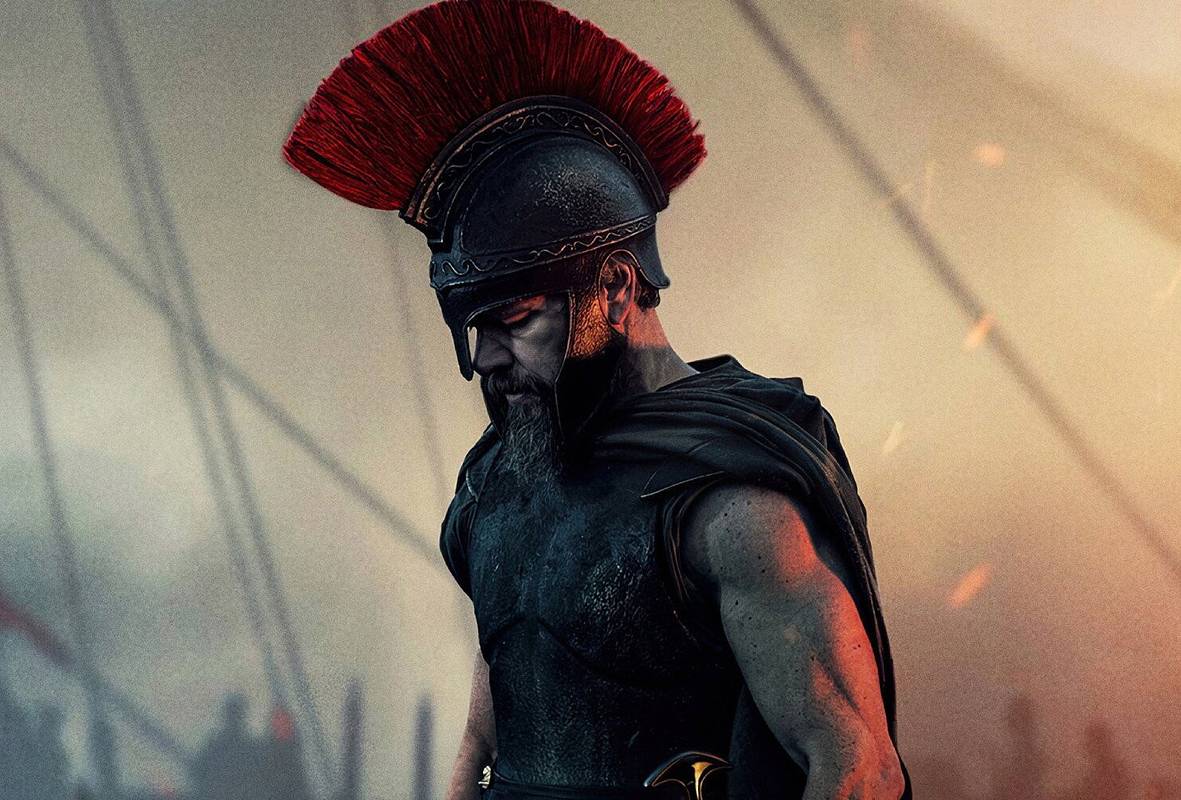
Odysseus, played by Matt Damon, has spent years growing a gray beard on the island of the nymph Calypso, played by Charlize Theron. He arrived there unconscious and woke with no memory, but the traumatic events of the Trojan War are beginning to resurface, pushing him toward the journey home. Penelope, meanwhile, can barely hold off a group of greedy suitors led by Antinous, played by Robert Pattinson and described as resembling a gaunt sea fish.
Film details
- Release date: July 30
- Countries: United Kingdom, United States
- Runtime: 2 hours 52 minutes
- Director: Christopher Nolan
- Cast: Matt Damon, Anne Hathaway, Jon Bernthal, Tom Holland, Zendaya, Robert Pattinson
During filming of "Tenet," Nolan reportedly made famous actors, including Yuriy Kolokolnikov, walk backward for hours at a time, a habit that reflects his taste for discipline on set. That same rigor shows in "The Odyssey," where he strips away excess from the opening scenes. The choice of modern English dialogue instead of archaic stylization, along with the unconventional casting, drew comment even before the premiere.
One notable departure is the film's refusal to lean on the epithet "cunning," long attached to its title character. Damon's Odysseus instead tries to be honest, even with animals while hunting, works to protect his men, and understands the necessity of the Trojan campaign even though he does not want to leave his wife and infant son. Damon likely could have played the mythical episode in which Odysseus feigns madness as a farmer to avoid the war, but that would have made for a different hero and a different film.
An independent work, not a retelling
Nolan is often criticized for a limited sense of humor, and it might be interesting to imagine his take on a story like the adventures of Svejk, or what a Nolan version of the Soviet comedy "The Twelve Chairs" might resemble something closer to "The Prestige." That criticism does not really apply here, since the ambition of Nolan's first-ever screen adaptation was not to contradict Homer but to build an independent piece of art, one that stands as much on its own as possible given that this is the foundational myth of human culture. Every artist who retells the Odyssey ends up speaking about themselves and their own era, and this film reflects Nolan as a committed pessimist, a pragmatist, a devoted father and an avid dog owner.
The film opens at precisely the same point as Homer's poem, then gradually breaks down the audience's expectations scene by scene and image by image.
The gods fare worst in this version. Their presence is reduced to brief appearances by Zendaya, who appears to play Athena, the hero's patron. The word "appears" matters, because the film's ending offers an ambiguous take on that divine presence. Nolan does not treat his characters as primitive, and he does not deny the will of Zeus and Poseidon, but he refuses to simplify how that will shows up for a modern audience.
The film opens with a title card reading that it takes place in a time when the world was wrapped in magic. Before any image appears, the voice of rapper Travis Scott is heard offscreen, and he then appears onscreen playing an aoidos, a storyteller in the tradition of Homer himself. Scott appears visibly tense amid the clinical, cold atmosphere typical of Nolan's films.
The rapper's presence signals that the film is not a reconstruction dressed up as an ancient original, but a different kind of intellectual experiment. Its premise is that the poem's enduring popularity across millennia shows people have not changed much since Homer's time. The elaborate hexameter of the original is simplified into modern conversational speech, and the cast was chosen so that a relatively unfamiliar Balkan appearance, to wide audiences, would not distract from the substance of the story. Numerous set-piece sequences are built around these perceptual shifts, the kind of spectacle audiences go to the movies for.
War stories and unreliable memory
Any complaints about historical inaccuracies, such as the bone comb on Agamemnon's helmet or the rearing Trojan horse, are addressed within the first half hour. Nearly everything that happens away from Ithaca is relayed through Odysseus and Menelaus, played by Jon Bernthal, both war veterans with their own reasons to embellish their exploits.
Menelaus is searching for a way to explain years of slaughter triggered by his wife's infidelity. Odysseus endured not just the war but a nightmarish journey afterward in which all his companions died and he lost his memory. It is no surprise that Calypso, who is overseeing his recovery from amnesia, gently encourages him to blame fate, destiny, the gods and other supernatural forces for what happened. In both men's accounts, Agamemnon appears as a deranged figure in a cast mask, with the piece of spine attached to it explained indirectly twice over the course of the film.
The film's frank, sometimes crude psychological framing of ancient Greek material is softened by its visual style and performances. In the ideal 70mm IMAX projection Nolan favors, the sky turns a deep blue above the characters, though the film holds up even in a standard widescreen theatrical showing. Nolan's reliance on practical effects means the cyclops Polyphemus and the tentacles of Charybdis feel almost tangible, and the sirens' scene is scored with a flute piece where the performer's breath matters as much as the notes. That handmade quality is described as Nolan's tribute to the effects work of Ray Harryhausen, known for the golden-age Hollywood films "Jason and the Argonauts" and "Clash of the Titans."
A debt to Tarkovsky
Another major influence is Andrei Tarkovsky's "Andrei Rublev," which Nolan has referenced directly during the film's promotional campaign. Tarkovsky's film faced similar criticism in its time over historical inaccuracy and harshness, a familiar cost of the kind of storytelling approach that filmmaker Alexei German also used later for "Hard to Be a God."
In "Andrei Rublev," Tarkovsky and his co-writer at the time, Andrei Konchalovsky, developed a method of depicting a historical era that allowed the film to speak freely about themes with strong contemporary resonance. That film included a crucifixion staged in the style of Bruegel, near-documentary depictions of violence by warriors and Tatars, and medieval princes greeting each other the way Soviet leaders once did. Nolan's own anachronisms in "The Odyssey" work in a similar way and toward similar ends.
Nolan has explored fractured memory before, in "Memento," "Inception" and, to some extent, "The Dark Knight." "Oppenheimer" was largely structured around flashbacks reflecting the nonlinear thinking of its central physicist. "The Odyssey," which forms a loose pairing with "Oppenheimer" given both titles start with the letter O, inherits its nonlinear structure from the source material, though the finished film's overall design relates to that source only indirectly.
A central event, whose full meaning only becomes clear at the end, fractures not just the characters' memories but the reality of the film itself. Nolan is not a moralist, but some lines land with blunt force, among them ideas that victory is darkness itself, that looking for gods in other people only leads to disappointment, and that all that is left afterward is to sing about the past or to beg. These lines are delivered quietly rather than as grand statements, but they linger in the mind alongside the image of the cyclops Polyphemus's crooked nose, a character who is never given a name or a line of dialogue in the film.
The most expensive film of Nolan's career
"The Odyssey" was shot entirely on new-generation 70mm IMAX cameras, which were transported to locations around the world from Morocco to Iceland.
Actor salaries make up a significant share of the budget, and the film has the largest ensemble of stars in Nolan's filmography. Even so, the film makes clear that star status matters less to Nolan than the visual role actors play, which is part of why cast members are barely featured on the posters. Benny Safdie's face is never shown in full, nor is that of James Remar, who plays the blind prophet Tiresias. Elliot Page appears in one significant scene, and among the crew that sails with Odysseus, Himesh Patel, playing Eurylochus, gets the most lines, though he too remains a background presence for much of the film.
Samantha Morton appears for only a few minutes as the sorceress Circe, yet the role carries unexpected weight, as the battered Odysseus seems to see his own reflection in her. Damon's performance is described as a flawless piece of casting and a long-deserved mature showcase for an actor called modest and gifted. Still, within Nolan's directorial approach, actors serve a primarily visual role before an expressive one, meaning striking looks matter as much as talent. That choice carries extra weight here, since Nolan gives faces to characters who usually remain faceless statistics of wartime loss.
The trauma left by various forms of violence functions in the film both as an emotional core and as fuel for Nolan's storytelling, most visible in the fantastical middle sequence built around Morton's Circe. By the finale, the film's tragic tone reaches its peak and reveals what may be its most important parallel to "Andrei Rublev." Just as Tarkovsky's film follows its hero toward the creation of the icon known as the Trinity, "The Odyssey" traces how real catastrophe becomes song, with heroism naturally overshadowing horror.