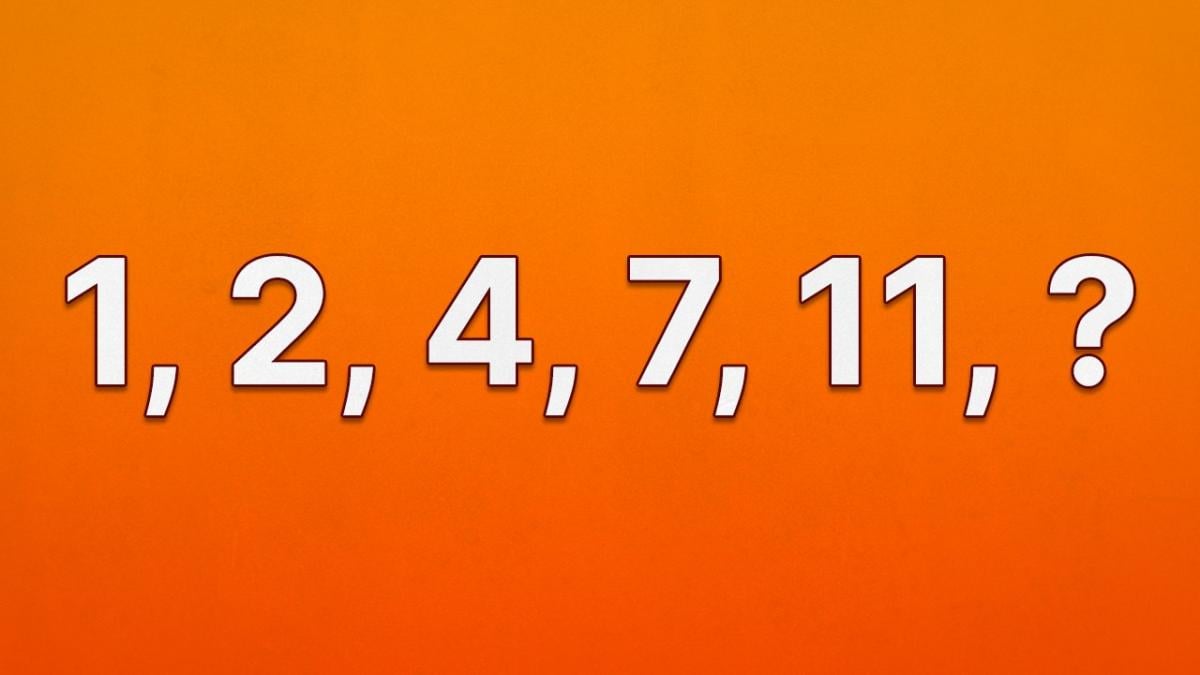
A new number puzzle is testing readers' mental math skills with a short sequence that looks random at first glance: 1, 2, 4, 7, 11, and then a question mark.
The brainteaser was published by the Polish outlet eDziecko, which asked readers to work out which number should come next in the sequence. The puzzle contains no multiplication signs, division signs or brackets. Instead, each number connects to the one before it through a single rule that solvers have to uncover for themselves.
At first the numbers appear to grow unevenly. The gap between 1 and 2 is just one, while the gap between 7 and 11 is four, which can make the sequence look inconsistent rather than logical.
How to crack the pattern
The trick is to look at the differences between each pair of numbers rather than the numbers themselves. Subtracting 1 from 2 gives 1. Subtracting 2 from 4 gives 2. Subtracting 4 from 7 gives 3. Subtracting 7 from 11 gives 4.
Lined up together, those differences form their own simple sequence: 1, 2, 3, 4. That reveals the underlying rule: each step adds one more than the previous step did. The sequence starts by adding 1, then 2, then 3, then 4, so the next addition should be 5.
The answer
Adding 5 to 11 gives 16, which is the number eDziecko gives as the correct answer to the puzzle.
The full sequence can be checked step by step: 1 + 1 = 2, 2 + 2 = 4, 4 + 3 = 7, 7 + 4 = 11, and 11 + 5 = 16. Every step follows the same rule of increasing the added number by one each time.
The puzzle notes that, with such a short sequence, it is theoretically possible to invent other patterns that would also fit the first few numbers. In this case, though, the intended logic is the steadily increasing addition described above.
More puzzles to try
Readers who enjoy this kind of brainteaser can also try a separate number puzzle involving 8, 6, 2 and 20, published by UNIAN. Unlike a standard arithmetic problem, that puzzle gives no ready-made sequence of operations, leaving solvers to work out the method themselves.
Test yourself
What is the missing number in the sequence 1, 2, 4, 7, 11, ?
What pattern do the differences between the numbers follow?
Which outlet published the second puzzle mentioned, using 8, 6, 2 and 20?
Have your say
Did you solve the number puzzle before reading the answer?