

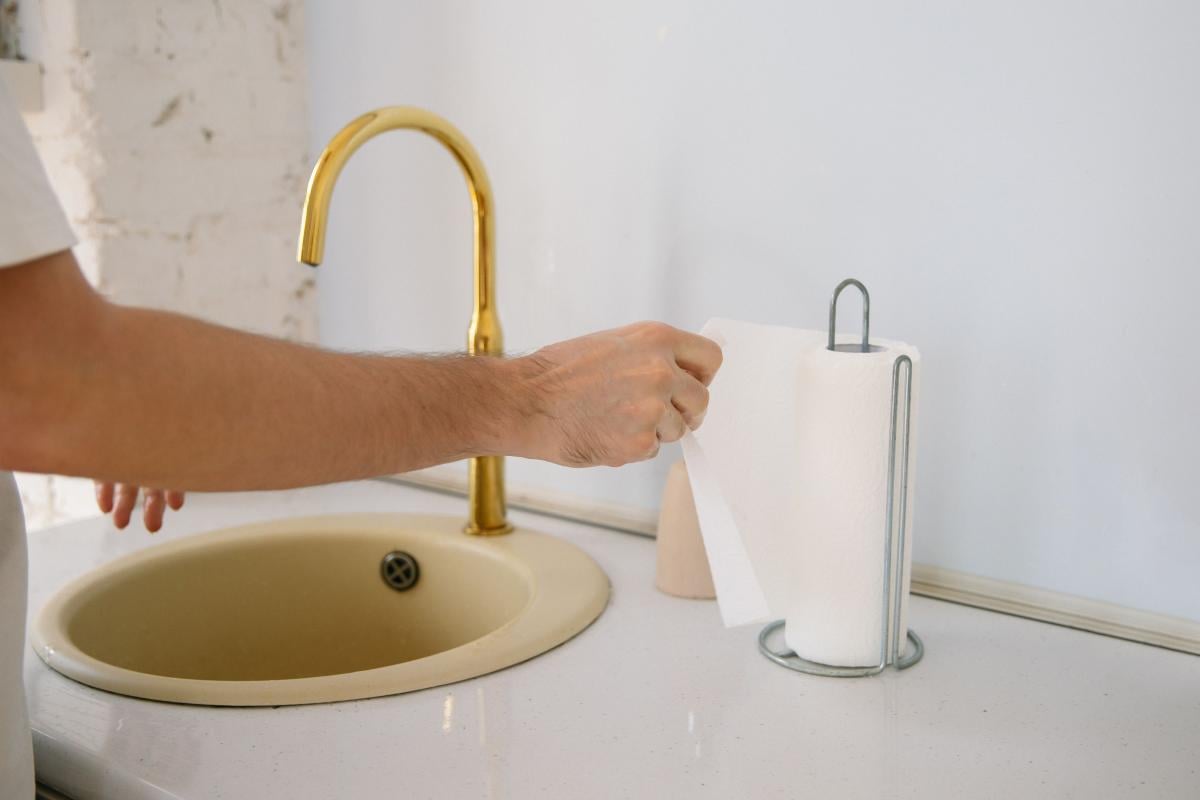
Almost every roll of paper towel in the kitchen carries a raised pattern of flowers, dots, diamonds or lines. It looks decorative, but the design actually serves a practical purpose, according to a report by Observator.
The patterns come from a manufacturing process called embossing, in which paper is pressed between special cylinders so the surface develops tiny ridges and grooves. Jerry Ballas, a specialist in paper product innovation, said the technique began in the 1920s to improve the material's performance rather than simply its appearance.
How dots and flowers help absorb water
A completely smooth sheet of paper towel has a different structure from one with raised and recessed sections. Embossing changes the volume and porosity of the paper, creating space for liquid to soak in and stay there. Depending on the material and the pattern used, this structure can improve how much water the towel absorbs.
Embossing also makes the paper look visually thicker and feel softer and more flexible, the report said. But the technique has a downside too. If the paper is pressed too hard to create a very pronounced pattern, the fibres can weaken, making the towel more likely to tear when wet. Manufacturers therefore have to strike a balance between absorbency, softness and strength.
What research shows about the best absorbing pattern
A study published in the scientific journal Polymers examined how patterns formed by dots and lines change the properties of paper. Researchers found that the geometry and size of the raised elements can affect the structure and mechanical characteristics of the finished product.
Patterns with small, densely packed dots can help increase the paper's volume, according to the study, but the results did not show that any single pattern always absorbs better than another. The type of fibres used, the number of layers and the manufacturing process all play an important role too.
Why some paper towels fall apart when wet
The raised patterns serve another function as well. In towels made of two or more layers, the embossed points help the layers stick together, a technique that became especially useful as two-ply towels spread in the 1950s.
Without proper bonding, the layers can separate while wiping, particularly once they have absorbed a lot of water, the report said. It also noted an important difference between kitchen towels and toilet paper: kitchen towels are designed to withstand moisture, while toilet paper needs to break down relatively quickly in water to reduce the risk of blocking sewage pipes.
Test yourself
What manufacturing process creates the patterns on paper towels?
According to Jerry Ballas, when did this technique begin?
Why do two-ply towels use embossed points?
Have your say
Does the pattern on a paper towel affect which brand you choose?

