

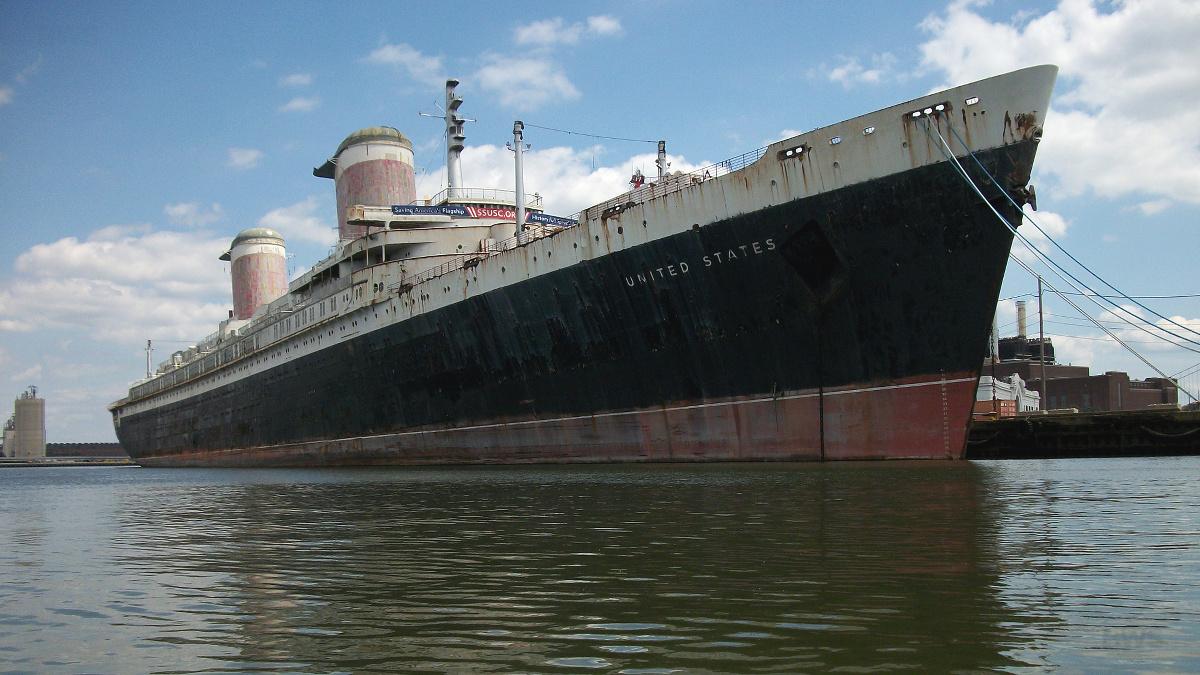
The historic American ocean liner SS United States has been sunk off the coast of Florida to create the world's largest artificial reef.
The vessel settled onto the bottom of the Gulf of Mexico near the city of Destin on Wednesday, 11 November, according to The Guardian.
Crews began preparing the ship for sinking at 2:40 pm US Eastern Time on Wednesday, 11 November, and the scuttling process itself started shortly before 5:00 pm. Holes had been cut into the hull beforehand so water could flow inside and bring the liner down onto the seabed in an upright position.
The vessel gradually filled with water over the next several hours before finally sinking in the Gulf of Mexico at around 10:00 pm. The liner now rests on the seabed at a depth of about 55 metres, with its upper decks sitting roughly 17 metres below the water's surface.
New marine habitat and diving site in Okaloosa County
Okaloosa County in Florida bought the liner for $1 million in 2024 as local authorities planned to turn it into the world's largest artificial reef. The site is expected to become a popular destination for divers from around the world.
The submerged ship is also expected to serve as a new habitat for a variety of marine species, including red snapper, grouper, amberjack, mackerel and tuna. Destin is a coastal city in Okaloosa County on the Florida Panhandle, a northern Gulf of Mexico region well known for fishing and diving.
Before the sinking, Susan Gibbs, president and co-founder of the nonprofit SS United States Conservancy, said turning the ship into a reef meant it would stay intact as a living, dynamic marine environment. She added that alongside a land-based museum and visitor space, the project would honour its history in a very moving way.
Philadelphia docking fees and preservation battle
For many years, the SS United States was moored at a pier in Philadelphia, Pennsylvania's largest city and a major Delaware River port. Different owners tried to save and restore the ship, but maintaining the ageing liner grew increasingly expensive and complicated its preservation.
In 2021, port authorities raised the docking fee to $1,700 a day, a cost the SS United States Conservancy could no longer afford.
Gibbs is the granddaughter of William Francis Gibbs, the American naval architect who designed the liner. Speaking of his special attachment to the vessel, she described his relationship with the ship as an all-consuming obsession and said he joked that he loved the SS United States a thousand times more than her grandmother. Whenever the ship left for Europe he came to see it off, and on its return he was among the first to greet it.
Transatlantic speed record and Gulf of Mexico reef projects
At about 305 metres long, the SS United States was once the world's fastest ocean liner. Launched in 1952, it set the transatlantic speed record on its maiden voyage and carried thousands of passengers across the Atlantic Ocean over 17 years before retiring in 1969, as jet airliners overtook passenger ships.
It was previously reported that a 31-tonne propane tank and a steel tower were sunk in the Gulf of Mexico about 21 kilometres south of Petit Bois Island, a barrier island off the coast of Mississippi. Those structures were formerly used to train firefighters and now form part of an artificial reef that provides shelter for fish and supports marine life.
Unlike natural reefs, which form on their own through natural processes, artificial reefs are purpose-built on the seabed using steel, concrete, decommissioned vessels and other structures. The goal of such projects is to create new habitats in areas lacking natural reefs so fish can gather, hide from predators and find food.


