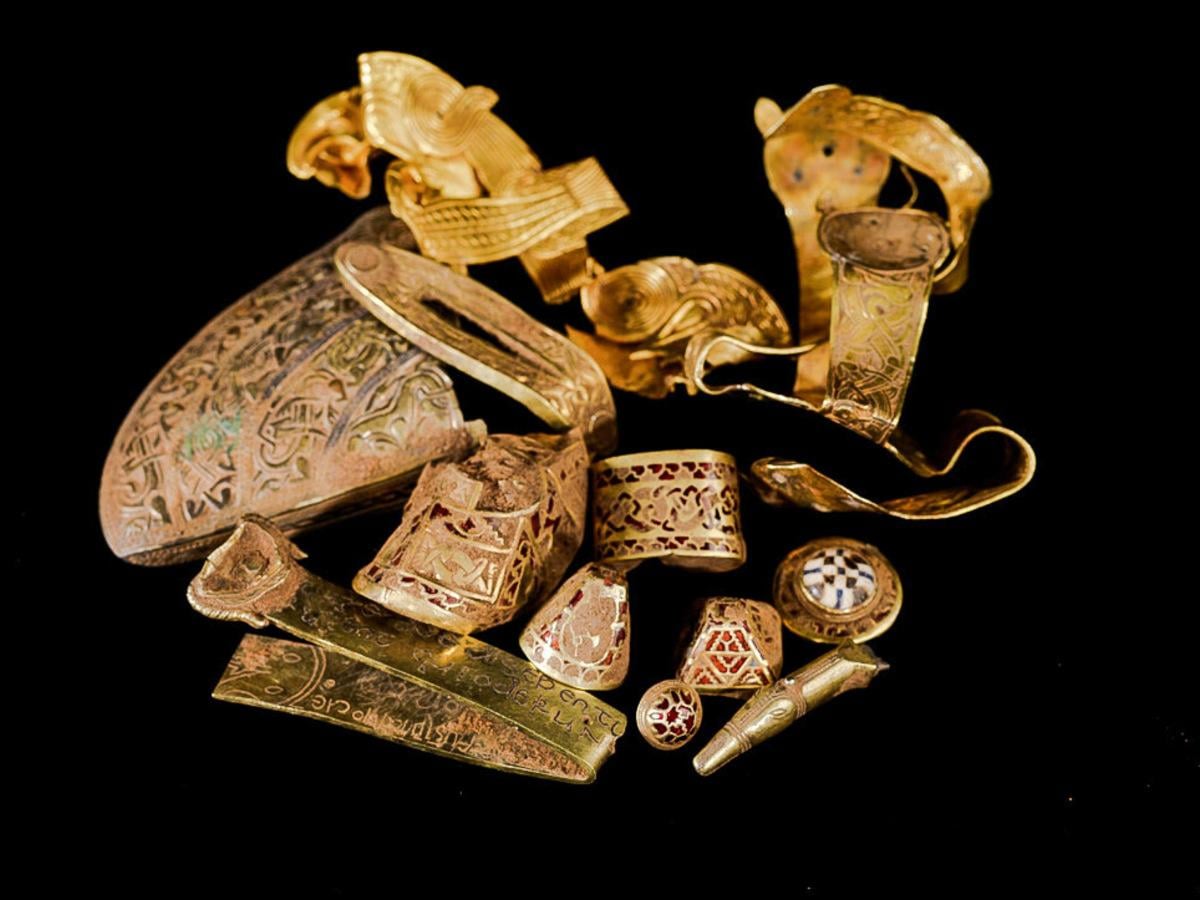
Almost 5 kilograms of gold dating back to the 7th century were found lying in a field near the village of Hammerwich in Staffordshire, England. The hoard contains around 4,000 items and fragments and is considered the largest known collection of Anglo-Saxon gold and silver objects, according to Forschung und Wissen.
The find, known as the Staffordshire Hoard, was discovered on 5 July 2009 by metal detectorist Terry Herbert using a metal detector. Before the discovery was officially announced on 24 September that year, archaeologists had already managed to systematically survey a large part of the field.
The gold lay in the upper layer of soil, in some places only a few centimetres beneath the surface. In the autumn of 2008, farmer Fred Johnson had ploughed the plot, which caused the once-intact hoard to break apart into numerous fragments that scattered through the ground.
How the Hoard Was Unearthed
The archaeological excavation lasted four weeks. Specialists examined 155 square metres of land, trying to recover every item and reconstruct its original position. The work was difficult, because soil had gradually shifted down the slope over time, thinning the protective layer above the metal objects and moving the fragments away from where they had first been buried.
No traces of buildings, graves or a battle were found at the site, and archaeologists were unable to identify any settlement directly linked to the hoard. Finds kept turning up even after the main dig ended. In 2012, when the farmer ploughed the field again, additional fragments came to light.
Weapons, Jewels and a Golden Helmet
The bulk of the collection consists of gold and silver fittings from swords and daggers, including pommels, hilt plates and other weapon parts. They are decorated with intricate geometric patterns and interwoven animal designs. Craftsmen used red almandine garnets, set between thin gold cell walls, for the decoration.
Despite the huge number of weapon fittings, archaeologists did not find a single complete sword with its blade, and the hoard contains almost no jewellery typical of women's dress. According to Historic England, the recovered pieces could have come from more than a hundred individual weapons, suggesting the hoard was assembled selectively rather than simply buried as the full equipment of fallen warriors.
One of the hardest pieces to reconstruct was a richly decorated helmet. Roughly a third of all recorded fragments in the hoard, counted by number of pieces rather than weight, belong to this single helmet. Other fragments may have come from horse harness fittings, precious books or religious objects.
The materials themselves point to considerable skill among the craftsmen of the time. Gold survives in soil far better than iron, which corrodes, so even the smallest decorative details on the objects remained intact. The metal was not pure gold, however; the alloys also contained silver and copper. Research has shown that the craftsmen could reduce the silver content on the surface of an object, making the outer layer appear more golden, which allowed them to even out the colour of different pieces or highlight particular decorative elements.
Christian Relics Among the Weapons
Alongside the military equipment, archaeologists found several objects bearing Christian symbolism, including a small pectoral cross and a damaged cross set with precious stones.
Particular attention has focused on a narrow gold strip bearing a Latin inscription from the Book of Numbers, chapter 10, verse 35. The text calls on God to rise up, scatter his enemies and drive away those who hate him. The Latin wording contains errors in two places.
Dating a Mystery Burial
By comparing the finds with objects whose age is known more precisely, archaeologists date the burial of the hoard to roughly between 650 and 675. That does not mean every object in the collection was made during that period.
The collection includes older silver weapon fittings from the 6th century that show signs of wear, as well as later gold jewellery. The differences in style and quality may point to origins in different workshops and regions. Some items could have been used for a long time, passed down as inheritance, or given as gifts, before ending up in the ground together.
Why the Hoard Was Buried
Researchers have considered several possible explanations. The gold could have been war booty, part of a ransom, a religious offering, or valuables hidden from attackers. None of these theories has been confirmed by archaeological research so far.
Even the fact that many of the recovered items are separate weapon fittings without blades does not settle whether whoever buried them planned to come back for them.
The objects are currently in the care of the Birmingham Museums Trust and the Potteries Museum and Art Gallery in Stoke-on-Trent, where they are being studied through X-ray imaging, material analysis and careful cleaning.
What happens next
The objects remain in the care of the Birmingham Museums Trust and the Potteries Museum and Art Gallery in Stoke-on-Trent, where they continue to be studied using X-ray imaging, material analysis and cleaning.
Test yourself
Who discovered the Staffordshire Hoard?
Roughly how much gold did the hoard contain?
What text is quoted in the Latin inscription found among the fragments?
Have your say
What do you think best explains why the Staffordshire Hoard was buried?
Where it happened
Hammerwich, England