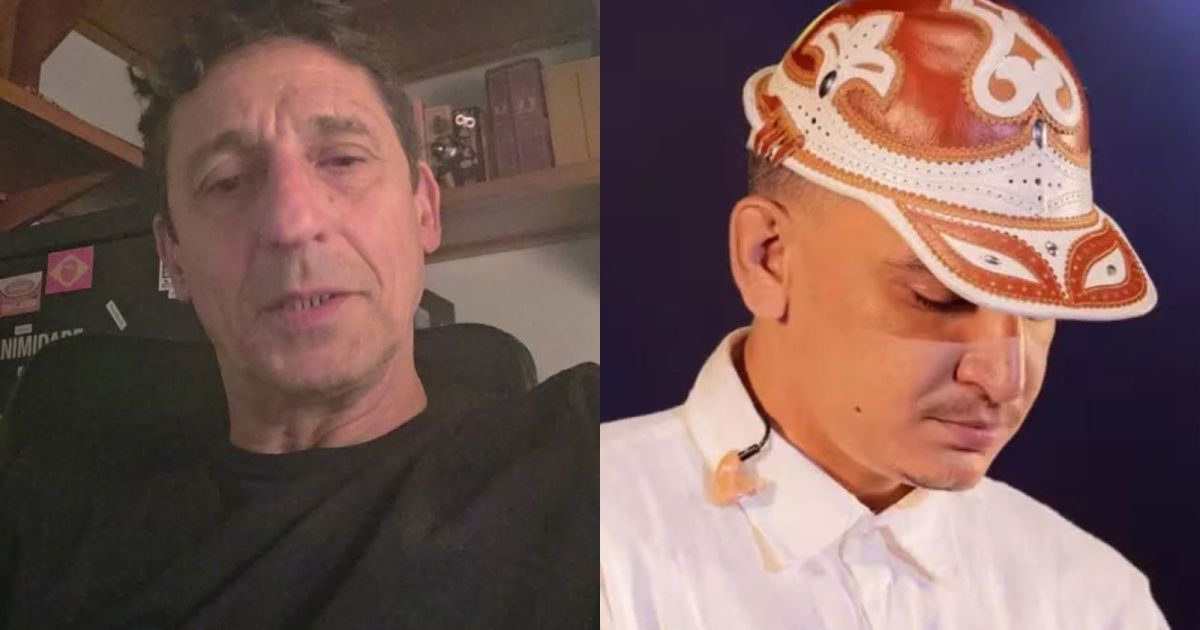
Brazilian actor Tuca Andrada, 61, responded to singer João Gomes, 24, in an Instagram video posted on Wednesday, November 11, after Gomes recorded his own video criticizing and rejecting a comment Andrada had made about his cowherd-style outfits.
Andrada said he had not planned to reply, but changed his mind after Gomes posted his video. He said he had made a joke about Gomes and it seemed to have offended him. Andrada said he had written that Gomes dressed up as a cowherd, or vaqueiro, and wanted to clarify that he himself was from the northeastern state of Pernambuco, born in the city of Recife, with a father from Limoeiro and a mother from Vitória de Santo Antão.
Andrada said he knew the reality of Pernambuco and Brazil's northeast well and was not ignorant of it. He said that when he said Gomes dressed up as a vaqueiro, it was because he considered him a singer who dresses like a cowherd, which makes it a costume, not an identity. He said it did not matter that Gomes's grandfather, father or great-grandfather had been a vaqueiro, Gomes himself was a singer.
Praise alongside the criticism
Andrada added that he still saw something positive in Gomes's work, saying the singer carries northeastern culture to many parts of Brazil and the world, and that he hoped Gomes found great success across Europe, the United States and anywhere else he performed, adding that he never roots for anyone's failure.
He said Gomes was not the first performer to adopt such imagery, pointing to Chico Sá's use of a lance-carrying caboclo figure, singer Alceu Valença's occasional nods to northeastern folklore characters, and the forró pioneer known as Gonzagão. He said items such as the leather gibão jacket and leather hat exist to protect people who work with cattle from the thorny caatinga scrubland, and that wearing them does not make someone a vaqueiro. He said he had only come to explain that Gomes was dressed as a vaqueiro, nothing more.
Tuca Andrada addresses depression remark
Andrada also said his original comment had nothing to do with Gomes's political views or mental health. He said he had never spoken about Gomes's political position, since that did not interest him, and that he was interested in who did take a side and who did not. He said that if Gomes had leaned one way or another politically he might have had something to say, but since Gomes had chosen to stay silent, that was his right, and Andrada said he had never demanded anything of him.
Andrada said he sincerely hoped Gomes recovered from his depression, calling it a horrible, terrible illness. He said he knew people close to him who suffered from depression and understood how complicated it was, and that he would never joke about it and did not want others to either. He said that if Gomes still felt offended, he was sorry, but Gomes was a singer, not a vaqueiro, and took the stage in costume. He closed by congratulating Gomes for carrying Pernambuco's culture so far and wishing him well.
How the dispute began
The row started after Andrada wrote on X, formerly known as Twitter, that every time he saw João Gomes dressed as a sertanejo-style vaqueiro, it reminded him of people from the southern state of Santa Catarina dressing up as Germans.
Gomes, who is known for performing piseiro, a popular northeastern Brazilian music genre, felt offended and posted a video responding to the comment. He asked what exactly he was supposed to be dressed as, and said what he wore was not a costume but a gibão jacket, leather leg guards and a leather chest protector, adding that the leather used was highly valuable.
João Gomes defends his roots
In the same video, Gomes spoke about his family background and his own name. He said his full name was João Fernando, with Fernando taken from his uncle, a well-known vaqueiro from Serrita, in Pernambuco, where Gomes was born. He said he holds the Festa do Vaqueiro de Couro, a leather-cowherd festival, every year so that tradition does not die out.
He said people who make such comments are those with nowhere to return to, while he had somewhere to return to and took great pride in where he was born and grew up. He said that whenever he goes back to Petrolina or Serrita he feels a sadness, knowing that before long there will be no one left there that he knew as a child.
Gomes also recalled the early days of his career and the hardships he faced. He said he had often found himself stranded on roads deep in the interior of the state of Pará, struggling to reach a venue, and would tell himself that even if he did not succeed as a singer, he hoped at least to be able to go back to school. He said everything in his life was built through hard work and struggle.
He said many of his friends were still struggling, with some already up at four in the morning heading out to pick mangoes or grapes, and that he did not need glamour or famous friends to prove his life had turned out well, only his friends by his side. He said that if someone was unwell, it should not be him, since he could not afford to get sick over what he called the madness of such people, before telling Andrada directly that he was crazy.