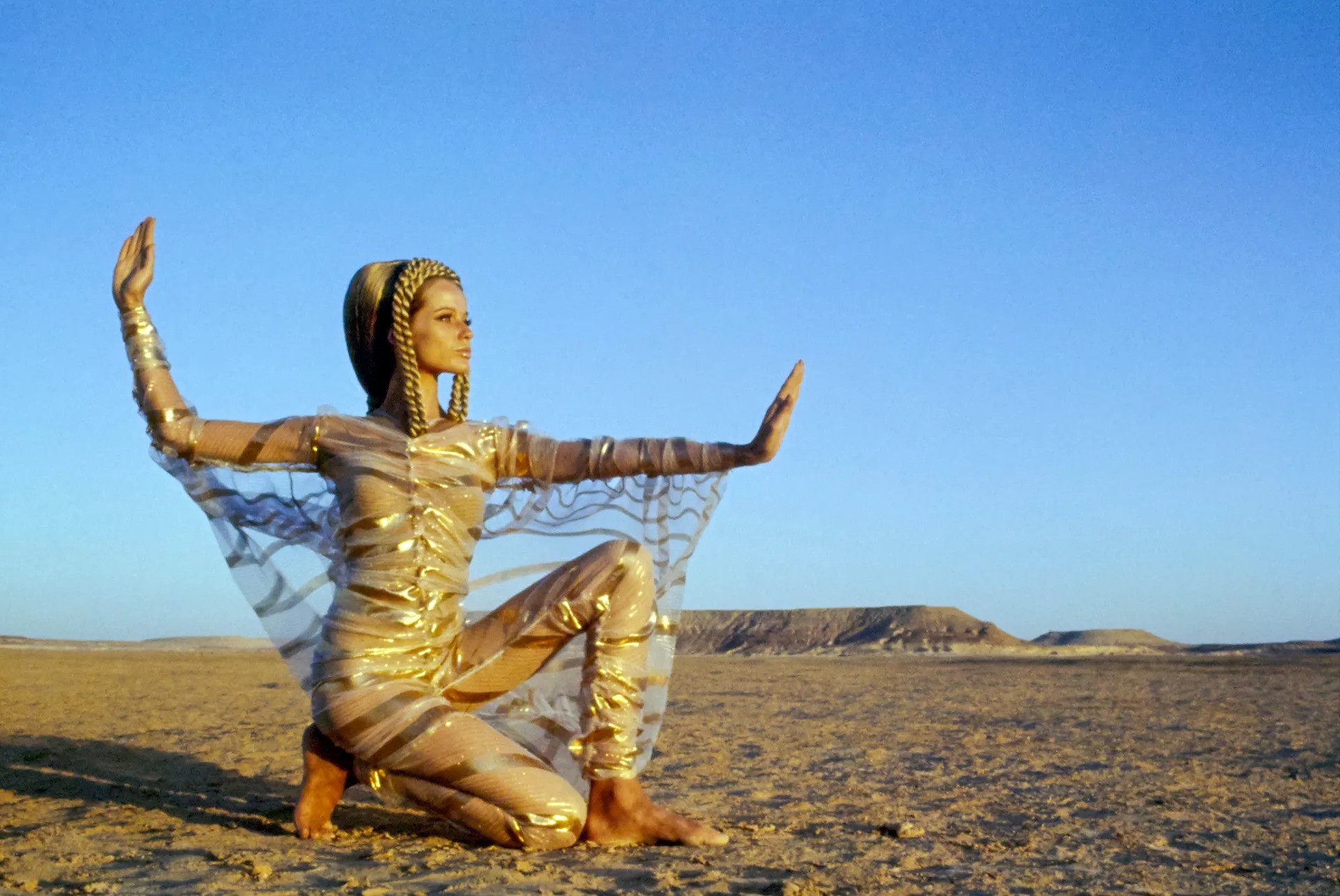
Veruschka, the German-born model celebrated as one of fashion's first supermodels in the 1960s, has died at the age of 87. Her death was confirmed on Wednesday, 25 November 2026, by the German newspaper Bild.
According to vogue.globo.com and Vogue.fr, she died at home surrounded by friends and family. The Russian outlet lenta.ru, citing Bild and a relative of the model, reported that she died at her home in Berlin and that the cause of death had not been disclosed.
Born Vera Gottliebe Anna Gräfin von Lehndorff-Steinort on 14 May 1939 in Königsberg, East Prussia, in what is now Kaliningrad, Russia, Veruschka grew up in the shadow of the Second World War. She was five years old when her father, Count Heinrich von Lehndorff-Steinort, was executed for his part in the failed 1944 plot to assassinate Adolf Hitler, known as the 20 July plot. Her family was imprisoned by the Nazi regime, and the aristocratic world into which she had been born had largely vanished by the time the war ended.
Lenta.ru added further detail on the aftermath, reporting that her pregnant mother was sent to a labour camp, while she and her sisters were placed in a children's home run by the SS.
Discovery in Florence
An art student, Veruschka was discovered in Florence in 1959, according to vogue.globo.com and Vogue.fr. Lenta.ru gave a different account, reporting that she had studied art before travelling to Italy, where she was noticed by the photographer Ugo Mulas.
Her height set her apart from the outset. Vogue.globo.com described her as standing more than 1.80 metres tall, while Vogue.fr put her height at 1.93 metres, an unconventional profile for a model at the time. An early stint in New York proved disappointing, but in Italy she built a fruitful creative partnership with the photographer Johnny Moncada. About 3,000 images from those formative years, unseen for decades, later formed the basis of the book "From Vera to Veruschka: The Unseen Photographs by Johnny Moncada" and an accompanying exhibition at Somerset House in London in 2014.
Her greatest act of reinvention, according to vogue.globo.com and Vogue.fr, was the creation of "Veruschka" itself. Taking a Russian-sounding diminutive of her first name, she cultivated a persona of uncertain origin wrapped in mystery. When she returned to New York in 1964, she found an industry increasingly receptive to her look, and in Diana Vreeland, then editor-in-chief of Vogue, she found a kindred spirit.
A defining face of the 1960s
The 1960s brought a new generation of models to prominence, among them Jean Shrimpton, Twiggy, Donyale Luna and Penelope Tree. With her high forehead, sculptural cheekbones and elongated limbs, Veruschka was one of the decade's most striking presences, whatever style she adopted. She appeared on 13 covers of American Vogue, working with photographers including Richard Avedon, Irving Penn, Horst P. Horst and David Bailey, and became one of the highest-paid models of her generation.
Avedon once described her as the most beautiful woman in the world, according to vogue.globo.com and Vogue.fr. Earlier this month, the release of Ron Howard's documentary "Avedon" on Netflix prompted Vogue to revisit an extraordinary 25-page fashion story the magazine ran in its 1 March 1967 issue, in which Veruschka leapt and pirouetted with her hair braided into a long, rippling plait by the hairstylist Ara Gallant. Avedon said her beauty demanded something of whoever looked at it, adding that one had to rise to the challenge or risk losing a certain splendour forever.
Franco Rubartelli and the Saint Laurent photograph
Some of her most memorable images came from her collaboration with the Italian photographer Franco Rubartelli, who was both her creative and romantic partner. Among them was an unforgettable 1968 photograph for French Vogue of Veruschka wearing Yves Saint Laurent's tie-waist safari jacket, an image that captured the designer's new vocabulary of sensuality and female authority.
Vogue.fr also described her as an endlessly inventive muse for hairstylists and make-up artists, who dressed her in extravagant false eyelashes, elaborate braided hairstyles, graphic eye make-up and spectacular headpieces.
A role in Blow-Up and a stand on abortion
Her fame extended well beyond fashion magazines. According to Vogue.fr, Veruschka played a version of herself in Michelangelo Antonioni's 1966 film "Blow-Up," a brief but electric scene opposite the fashion photographer played by David Hemmings. Lenta.ru also noted her role in the film, dating it to the same year. A year after its release, Veruschka appeared on the cover of Life magazine, Vogue.fr reported; lenta.ru said she repeatedly featured on the covers of Vogue and Life.
In 1971 Veruschka joined 27 other women in the West German magazine Stern under the headline "Wir haben abgetrieben!" ("We have had abortions!"), a collective statement in favour of reforming abortion law at a time when the procedure was illegal in Germany. Vogue.fr described it as a significant moment in the feminist movement that swept the country in the 1970s.
Later years and legacy
By the mid-1970s, Veruschka had begun to step back from the fashion industry as her artistic ambitions took precedence over modelling, according to Vogue.fr. Lenta.ru offered a more specific account, reporting that she left the mainstream modelling business after disagreements with the editorial team at American Vogue and turned her focus to painting, photography and performance. Working with the German artist Holger Trülzsch, she produced body-art photography in which her painted body merged into architectural surfaces and natural landscapes, at times appearing to dissolve into the scenery or take on entirely different identities. Lenta.ru credited her as a pioneer of body art.
Fashion never entirely lost interest in her, and she occasionally returned to it. She walked for Chanel in 1994 and, at 71, for Giles Deacon's spring/summer 2011 show in London. In 2017, Acne Studios chose her for the lookbook of its 2018 Cruise collection.
Lenta.ru reported that in recent years Veruschka had lived a secluded life but maintained contact with young artists until the end, and that part of her legacy had been donated to a museum of East Prussia in Lüneburg, Germany.
Test yourself
Which German newspaper confirmed Veruschka's death?
How many covers of American Vogue did Veruschka appear on?
Which 1966 film featured Veruschka playing a version of herself?
Where it happened
Berlin, Germany