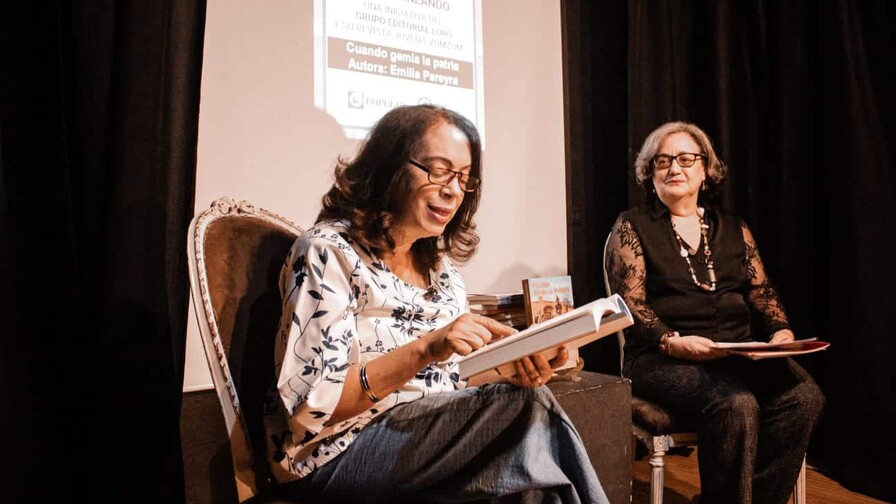
Journalism, literature and historical memory came together at the first session of the Club de Lectura Zumzumneando, a new Dominican reading club that opened its cycle of literary gatherings with writer Emilia Pereyra and her historical novel "Cuando gemía la patria" ("When the Fatherland Groaned").
The event was held on Wednesday, November 25, 2026, in the hall of the Teatro Alternativo in Santo Domingo, with support from Banco Popular, one of the Dominican Republic's largest banks. It drew readers of different generations interested in exploring Dominican history through fiction.
The club was created by journalist Isabel López, a founding partner of the Grupo Editorial Loro publishing group. Its first session was built around Pereyra's novel, which is set during the period of the Dominican Republic's Annexation to Spain and the events that led up to the War of Restoration.
During the session, Pereyra read passages from her book and spoke with participants about the ties between journalistic practice, documentary research and the writing of stories set in the 19th century. She focused in particular on the years surrounding the Annexation and the lead-up to the Restoration war.
Pereyra, who was born in Azua de Compostela, discussed daily life under the political tensions of that era, the divisions that ran through families at the time, and the importance of recovering the experiences of ordinary, unnamed people in reconstructing history. Historical novels like hers combine documented fact with narrative imagination, a form often used to give voice to people left out of official records.
Historical backdrop of the novel
The Dominican Republic first declared its independence from Haiti in 1844. Less than two decades later, in 1861, the country's leadership arranged its Annexation to Spain, returning it briefly to colonial rule. The arrangement collapsed in 1865, after the War of Restoration, a conflict fought to recover Dominican sovereignty. The divided loyalties that split families during those years form the backdrop of Pereyra's novel.
Who is Emilia Pereyra
Pereyra is a journalist and novelist who graduated in Social Communication from the Universidad Autónoma de Santo Domingo (UASD), the country's main public university. She is a corresponding member of the Academia Dominicana de la Lengua, the Dominican counterpart to Spain's Real Academia Española and the body responsible for matters relating to the Spanish language in the country. She has received the National Journalism Prize, awarded in 2019, and the Enriquillo Prize for Historical Novel, awarded in 2020.
Activities for every generation
The gathering also included reading and writing activities adapted to different age groups. Children and teenagers between seven and 13 years old took part in creative exercises and an introduction to writing news chronicles. Young people and adults between 14 and 25 debated historical positions on the 1861 Annexation, its parallels with the present, and ideas for developing transmedia storytelling projects, an approach that spreads a single narrative across multiple formats such as text, audio and video.
One of the central themes of the discussion was the role of women in the political conflicts of the 19th century, alongside the continued relevance of concepts such as sovereignty and citizenship. Organizers also pointed participants toward resources for learning more about the period, including documents held at the Archivo General de la Nación, the country's national archive.
What comes next
The Club de Lectura Zumzumneando will continue meeting until June, with future sessions dedicated to the work and careers of writers Maritza Florentino, Arlette Pichardo, Domingo Abreu Collado, Lorena Oliva, María José Rincón and Avelino Stanley.
What happens next
The Club de Lectura Zumzumneando will continue meeting until June, with sessions dedicated to Maritza Florentino, Arlette Pichardo, Domingo Abreu Collado, Lorena Oliva, María José Rincón and Avelino Stanley.
Test yourself
Which novel by Emilia Pereyra opened the Club de Lectura Zumzumneando's cycle?
Who founded the Club de Lectura Zumzumneando?
What historical period does Pereyra's novel focus on?
Have your say
Do you think historical novels help readers understand difficult periods of a country's past?
Where it happened
Santo Domingo, Dominican Republic