The Finnish city of Jyväskylä holds 29 buildings and a boat designed by the architect Alvar Aalto, the largest concentration of his work found anywhere in the world. The city of lakes and wooded hills in central Finland shaped much of Aalto's life, from his childhood there to the office he opened as a young architect.
The scale of that legacy gained new weight in 2026, after UNESCO added thirteen works and architectural complexes by Alvar Aalto, his first wife Aino Aalto and his second wife Elissa Aalto to its World Heritage List. The listing, approved on July 26, 2026, recognised the contribution of their architecture to the development of modernism and its link to Finland's welfare society. Three of the listed complexes sit in Jyväskylä and its surroundings: the university campus, the Säynätsalo Town Hall and the Experimental House on Muuratsalo.
Known as the Athens of Finland
Jyväskylä has long been known as the Athens of Finland for its role in developing education in the Finnish language. Aalto was born in 1898 in Kuortane, a small town in western Finland, and was five when his family moved to Jyväskylä, home to a Finnish-language secondary school. His father, Johan Henrik Aalto, was a surveyor who spoke Finnish, while his mother, Selma Matilda Hackstedt, worked in the postal service and spoke Swedish, giving the architect a bilingual upbringing that was common in Finland, where both languages hold official status.
Aalto grew up surrounded by wooded hills and lakes, developed a love of drawing, and finished his studies at the lyceum in 1916 before leaving for Helsinki to train as an architect. His mother is buried in Jyväskylä's cemetery, a lasting link between the architect and the city of his youth even after his career took him elsewhere. In 1958, Aalto returned to the lyceum to take part in celebrations marking its centenary. By then an internationally recognised architect, he chose to speak about something he said he had learned in those same classrooms. In a speech titled "What is Culture?", he argued that a much-debated skeptical view of the world was in fact necessary for anyone seeking to make a cultural contribution, and said that skepticism, at its highest expression, could become a way of loving with critical sensitivity.
A first office and a first marriage
In 1923, newly qualified and only 25 years old, Aalto returned to Jyväskylä to open his first office, betting that his family contacts and knowledge of the city would bring early commissions. He named the practice the Alvar Aalto Architecture and Monumental Art Office. The architect Aino Marsio joined him the following year, and the two married in 1924; she went on to play a decisive role in his career. The couple stayed in Jyväskylä until 1927, when they moved their practice to Turku, though the projects Aalto later built in his childhood city would make it an exceptional chapter in his career.
A university campus built as a city
In 1951, Aalto won a competition to expand Jyväskylä's former teacher training college, later a university, with a proposal titled Urbs, the Latin word for city. Developed in phases until 1971, the project transformed Seminaarinmäki, the hill where the original seminary buildings had stood since the 1880s. Drawing on Anglo-Saxon university campuses he had seen on his travels, Aalto laid out the new buildings in an open, horseshoe-shaped plan around a sports field, linked by pedestrian paths. The historic buildings stayed on the higher ground, while the new construction occupied the lower terrain, preserving much of the existing woodland. Red brick, already present on the old seminary's facades, became the dominant material of the extension, creating visual continuity between the two eras.
The main building, completed in 1955, combines a rectangular three-storey wing of classrooms and offices with a fan-shaped wing housing the main auditorium, joined by a tall vestibule and a staircase inspired by Venetian design. Inside, brick is combined with marble floors and wood details, while large glass panels on the ground floor open the vestibule toward the surrounding pines.
A town hall with a cloister and a 'butterfly' roof
About fifteen kilometres from central Jyväskylä, the Säynätsalo Town Hall drew on a competition Aalto won in 1949 with a proposal called Curia, a design far removed from a conventional administrative building and closer in feel to a medieval monastery or small Italian palace. Built on a hill, it is organised around four red-brick wings surrounding a raised courtyard, reached by either a granite stairway or a flight of grass-covered steps. A glazed gallery runs along part of the courtyard, where a fountain with a sculpture by Wäinö Aaltonen reinforces its resemblance to a cloister, while the tower of the council chamber rises above the complex. Beyond its administrative offices, the project included a library, shops, housing and two guest rooms that can still be booked today.
The council chamber, topped by a wooden roof held up by fan-shaped trusses that Aalto called "butterflies," holds another unusual story. Aalto had set aside a niche in one of its brick walls for a painting by his friend Fernand Léger, who had offered to collaborate on the project. The abstract composition led to a dispute when the town council, on receiving the invoice, refused to buy it. Aalto kept the original himself, and a copy now hangs in the room, lit from the side through a wooden lattice. The painting, displayed vertically, has also given rise to a persistent story that it was originally conceived to be shown horizontally.
Aalto's imprint on Jyväskylä extends well beyond the sites now recognised by UNESCO. In the town centre, he left his mark on several administrative and cultural buildings, including the municipal theatre, while the Alvar Aalto Museum, completed in 1973, holds a particularly significant place in his legacy. It now forms part of Aalto2, a museum centre that connects it with the Museum of Central Finland and traces the architect's career.
A boat to reach the summer house
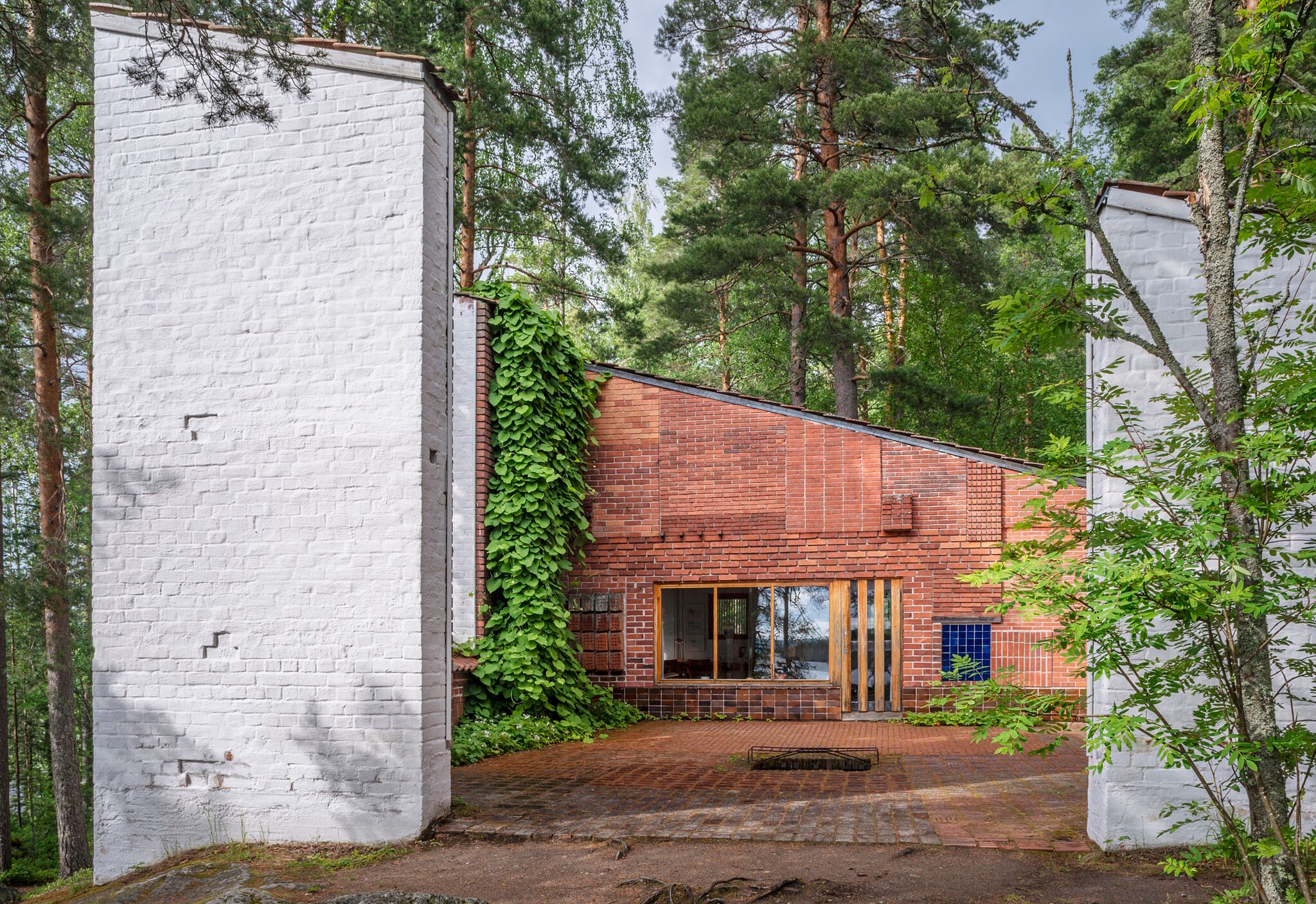
The third Jyväskylä site on the World Heritage List lies on the island of Muuratsalo, on the shores of Lake Päijänne. There, between 1952 and 1954, Alvar Aalto and his second wife, the architect Elissa Aalto, designed a summer residence known as the Experimental House, one of his most personal projects. Built around an interior courtyard, the house became a testing ground for different brick-laying patterns and construction methods, free of the constraints of a client's brief. It can be visited during the summer season and remains closed during the colder months.
Reaching the house posed a practical problem in the 1950s, since the island had no road connection at the time and could only be reached by water. Aalto solved it by designing his own boat, a wooden vessel just over ten metres long named Nemo propheta in patria, a Latin phrase meaning "No one is a prophet in his own land."
Built in 1955 by craftsmen from Säynätsalo, the boat had a black-painted hull, a mahogany deck and brass fittings. Its American engine, rated at 96 horsepower, promised considerable speed, but the result reportedly fell short of expectations: the boat was said to move through the water almost like a plough, an unflattering comparison for a creation by one of the twentieth century's great design masters. Elissa usually took the helm, and the couple used it to travel to the summer house and bring guests there.
Today the Nemo propheta in patria is on display at the Lutakko harbour in Jyväskylä, protected inside a pavilion built specifically to house it. The boat arrived at its current location in 2023 and now forms part of the Alvar Aalto Museum's collections, after several rounds of restoration that preserved much of its original character.
The boat adds an unexpected dimension to Aalto's presence in Jyväskylä, a city that counts 29 of his buildings, a concentration of work that is difficult to match anywhere else and makes it a notable destination for anyone interested in the architecture of one of the twentieth century's great masters. His legacy does not end there: Helsinki, Turku and many other Finnish towns also preserve notable examples of his architecture, which eventually crossed the country's borders as well.
Test yourself
How many buildings in Jyväskylä did Alvar Aalto design, according to the article?
What happened on July 26, 2026, according to the article?
What was unusual about the boat Aalto designed to reach his summer house?
Have your say
Would you plan a trip around visiting the work of a single architect in one city?
Where it happened
Jyväskylä, Finland