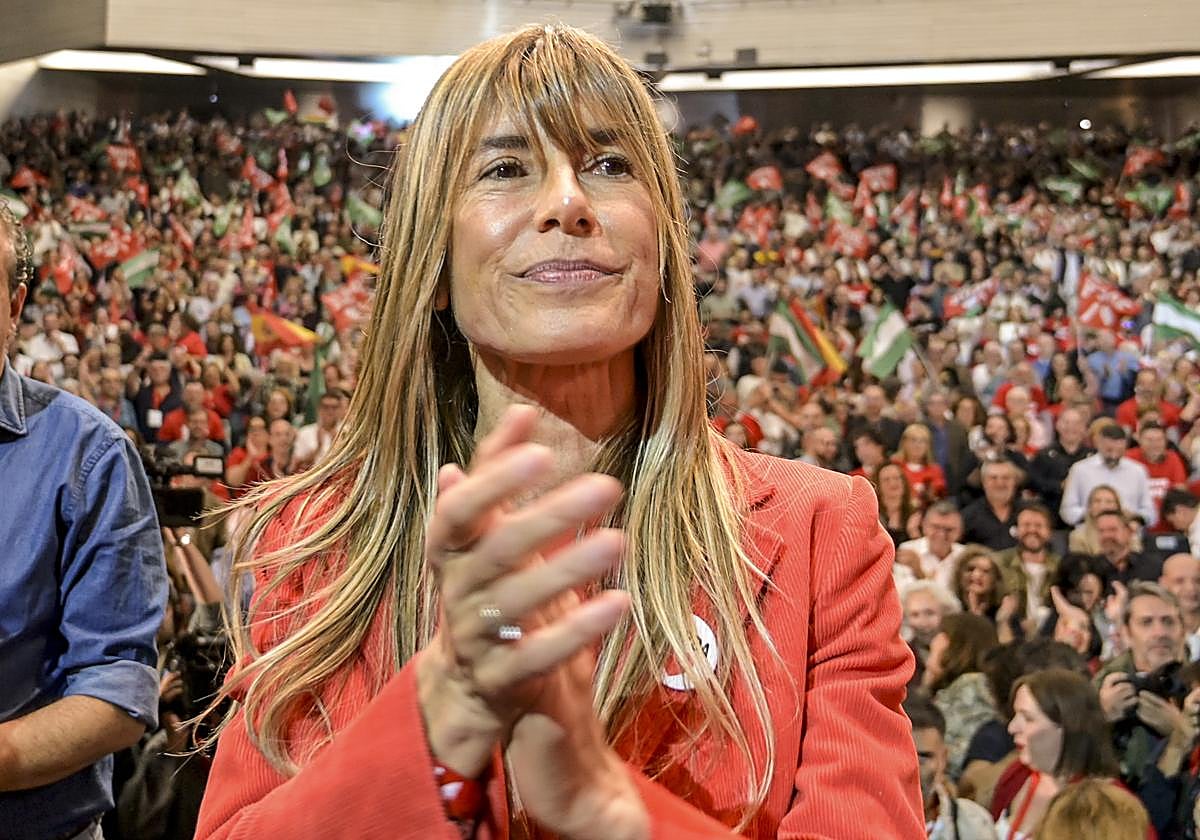
Spanish media often call Begoña Gómez, the wife of Prime Minister Pedro Sánchez, the country's "first lady," but Spanish law does not recognise any such role. The same label has been applied over the years to Elvira Fernández, Sonsoles Espinosa and Ana Botella, the wives of previous Spanish prime ministers, even though none of them held an official position either.
The term first lady refers to the spouse of a president in a republic, a role that does not fit a country with Spain's system of government. Spain is a parliamentary monarchy, not a republic, so the role played by a president and a first lady as head of state elsewhere is instead held by the King, alongside a Queen consort.
The first lady title also does not always go to a president's wife elsewhere. In Italy, President Sergio Mattarella is accompanied at official engagements by his daughter, Laura Mattarella, who performs the same basic duties: acting as hostess at public events and as companion during state visits.
Where the Term Came From
Dolores del Mar Sánchez-González, a professor at the Faculty of Law and coordinator of the university master's degree in protocol at Spain's National University of Distance Education (UNED), said the confusion comes from the United States, where the term is frequently used in what she called a "pernicious practice" that amounts to an ideological regression and general media confusion, with resulting institutional interference.
The term "first lady" did originate in the United States, so it is understandable that other countries try to find an equivalent label for the role. The first person to use it was Mary Clemmer Ames, a Victorian-era journalist who wrote for The Republican, the New York Press and The Brooklyn Daily Union, and who authored the 1871 book "Ten Years in Washington. Life and Scenes as a Woman Sees Them." Writing about Lucy Webb Hayes, the wife of President Rutherford B. Hayes, she used the phrase "The First Lady of the Land."
Earlier First Ladies
Newspapers had already used the expression earlier when referring to Mary Lincoln and, above all, to Harriet Lane, the niece of President James Buchanan, who acted as first lady during her uncle's presidency. Nicknamed "the democratic queen," Lane had a reputation as a hostess with great tact and was careful to observe protocol rules at a time of major regional tensions in the United States.
Playwright Charles Nirdlinger further popularised the term when his play "The First Lady in the Land," about Dolley Madison, the wife of President James Madison, who took office in 1809, opened in 1911. From the 1930s onward, the expression became firmly established and spread to nearly every republic in the world, particularly across Latin America.
That history explains why, even though Queen Letizia of Spain is sometimes described as a first lady in the United States, she is not one. Nor is Begoña Gómez, nor were the wives of previous Spanish prime ministers. To find an actual first lady in Spanish history, one has to go back to the Second Spanish Republic, even though the 1931 constitution of the Republic never names the figure in the section covering the presidency.
Spain's Constitution Is Silent on the Role
Spain's current constitution does not mention a first lady either. On the queen consort, it states only that "the Queen consort or the Queen's consort may not assume constitutional functions, except as provided for the Regency." Republics generally do not address the first lady figure in their constitutions either, although they usually give her an office of her own to carry out protocol duties. In recent years, several countries have adopted commitments to make that activity more transparent.
How Other Countries Handle Transparency
In the United Kingdom, the government's code of conduct requires the prime minister and their spouse to declare potential conflicts of interest. In France, President Emmanuel Macron published a "transparency charter" setting out Brigitte Macron's role, along with a budget and specific duties. In the United States, the first lady has become an unwritten but accepted institution, with her own staff, public objectives and a symbolic framework for action.
Is Spain at a Disadvantage?
Institutionally, Spain is not at a disadvantage compared with France, the United States or Germany, since Queen Letizia already carries out those functions as consort of the head of state. In terms of transparency, however, a gap can exist: a president's wife in a republic already has a minimum framework of reference for her role, while in Spain that role remains entirely unregulated.
Test yourself
According to the article, why does Spain not have an official first lady?
Who first used the phrase "The First Lady of the Land" in print?
Which country created a "transparency charter" defining the role of the president's spouse, according to the article?
Have your say
Should Spain create an official role and transparency rules for the prime minister's spouse?
Where it happened
Madrid, Spain