The Elizabeth Holmes documentary "You Can See Everything," directed by Nathan Fielder and Lance Oppenheim, has become the third highest-grossing documentary in history, earning more than $105 million at the box office since it premiered at the Telluride Film Festival in September.
The Telluride Film Festival, held every September in Colorado, is known as an early launch pad for films that go on to wider attention during awards season. "You Can See Everything" has already screened exclusively in a handful of selected cinemas, but it is still awaiting its wider release in Spain, where it is scheduled to open on December 25.
Its unusual access is central to the story. Holmes invited the two directors into her home to film her daily life with her partner, Billy Evans, and their two young children, during the 34 days before she entered prison.
Holmes is already a familiar figure. She was accused and convicted of deliberately deceiving multi-billion-dollar investors about the technology behind her company, Theranos, which she spent years claiming could run hundreds of complex clinical tests, including screening for cancer, diabetes and cholesterol, from a single drop of blood drawn with a finger prick. The technology never worked. She is currently serving her sentence in prison.
A psychological experiment, not a biography
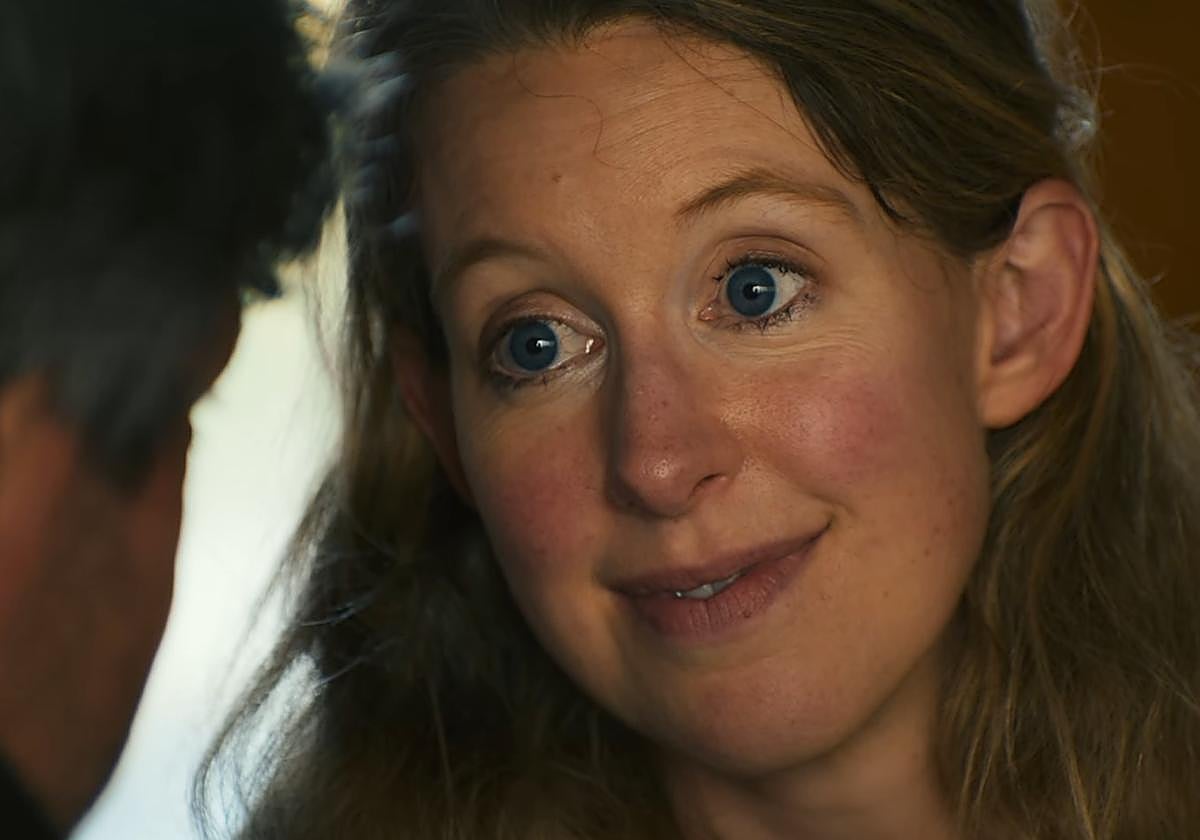
The nearly three-hour film explores the battle to control Holmes's public narrative. Rather than a conventional biography, it works as a psychological experiment on manipulation and truth, built around uncomfortable interviews and extreme close-ups that study every microexpression on her face, including her well-known blue eyes, which barely blink.
The film keeps returning to the same question: is Holmes a calculating fraudster trying to use the documentary to clean up her image, or does she genuinely believe her own version of events?
Recreating scenes with Amanda Seyfried
The second half of the film takes an even stranger turn. Once Holmes entered prison in 2023 and the cameras could no longer follow her, the filmmakers, in a move typical of Nathan Fielder's style, carried on telling the story of what was happening both behind bars and inside Hollywood production offices. They hired Amanda Seyfried, who won an Emmy for playing Holmes in the series "The Dropout," along with Christopher Abbott, to recreate scenes.
Alex Gibney, who directed the earlier documentary "The Inventor: Out for Blood in Silicon Valley," has described Holmes as the perfect symptom of a Silicon Valley culture built around faking success until you achieve it, taken to a dangerous extreme.
Extreme secrecy during production
Secrecy around the production was extreme. Both the surprise premiere at Telluride and Seyfried's involvement were kept hidden behind strict confidentiality agreements and tight security measures governing who could even read the script. The production company, A24, known for backing independent and art-house films, was determined to prevent the film's hybrid twist, which mixes documentary footage with dramatized recreation, from leaking before audiences saw it for themselves.
An uncomfortable ethical question
Writing in The Guardian, film critic Catherine Shoard has raised an uncomfortable question about the film's success: how far is it acceptable to turn a fraud with real victims into a psychological guessing game where the facts stop mattering?
According to Shoard, rather than confronting Holmes with the evidence from her trial or the testimony of patients harmed by Theranos, Fielder opts for what she called an extended vibes check, simply looking into her eyes to try to sense whether she is lying. She argued that this deliberate abandonment of journalistic rigor turns the film into an enormous slap in the face for the justice system and for the whistleblowers in the case, reducing a serious fraud to shallow entertainment about subjective impressions.
Shoard said the problem is made worse by a contemporary culture that places emotion above evidence. By presenting the story as an open-ended riddle, one where audiences are left unsure whether Holmes is guilty or simply living inside her own reality, she said the film carries out what she called the most damaging attack on objective truth she has seen, precisely because it is so open-ended and slippery.
Shoard said the documentary ultimately forces its audience to ask whether they are rewarding a masterpiece about human manipulation at the box office, or whitewashing a convicted fraudster because audiences today are more drawn to emotional truth than to demonstrated facts.
What happens next
You Can See Everything is scheduled to open in Spanish cinemas on December 25.
Test yourself
Who directed "You Can See Everything"?
How much has the documentary earned at the box office?
Who plays Elizabeth Holmes in the film's recreated prison-era scenes?