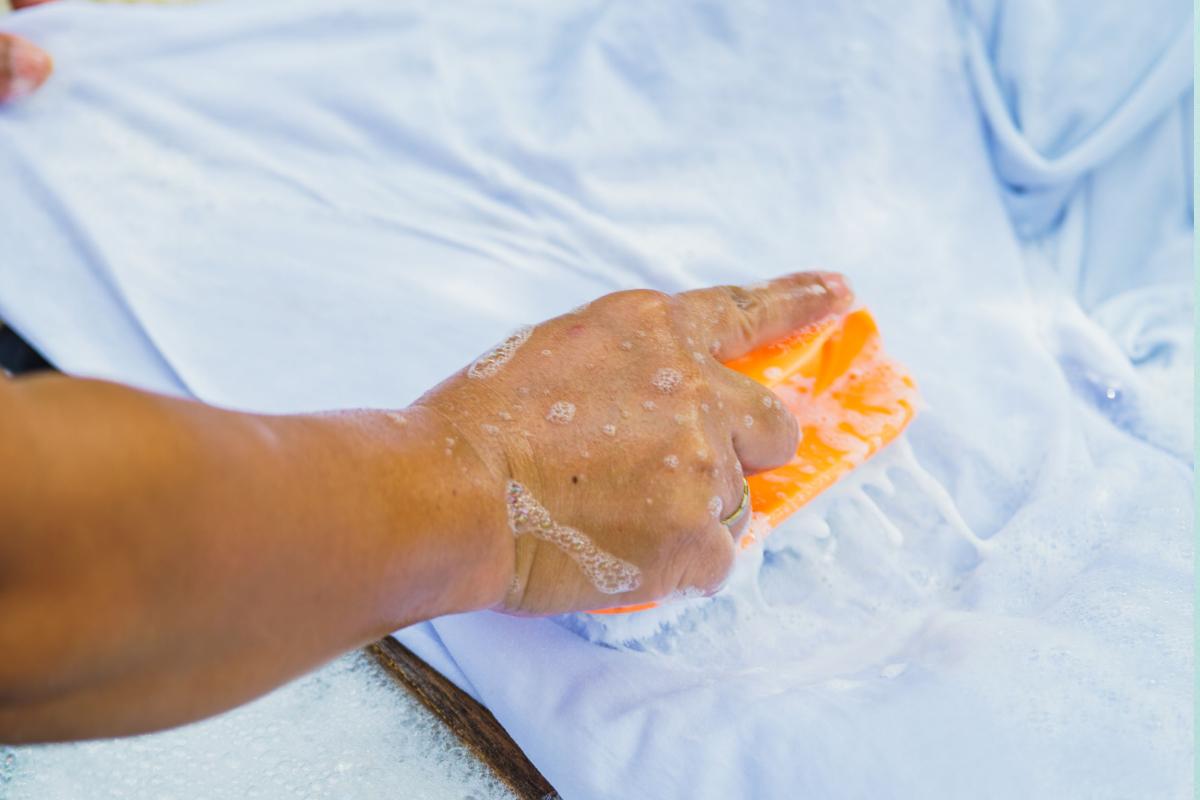
Old household guides have long offered home remedies for removing stubborn old stains from clothing, including makeup, sweat, blood and iodine, without always needing a trip to the dry cleaner. Regular washing often fails once marks like these have soaked deep into the fibres of a fabric, but a handful of simple kitchen and pharmacy ingredients are said to help, depending on the type of stain and the material involved.
According to old household recommendations, the right fix depends as much on the fabric as on what caused the mark in the first place. Different materials call for different treatments, and some mixtures are only suitable for certain colours or fibres.
Removing Makeup and Foundation Stains
For foundation marks on white cotton garments, old recommendations suggest applying ammonia and then rinsing thoroughly with water. Another option mentioned is a hydrosulfite solution, made by dissolving one teaspoon of the substance in a glass of water heated to 40 to 50 degrees Celsius, before washing the fabric well with water and detergent. The advice notes that the fabric's composition and colour need to be taken into account, since these methods do not suit every material.
Treating Sweat Stains Under the Arms
The right approach to stubborn yellow sweat stains also depends on the type of fabric. For cotton and linen, old guidance recommends a mixture of table salt or borax and ammonia, using one teaspoon of each per glass of water, followed by rinsing the area with water.
For old sweat stains on coloured wool, a mixture of four parts white spirit to two parts ammonia is suggested. White silk, meanwhile, is treated with a solution of hydrogen peroxide and water in a ratio of 1 to 10.
Getting Blood Out of Fabric
The key rule when dealing with blood is to avoid hot water, since heat sets the stain into the fabric. Fresh blood stains should first be rinsed in cold water and then washed in a soapy solution.
For old blood marks on white cotton and linen, the advice recommends a solution of ammonia, one teaspoon per glass of water, or borax in the same proportion. Hydrogen peroxide, at one to two teaspoons per glass of water, is also mentioned as an option. On wool, a hyposulphite solution of one teaspoon per glass of water is suggested instead, meaning the choice of treatment should match the material.
Lifting Iodine Stains
Two methods are suggested for iodine marks. The first involves repeatedly dabbing the stained area with milk before rinsing it in soapy water.
The second method dissolves 10 grams of hyposulphite in half a glass of water. This solution is applied to the stain until it disappears, after which the fabric is rinsed with warm water. Old household tips confirm that iodine stains can be removed from clothing using either of these approaches.
Other Common Household Stains
The advice also covers several other everyday stains. Fresh fruit and berry marks should be rinsed with water, while old stains on white items are treated with a citric acid solution of two teaspoons per glass of water.
Old tea stains are removed with a warm oxalic acid solution, at two to three teaspoons per glass of water. Coffee stains call for a mixture of one teaspoon of glycerin, one teaspoon of water and a few drops of ammonia. Rust marks are treated with lemon juice, ink stains with acetic acid, and grass stains with salicylic alcohol.
Before trying any of these methods, it is important to test the solution on a hidden part of the garment first. Some of the old recipes involve strong chemicals, so for delicate fabrics it is safer to take the item to a dry cleaner instead.
Test yourself
What should never be used when treating a blood stain, according to the advice?
How much hyposulphite is dissolved in half a glass of water to treat iodine stains?
What is recommended for removing rust stains from fabric?
Have your say
Would you try old home remedies to remove stubborn stains, or stick to commercial products?