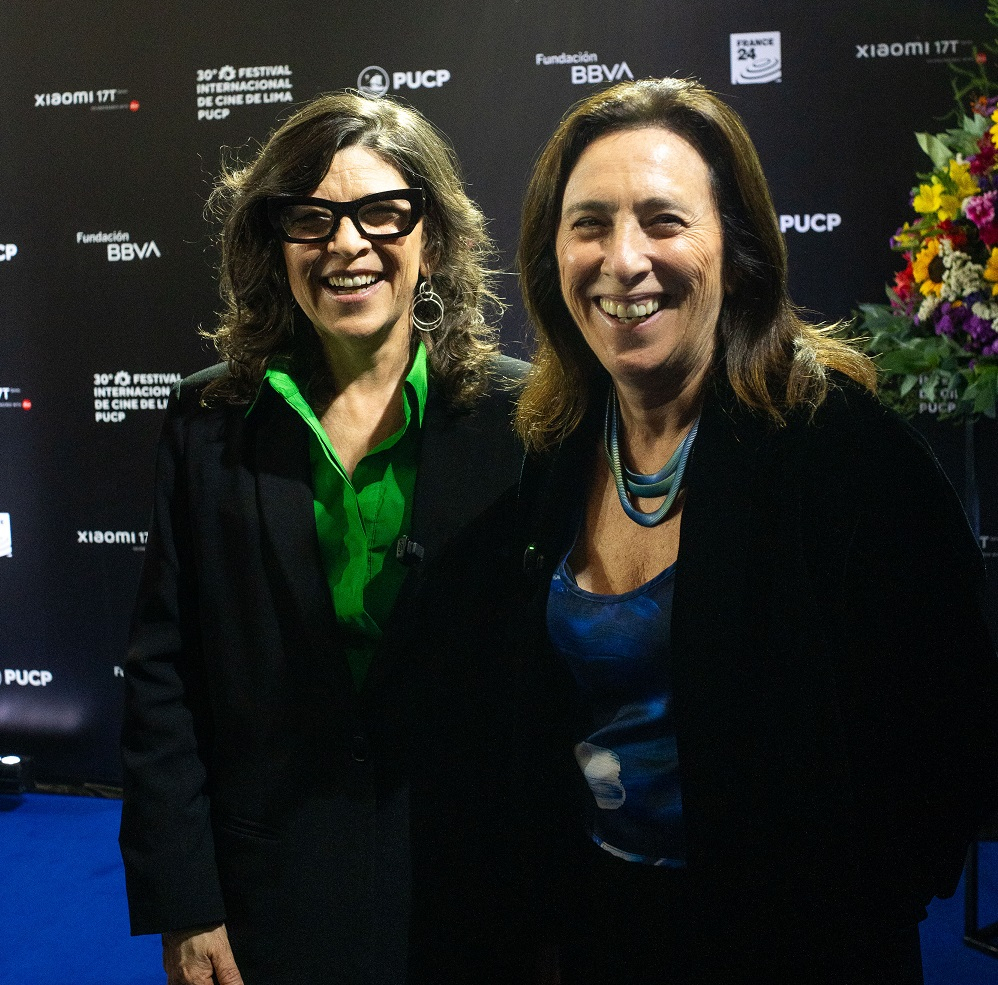
The Lima Film Festival 2026 opened its first weekend with a spotlight on Peruvian and foreign women filmmakers. Thursday's opening ceremony included an In Memoriam tribute to Argentine artist Ana María Teruel, who coordinated the festival for 25 years.
Minutes later, organizers played a video in which filmmaker Nora de Izcue honored the careers of Venezuelan director Mariana Rondón and Peruvian director Marité Ugás, the festival's honorees this year. De Izcue highlighted their work as screenwriters, directors and producers.
Accepting the festival's Spondylus trophy, Rondón said the festival had always supported their films and called that enormously important to them. She said she and her collaborators had long made films between Peru and Venezuela before she moved to live in Lima, and that a project with DAFO led them to begin mentoring young filmmakers from Peru's regions. She added that the experience had let her get to know Peru, and that she did not believe there was currently a more powerful or beautiful way to know a country. Rondón is one of the founders of Sudaca Films.
Ugás on Coproduction and Peruvian Cinema
Ugás, who co-directed Aún es de noche en Caracas with Rondón, stressed the importance of coproduction with other countries for filmmaking to continue. She said alliances between filmmakers protect their images, their imagination and their memory.
Referring to remarks she had made to La República about her nomination for the 2026 Platino Awards, Ugás addressed the difficult outlook for culture in Peru. She said that now more than ever they had to look after Peruvian cinema, arguing that culture is not a luxury but the place where society preserves its memory, its capacity for critical thought and its ability to imagine the future. She said a country that does not film itself risks losing its memory, and that the coming years would not be easy, but that storytelling, done faithfully and with care for memory, was what filmmakers knew how to do. Ugás closed her speech to applause, exclaiming her support for Peruvian cinema, Latin American cinema, women's cinema and queer cinema.
Reinventing Hamlet
Another highlight of the festival's opening weekend was Ser Hamlet, the debut feature by Chela De Ferrari. After the screening, the audience stood to applaud the cast, who were seeing the film on a cinema screen for the first time.
The documentary follows the creation and rehearsal process behind the stage production De Ferrari premiered in 2019. That Hamlet broke conventions with a free adaptation featuring a cast of actors with Down syndrome and became a successful production that represented Peru internationally.
De Ferrari said people had told her the actors would not be able to be on stage alone, that neurotypical actors would need to guide them. She said they decided that if there were mistakes, as could happen in any performance, they would trust that the cast would work through them, adding that trust was perhaps the most important word in the process.
One of the most emotional moments of the premiere came when Octavio Bernaza, who plays Claudio, asked cast members seated in the audience to stand. Some critics have said Ser Hamlet, like the stage production before it, is ready to represent Peru.
International Competition and What's Next
Among international entries, two films directed by women are competing this year and are seen as contenders for festival awards: the Mexican film Chicas tristes and the Argentine film Las corrientes.
In the national cinema section, Mauricio Freyre's Estados generales premieres today at 6:50 p.m. In the fiction competition, Daniel Vidal Toche's La anatomía de los caballos screens at 9:10 p.m. Both screenings take place at Teatro Nos.