

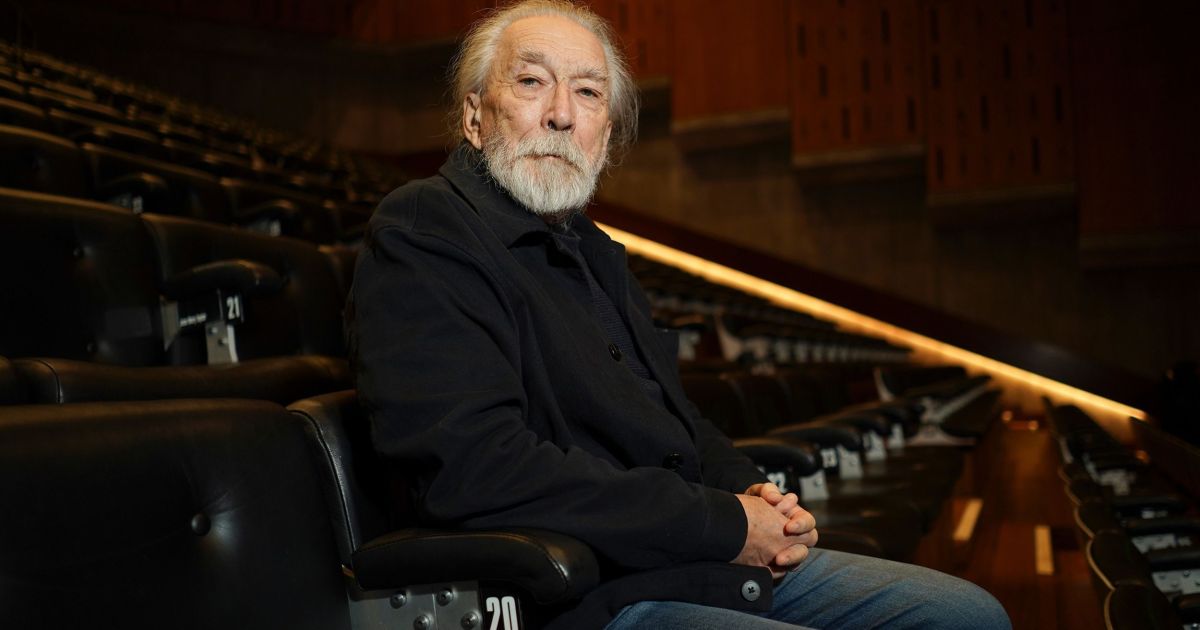
British author M. John Harrison has won the 2026 Booker Prize for his novel The End of Everything at a ceremony in London, becoming the oldest winner in the prestigious literary award's history at the age of 81.
Organisers announced the winner on Monday, November 9, at Old Billingsgate, the site of a former fish market on the River Thames in London. Harrison receives a £50,000 prize, equivalent to about 374,000 Brazilian reais.
Accepting the trophy, Harrison said that while people talk naturally about how their lives have changed, experiencing that shift in reality felt strange. The first-time nominee added that he finally felt like a real writer, even though he still lacked confidence completely.
Harrison prevailed over five other shortlisted authors, upsetting the bookmakers' favourites, former Booker winners Marlon James and Douglas Stuart.
The End of Everything plot and themes
At 198 pages, The End of Everything was the most concise of the six books on the 2026 shortlist. The post-apocalyptic novel is set in the not-too-distant future in the English coastal town of Dalston-on-Sea during an occupation by mysterious lifeforms called the iGhetti.
The story is told mainly from the perspective of Phillip Tennent, a beachcomber who recovers a biological artefact discarded into the sea by the invaders. Because the origins, intentions, and activities of the visitors remain largely ambiguous, many critics have treated the novel as an allegory for artificial intelligence.
Harrison, however, stated that he conceived the book before the boom in generative artificial intelligence. Speaking to BBC radio, the author said the real-world event that inspired the plot was the 2008 global financial crisis.
In a question-and-answer feature published before Monday's announcement, the judges wrote that Harrison's book could be read as a thriller, a mystery, a satire, a dystopia, a road novel, or a work of realism. They added that readers could find whatever they were looking for in the book, even if told obliquely and with a twist.
2026 Booker Prize judging panel
This year's judging panel was chaired by British historian and classicist Mary Beard, a professor at the University of Cambridge known for her scholarship on ancient Rome. She led a five-member panel that reviewed 163 submissions before narrowing the field to a longlist of 13 books and a shortlist of six finalists announced in September.
Joining Beard on the panel were writers Raymond Antrobus and Patricia Lockwood, literary critic Rebecca Liu, and musician Jarvis Cocker, frontman of the British band Pulp. Old Billingsgate, where the judges unveiled their choice on Monday evening, is a Grade II listed Victorian building in central London that operated as the capital's fish market until 1982.
Science fiction milestone and M. John Harrison career
Harrison's triumph can be regarded as the first time a science fiction novel has won the Booker Prize. Although the 2024 winner, Samantha Harvey's Orbital, takes place aboard a space station, that philosophical novel is more ambiguous in its genre categorisation. Regardless, the 2026 decision marks a rare honour for science fiction and recognises an author who has published in the field for more than five decades.
Born Michael John Harrison in 1945, he emerged in the late 1960s as a central figure in the British New Wave of science fiction. He began his acclaimed Viriconium series in 1971, set on a futuristic Earth, and continued writing about the fictional city across novels and short stories until 1984.
Among his later works, Harrison completed the three-volume Kefahuchi Tract space opera trilogy between 2002 and 2012. This year marked his first nomination for the Booker Prize.
2026 Booker Prize shortlist and isolated characters
The six-book shortlist included new fiction from two former winners backed by bookmakers as the leading contenders. Jamaican writer Marlon James, who won in 2015 for A Brief History of Seven Killings, was shortlisted for The Disappearers, while Scottish-American author Douglas Stuart, the 2020 winner for Shuggie Bain, was a finalist with John of John.
The other shortlisted novels were Black Bag by Luke Kennard, The Things We Never Say by Pulitzer Prize-winning author Elizabeth Strout, and May We Feed the King by Rebecca Perry.
Before Monday's ceremony, Booker Prize Foundation chief executive Gaby Wood said in a statement on the award's official website that the six finalists were united by a central question: what people can know about one another, what they infer or assume, and what they are willing to see.
Wood said that despite the wide variety of styles and themes, all six novels explored forms of isolation, featuring relationships that fall apart or remain secret, people holding on to secrets or pain, and characters who either isolate themselves or try to reach beyond their loneliness toward others.
Booker Prize history and age records
First awarded in 1969, the Booker Prize was originally open only to writers from the United Kingdom, Ireland, or Commonwealth nations. Beginning with the 2014 edition, eligibility expanded to include English-language authors of any nationality, provided the nominated work is published in the United Kingdom or Ireland markets.
Its sister award, the International Booker Prize, honours a work of fiction translated into English. Last year's Booker Prize went to David Szalay for Flesh, a concise novel charting a taciturn Hungarian immigrant's journey from poverty to the upper echelons of London society.
Other notable past winners include Salman Rushdie, William Golding, Ian McEwan, Arundhati Roy, and Kazuo Ishiguro. Canadian writer Margaret Atwood previously held the record as the oldest author to win when she was honoured at the age of 79 for The Testaments, sharing the 2019 Booker Prize with Bernardine Evaristo, author of Girl, Woman, Other.