The Museu de Arte de São Paulo (MASP) opened two new exhibitions on Friday, November 27, the final shows of its annual calendar dedicated to Latin American histories. Both will remain on view until April 4, 2027, in the museum's Edifício Lina Bo Bardi.
The two shows, Jesús Soto: Obra aberta and Manuel Herreros e Mateo Manaure: Mi nombre es Venezuela, approach Venezuelan art from very different angles: one through physical movement in space, the other through the recovery of memories from Caracas's trans nightlife scene in the 1980s.
Largest Soto show in Brazil in decades
On the museum's second basement level, Obra aberta is the largest exhibition dedicated to Jesús Soto (1923-2005) in a Brazilian museum in more than two decades. Curated by Adriano Pedrosa and Mateus Nunes, it brings together about 40 works and archival material produced between the late 1940s and the 1980s, tracing Soto's path from his early geometric paintings to installations that extend off the wall and into the space for visitors to walk through.
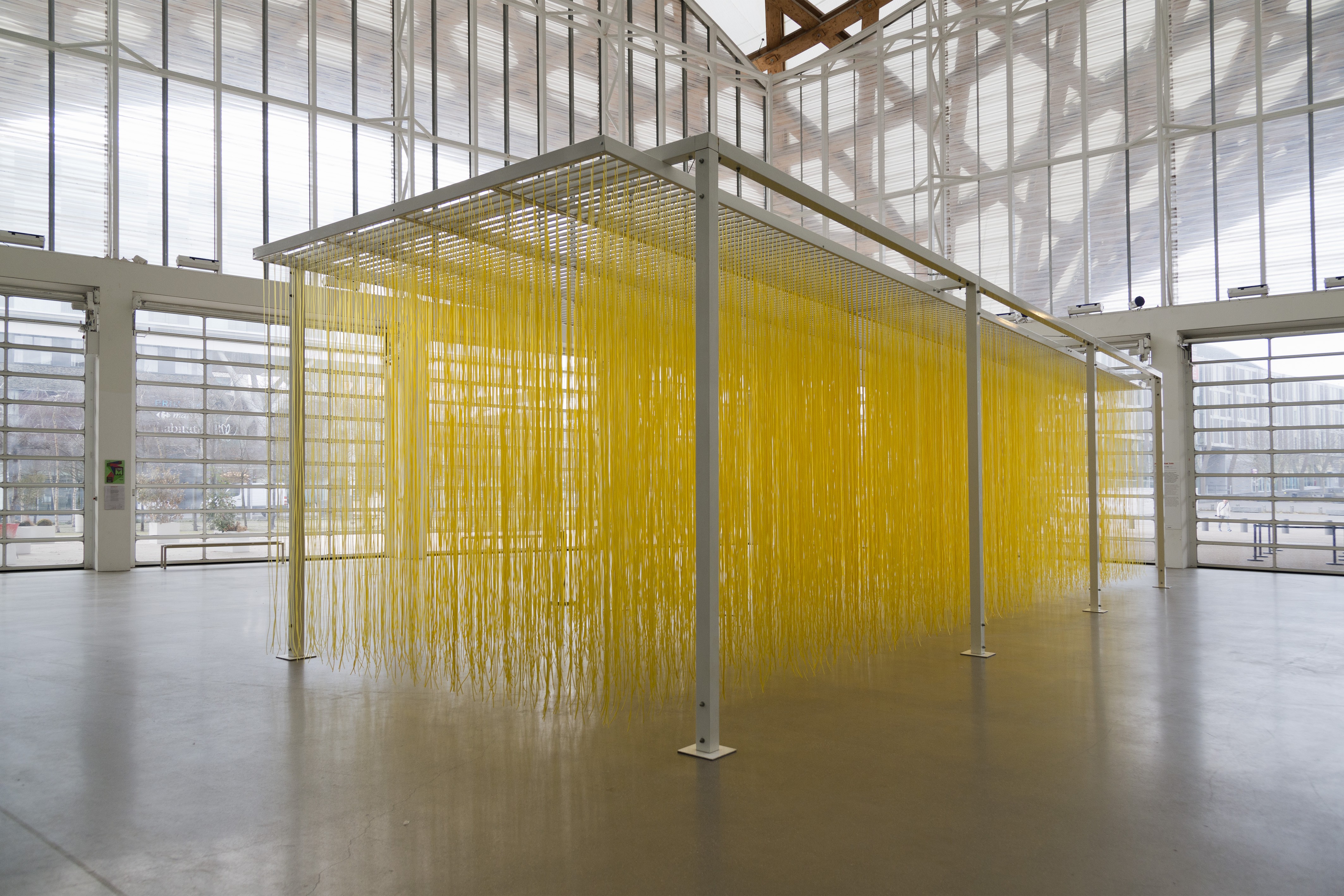
Visitors entering the gallery are met first by the show's centerpiece, the immersive installation Pénétrable BBL Jaune (1999). Made of thousands of flexible yellow PVC tubes suspended from a metal structure, the work arrives in São Paulo at its maximum dimension, 14 meters long, a scale that has not been assembled since 2018, in France. Visitors walk through the piece and activate it with their own bodies, a work the exhibition links directly to Hélio Oiticica's Penetráveis and Lygia Clark's Bichos, two landmark series by Brazilian artists associated with the country's Neo-Concrete movement.
The exhibition also explains how Soto created optical illusions without using motors, relying instead on the shift of the viewer's gaze. For the first time, it displays a piece from MASP's own collection, Disco em movimento (1935-65) by Marcel Duchamp, the French-born pioneer of conceptual art with whom Soto exhibited in Paris in 1955.
A rare film on Caracas's trans nightlife
One floor up, on the first basement level, Mi nombre es Venezuela approaches the country's history through film and photography. Curated by Glaucea Helena de Britto and Matheus de Andrade, the exhibition marks the Brazilian premiere of TRANS (1982), a 22-minute documentary short directed by Venezuelan filmmakers Manuel Herreros and Mateo Manaure. The film is shown alongside a previously unseen set of 75 photographs taken during its production. All of this material was donated to the museum's collection last year.
Filmed in Caracas in the early 1980s, during an oil boom that was modernizing the city while repressing minorities, the short follows the nightly lives and shows of trans women and female impersonators in neighborhoods such as Sabana Grande and El Rosal. The exhibition's title comes from a line spoken by one of the film's subjects, who said her name was Venezuela, that she was a transformista, that she worked in that nightclub, and that it was her means of living, but not her purpose in life.
A film silenced, then restored
According to MASP, the short's first screening at Venezuela's National Cinematheque ended when police arrived to detain the participants. The film then spent decades almost inaccessible before it was restored.
In the MASP gallery, the intimate testimonies of the film's protagonists and the street portraits taken of them are displayed alongside interviews with figures representing the conservatism of that era, including a police officer, a psychiatrist and a priest.
Visiting information
Both exhibitions run at MASP's Edifício Lina Bo Bardi, at Avenida Paulista, 1578, in the Bela Vista neighborhood of São Paulo, from November 27, 2026, to April 4, 2027. The museum is open Tuesdays from 10 a.m. to 8 p.m. with free admission, Wednesdays and Thursdays from 10 a.m. to 6 p.m., and Fridays from 10 a.m. to 9 p.m. with free entry between 6 p.m. and 8:30 p.m. Weekend hours are 10 a.m. to 6 p.m. on Saturday and Sunday, and the museum is closed on Mondays.
What happens next
Both exhibitions remain on view at MASP's Edifício Lina Bo Bardi until April 4, 2027.
Test yourself
How many kinetic works does the Jesús Soto retrospective include?
What is the length of the Pénétrable BBL Jaune installation shown at MASP?
Which film makes its Brazilian premiere in the Mi nombre es Venezuela exhibition?
Have your say
Which of MASP's new exhibitions interests you more?
Where it happened
São Paulo, Brazil