Personal trainer Nerea Povedano is recommending a move many women skip in their workouts: the lateral lunge with balance, an exercise that combines strength, coordination and body control in a single movement. Povedano, a coach with Entrena Virtual, says the combination becomes especially useful once women turn 40.
"From the age of 40 it is especially worthwhile to include exercises that work not only strength but also stability, coordination and body control," Povedano said.
Unlike a traditional squat, the lateral lunge sends the body sideways before it stabilizes on one leg. Povedano stressed that the move does not replace squats or forward lunges. Instead, it complements them by training capabilities that tend to get neglected in a typical routine.
Strengthens legs, glutes and abs without crunches
The exercise can look like it only targets the legs and glutes, but Povedano said it carries a less obvious benefit. Stepping sideways engages the quadriceps, the adductors and the glutes, while the hip and ankle work to keep the body stable.
The abdomen is involved too, according to Povedano. "The abdomen also works, even though we are not doing traditional crunches," she said. When one knee lifts and the body holds steady on the other leg, the core muscles switch on to keep the torso stable through every repetition, stopping the body from losing its balance or posture.
Holding that balance pause also trains proprioception, the ability to sense where the body is positioned in space. Povedano said this makes the lateral lunge a way of building strength and coordination at the same time.
How to do the lateral lunge with balance correctly
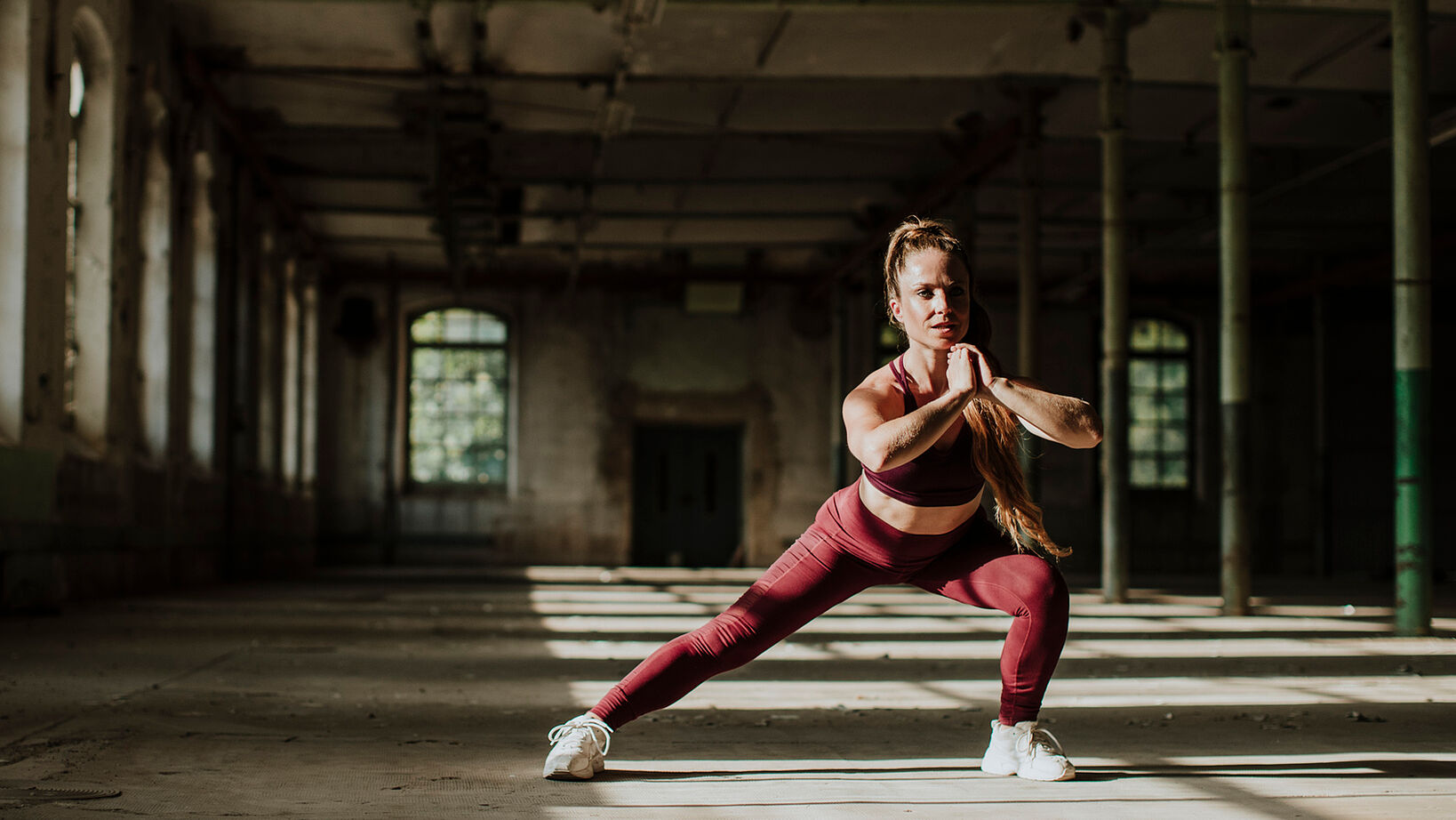
Povedano's technique starts with standing with the feet hip-width apart and the abdomen braced. From there, take a wide step to one side, bend the knee of that leg and push the hips back, while keeping the other leg straighter. Then push off the floor to return to the centre.
The move differs from a standard lunge at the finish: instead of placing the foot back down, the knee lifts and the body holds its balance on the opposite leg for one or two seconds.
Povedano said the repetitions should not be rushed. "My recommendation is to always prioritize the quality of the movement over speed or the number of repetitions," she said. She advised against letting the knee drift inward, rounding the back, or taking steps that are too long.
How many reps to do and how to adapt the exercise
The exercise requires no weights, machines or much space. Povedano suggests beginning with 2 to 3 sets of 8 to 10 repetitions per side, 2 or 3 days a week, leaving enough recovery time between sessions. The balance position should be held for 1 or 2 seconds.
For anyone who struggles to hold their balance on one leg, Povedano suggested doing the lunge without lifting the knee, or holding onto a chair for support.
If someone feels discomfort in the knees, Povedano recommended reducing the width and depth of the step, as long as the movement still feels comfortable. "There is no need to complicate exercises for them to be effective," she said. Once the technique is mastered, she said people can increase the time spent with the knee raised or add a light dumbbell, depending on their fitness level.
Why training balance at 40 helps you age better
Working on balance is not something to put off until after 60, according to Povedano. Muscle strength, proprioception and balance can all change with age. In women, perimenopause and menopause can also contribute to a loss of muscle and bone mass, particularly without enough strength training.
That is why Povedano said combining strength exercises with movements that demand coordination can be especially useful. The lateral lunge with balance helps train body control and preserve future mobility, she said.
"It is never too late to start working on strength and balance, but we also should not wait until we lose them to start taking them seriously," Povedano said.
Test yourself
According to Nerea Povedano, what muscle group works during the lateral lunge even without doing crunches?
What does Povedano recommend prioritizing when doing the exercise?
How long should the balance position be held, according to Povedano's guidance?
Have your say
Do you include balance exercises in your workout routine?