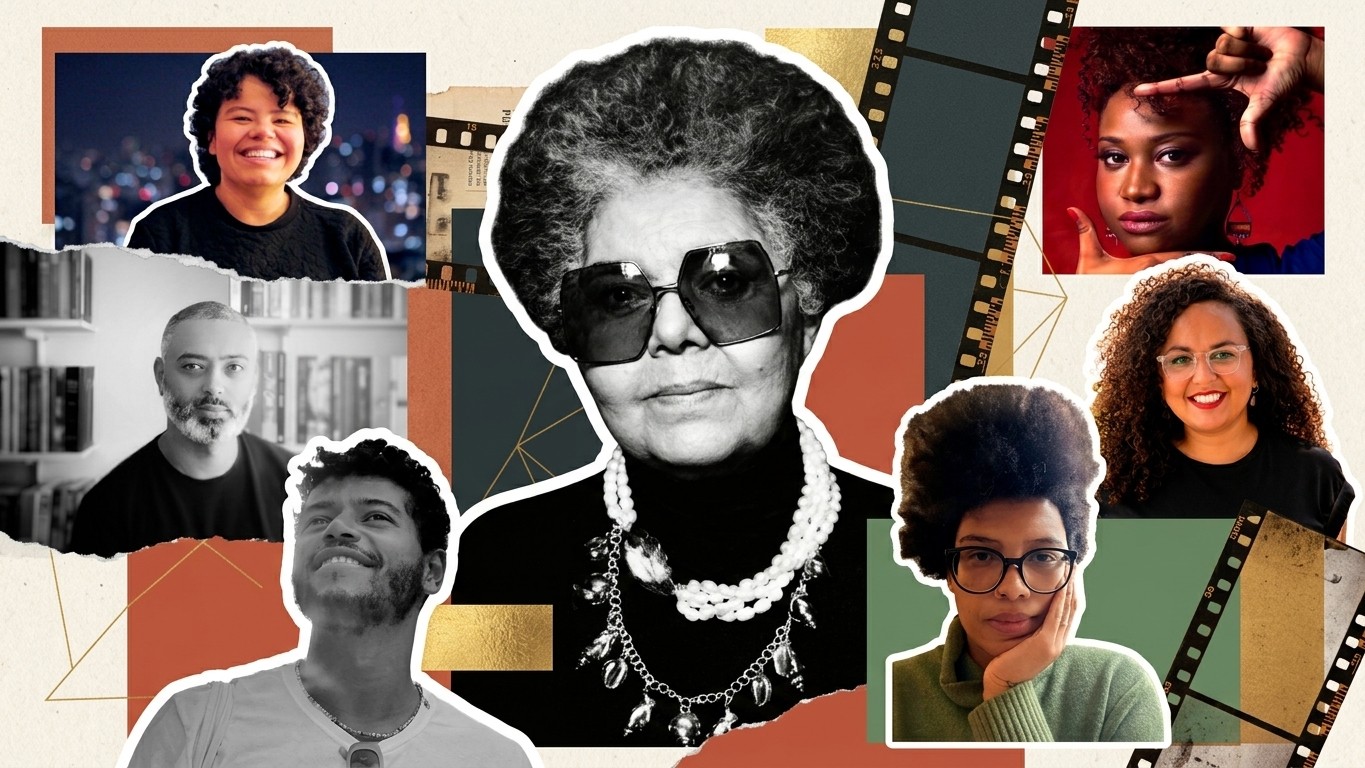
Seven Black professionals working in Brazilian film and television, including screenwriter Carol Rodrigues and director Fernanda Salgado, told Vogue that a new wave of Black-led stories is reaching screens, but that real power in the industry, over budgets and final decisions, remains almost entirely out of reach.
Recent Brazilian releases have put Black families, grief and complex relationships at the center of the frame, including Nosso Segredo, the feature directing debut of Grace Passô, Vicentina Pede Desculpas by Gabriel Martins, and Feito Pipa by Allan Deberton. On streaming, the series AYÔ, created and written by and starring Lucas Oranmian with Yasmin Thayná as general director, just premiered on Globoplay and follows a young Black, gay artist navigating his desires and career.
Fighting for Fully Written Characters
Henrique dos Santos, screenwriter of the award-winning Deserto Particular, said the conversation has moved on from proving Black stories can draw an audience. The current fight, he said, is making sure Black characters get real depth even when they are not the lead. He said that when a Black character is not in a starring role, there is usually little room to develop them with any depth, and that space has to be fought for.
Dos Santos said Black professionals are still called in almost exclusively for projects built explicitly around race, a pattern he called a trap that narrows the market. He said Black writers want to keep telling stories tied to their own existence, but do not want to be limited to only those stories, and that doing so shrinks the opportunities available. He added that beyond being Black screenwriters, they are simply good screenwriters who can write about anything.
The Right to Comedy and Fantasy
Director and screenwriter Sabrina Fidalgo, known for Black Berlim, Personal Vivator and the recent O Projeto, has long mixed humor, fantasy, archival footage and social critique rather than sticking to one register. She said the term "Black cinema" brought visibility to work the market was slow to recognize, while people rarely talk about "white cinema," and that it is worth asking who is automatically included in the broad idea of Brazilian cinema and who is still treated as a niche.
Fernanda Salgado, director of Ana, en passant, the first animated feature directed by a Black woman to reach Brazilian commercial screens, said she was repeatedly asked why she wanted to tell her story through animation while seeking funding. Her answer, she said, was simply: why not? She pointed to earlier genre-breaking works, including Branco Sai, Preto Fica by Adirley Queirós, Patakki by Everlane Moraes, Negrum3 by Diego Paulino, and the animated shorts Òrun Àiyé: A Criação do Mundo and Òpárá de Òsùn: Quando Tudo Nasce, arguing that the imagination and references already exist and what is missing is fertile ground and access to resources.
Elton de Almeida, who works between writers' rooms in Brazil and Los Angeles, said Brazilian Black creators are often pushed toward racial conflict or urban violence, while in the United States there is a strong tradition of Black comedy, from Living Single to Abbott Elementary, though horror, fantasy and prestige drama remain harder to access. He said African Americans hold far more economic and political power than Brazil's Black population, which helps explain the larger number of middle and upper-class Black characters in American productions.
The Gap at the Top of the Industry
Carol Rodrigues, a screenwriter and former creative executive at Amazon Studios now directing her first feature, Criadas, said the market hides behind financial caution to avoid "untested" narratives. She said there is a perversity in that logic, since the market uses the absence of precedent to justify an exclusion it created itself, pointing to global hits like Black Panther and Get Out as proof Black stories can turn a profit. She said the idea of a "niche cinema" is manufactured by a lack of investment in distribution and marketing, arguing it is not enough to make a film and then claim there is no audience if nothing was spent letting that audience know it exists.
Figures bear out the imbalance. A survey by the Association of Black Audiovisual Professionals (APAN) found Black people, despite being the majority of Brazil's population, make up less than 35% of the sector's formally employed workforce, and just 32.6% in broadcast television against 65% for white professionals. National Film Agency (Ancine) data on projects funded by the Audiovisual Sector Fund between 2018 and 2022 show white professionals held 87% of lead director roles and 89.3% of lead screenwriting credits, against 11.4% and 8.7% for Black professionals. For budgets above 5 million reais, 92.8% of directors were white, and Ancine reported white and Asian professionals earn over 6,000 reais on average compared with under 4,000 reais for Black and mixed-race professionals.
Dos Santos said both Brazil and Hollywood suffer the same core problem: the absence of Black people at the top of the pyramid, locked out of channel leadership and executive roles that decide which stories get told and funded. He said Brazilian screenwriters are usually kept away from final budget and editing decisions, unlike American showrunners who combine creative and executive production control. He also warned of a recent pullback after a diversity boom between 2019 and 2022, saying non-white creators were among the first to lose ground as the streaming bubble burst, and that inclusion is treated as a trend rather than structural change while leadership stays mostly white.
Money, Region and Memory
Since 2024, the Audiovisual Sector Fund has reserved at least 15% of competitive funding for production companies majority-owned by Black people, benefiting 47 qualifying projects. Labibe Araújo, a partner at a production company in Minas Gerais and director of the documentary As Benzedeiras, said decentralizing funding is not only about splitting money between regions but about who gets a say in decisions and which local structures are strengthened. She said irregular funding calls block independent producers from growing sustainably, and called for continuous public policy rather than one-off opportunities. She added that after filming, the next hurdle is reaching audiences without flattening stories rooted in memory and popular culture, and credited APAN's political work in pushing for that space.
A Pioneer Looks Back
In 1984, during Brazil's military dictatorship, Adelia Sampaio became the first Black woman to direct a fiction feature with a commercial release in the country, Amor Maldito. Now 82, she recently saw her short film Agora um Deus Dança em Mim, lost for more than four decades, restored, and published her first children's book, Voos e Sonhos de uma Borboleta.
Sampaio said she has seen many Black actors on television but that Black filmmakers in cinema still have far to go, calling money the persistent problem and describing progress as minimal. While working as a telephone operator at the production company Difilm among Cinema Novo figures, she was seen only in an administrative role, and found support from Zózimo Bulbul, a pioneer of Brazilian Black cinema. To get Amor Maldito, a drama about love between two women, released in the 1980s, she agreed to let an exhibitor market it as softcore exploitation after he told her it was that or nothing. The gamble worked, and praise from critic Leon Cakoff kept the film running for three months in São Paulo.
She is now preparing a feature, A Barca das Visitantes, drawn from her own memories visiting her ex-husband, a political prisoner held on Ilha Grande, and still shoots shorts on her phone with longtime friends. She said she helps whoever she can whenever possible and cannot stay quiet.
Rodrigues said what is at stake is not filling one empty seat but redesigning the whole room. She said the problem was never a lack of talent, and that Black creators do not just want a place inside an industry that has historically excluded them, but want to help transform how that industry produces, distributes and imagines the world.
Test yourself
According to Ancine data cited in the article, what share of lead director roles on 2018-2022 Audiovisual Sector Fund projects went to white professionals?
What film made Adelia Sampaio the first Black woman to direct a commercially released fiction feature in Brazil?
What is Ana, en passant notable for, according to Fernanda Salgado?
Have your say
Should Brazil's film and TV funding require minimum quotas for Black-led production companies?
Where it happened
Rio de Janeiro, Brazil