

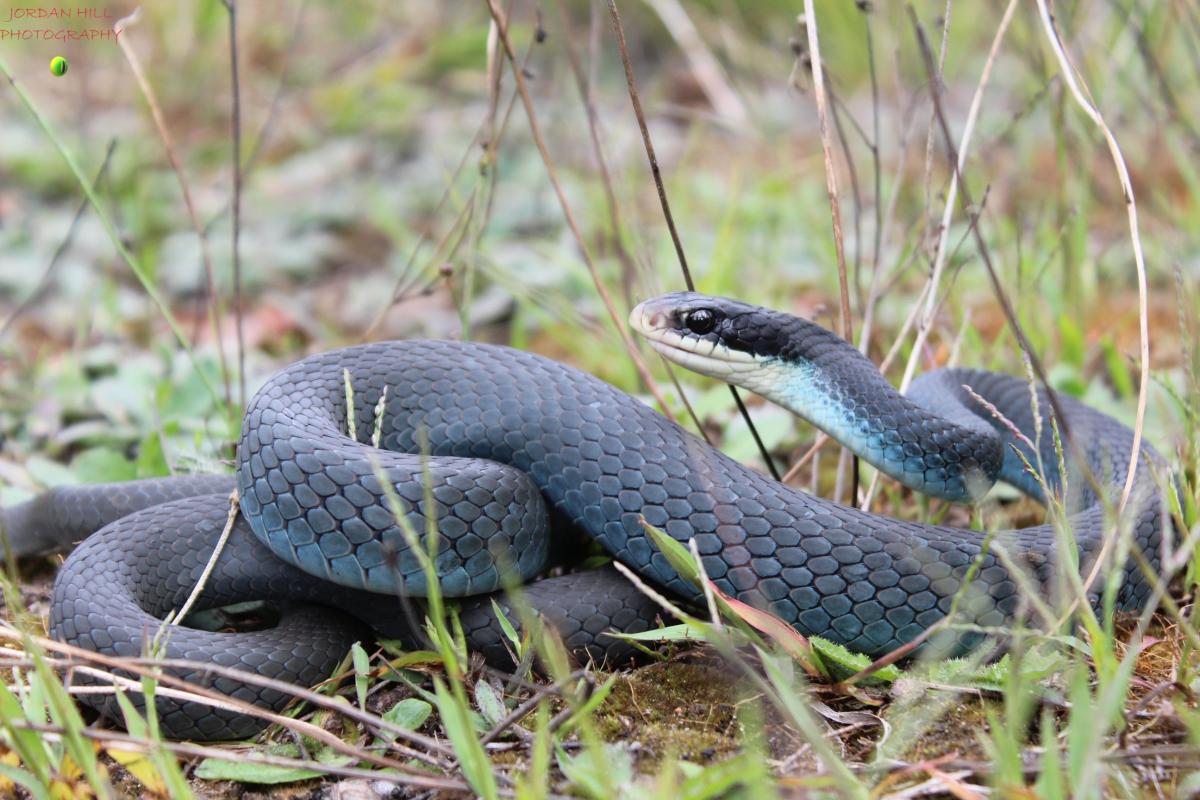
Blue racer snakes across North America are suffering population declines as habitat loss, land degradation, and human conflicts shrink their traditional living spaces.
According to Discover Wildlife, the non-venomous reptile remains vulnerable across several regions despite not being officially listed as an endangered species in Michigan. While the broader eastern racer species holds a status of least concern on the International Union for Conservation of Nature Red List, individual subspecies such as the blue racer have not been independently evaluated. In Michigan, the snake is becoming increasingly difficult to find, though some population growth has been recorded in the northern section of the Lower Peninsula.
Scientifically classified as Coluber constrictor foxii, the blue racer is one of 11 recognized subspecies of the eastern racer endemic to North and Central America. The harmless snake reaches lengths of up to two meters, with certain individuals growing even larger. It features a slender grayish-blue body, whitish belly scales, and a distinctive white and gold facial mask. Two preocular and two postocular scales encircle its eyes.
Behavior and defense mechanisms
Despite their imposing length, blue racers are fast, timid, and entirely harmless to humans. When threatened, the snake shakes its tail against dry leaves to mimic the sound of a venomous rattlesnake. Young blue racers are frequently mistaken for fox snakes, while mature adults are often confused with other racer species. Wildlife experts emphasize that the snakes are not poisonous and should be left undisturbed in the wild.
The natural range of the blue racer extends across the Midwestern United States and parts of Canada. Populations inhabit the entire Lower Peninsula of Michigan, the southern tip of the Upper Peninsula, northern Indiana, Illinois, and sections of Minnesota, Wisconsin, and Iowa. In Canada, the species is found at the southernmost edge of Ontario on Pelee Island in Lake Erie.
Blue racers prefer dry environments that offer ample sunlight and protective cover. Their typical habitats include open woodlands, grassy fields, old farm pastures, brush thickets, and marshes. Although primarily ground-dwelling animals, they frequently climb vegetation and search for prey above the ground.
Diet, predators, and breeding cycle
As diurnal hunters, blue racers search for food during daylight hours, allowing them to shelter at night when nocturnal predators emerge. Hatchling blue racers feed mainly on crickets, beetles, and grasshoppers. As they mature, adult snakes prey on rodents, frogs, other snakes, and small birds. In turn, they are hunted by birds of prey, raccoons, coyotes, and foxes.
The snakes emerge from a long winter hibernation to begin their breeding season, which runs from April through May. During this period, male blue racers engage in physical combat over territory. Females lay between five and 26 eggs in June, selecting sheltered and protected locations. The young hatch between August and September, emerging at lengths between seven and 12 inches.
Other wildlife observations
In related wildlife reporting, giant tortoises continue to survive on a select group of tropical islands, including the Galapagos Islands, Mauritius, and the Aldabra Atoll in the Seychelles. Reaching weights of up to 300 kilograms and lengths of 1.3 meters, these reptiles represent some of the oldest living land animals. Although Pacific and Indian Ocean giant tortoises share similar physical sizes, the two populations are not closely related and evolved their large bodies independently.


