


Reporter Marina Ros has evaluated five wardrobe organizers designed to eliminate closet clutter across drawers and shelves, testing fabric dividers and plastic towers.
Closet disorder typically develops in two specific locations: inside drawers where small items become mixed together, and on open shelves where up to 40 centimeters of vertical space remains unused.
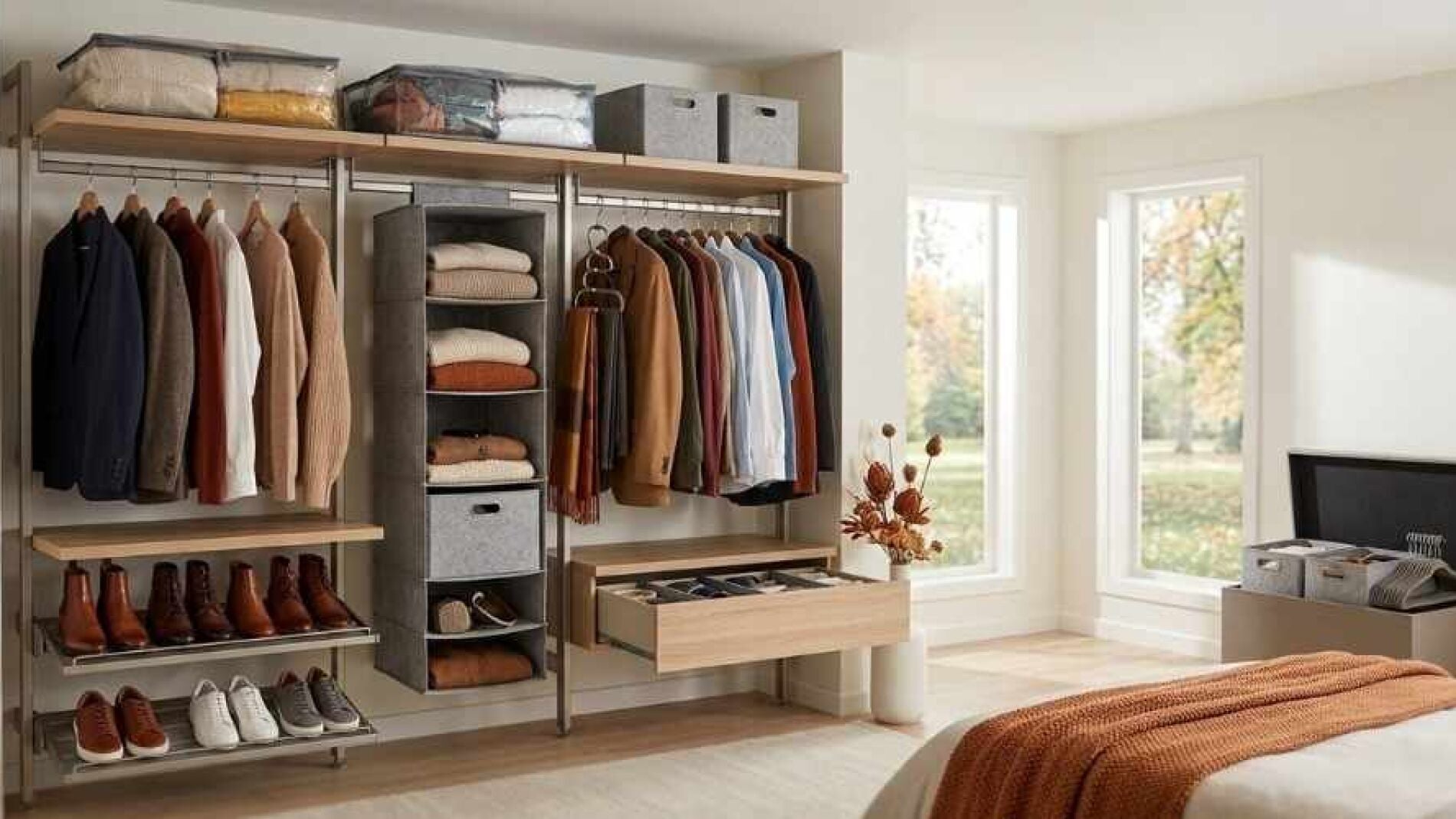
According to Ros, consumers rarely purchase closet organizers out of preference. Instead, purchases usually occur when a stack of sweaters topples over when removing a lower item, or when homeowners notice roughly two hand-spans of unoccupied air between folded garments and the shelf above.
The evaluation splits the five products into two functional categories. Fabric dividers from Vtopmart and DIMJ target drawer interior division, while plastic structures from Lifewit, SONGMICS, and RMAN focus on building vertical storage height on shelves.
Drawer Organizers with Fabric Dividers
Inside standard drawers, volume is rarely the primary issue. The main cause of clutter is item mixing, as socks, underwear, scarves, and neckerchiefs share an undivided rectangular box and return to chaos within two weeks.
Ros noted that low, soft fabric boxes provide effective internal walls. These flexible containers adjust to available drawer space and can be removed completely to select clothing without creating disarray.
Vtopmart Twelve Piece Drawer Divider Set
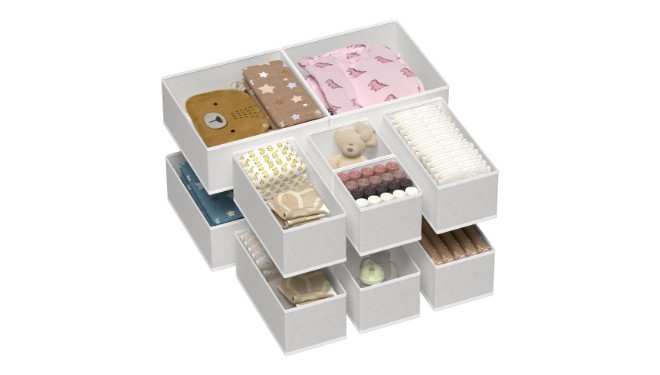
The Vtopmart system arrives as a 12-box package distributed across three distinct sizes. The set includes four large boxes measuring 28 by 28 centimeters for T-shirts or pajamas, four rectangular boxes measuring 28 by 14 centimeters for underwear, and four small boxes measuring 14 by 14 centimeters capable of holding paired socks for an entire season.
A key specification is the container height of 11.5 centimeters. This measurement allows boxes to reach near the upper rim of standard drawers, enabling clothing to be stored vertically on edge. This layout ensures every garment is visible immediately upon opening the drawer, replacing traditional layered stacks.
Plastic reinforcements built into all four side panels prevent the boxes from buckling inward when half empty. The non-woven fabric material can be cleaned using a damp cloth, and a bottom zipper allows unused units to fold completely flat. Ros pointed out that the actual grey fabric is darker than depicted in product photos, appearing close to graphite.
Lifewit Stacking Plastic Shelf Boxes
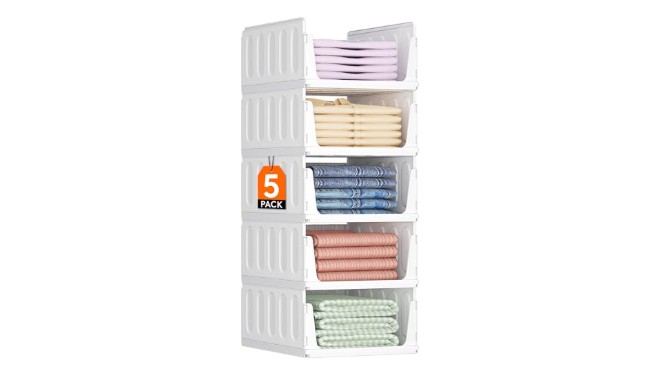
The Lifewit system addresses open shelf space, where a typical pile of folded T-shirts measures about 20 centimeters high while shelf gaps span 30 to 40 centimeters. Without rigid storage, upper air space goes unused.
Each Lifewit box offers a 24-liter volume capacity, measuring 32 by 42 by 17.7 centimeters. Made from white polypropylene, the units support up to three kilograms per box. The manufacturer equates this weight capacity to roughly 15 T-shirts, three to four sweaters, or four to five pairs of jeans.
Units assemble manually within two minutes without tools, securing fixed side panels in place. Interlocking slots keep stacked towers stable, while internal buckles create a front stop that prevents sliding trays from pulling entirely out onto the floor.
Ros observed an operational limitation with the Lifewit design. Because trays slide out partially, users must hold the upper tower steady with one hand while pulling out a lower tray with the other. This maneuver works well for seasonal clothing accessed twice a week, but can become cumbersome for daily items.
DIMJ Shallow Drawer Organizers
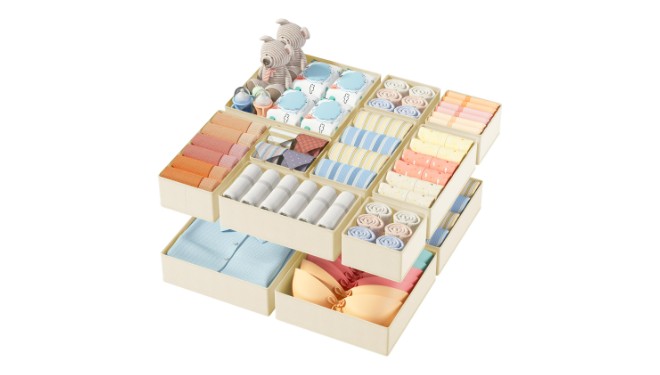
The DIMJ organizer set is engineered for shallow drawers located outside main wardrobes, such as nightstands, desk drawers, or antique dressers where 11 or 12-centimeter boxes create friction when closing.
Featuring a reduced height of nine centimeters, the 12-piece DIMJ set repeats the three-size format. Large units measure 30 by 30 centimeters, while medium units measure 30 by 15 centimeters. The entire set has a combined weight of 1.2 kilograms.
The system utilizes a double-stitched diagonal zipper that runs smoothly without catching on fabric edges. Ros highlighted that this closure detail proves advantageous when drawers are opened frequently, such as containers holding baby clothing that may be accessed up to 20 times a day.
Constructed from cardboard reinforcement wrapped in breathable, hypoallergenic non-woven fabric, the set is available in nine colors ranging from beige to pink and black.
SONGMICS Vertical Compartment Organizers
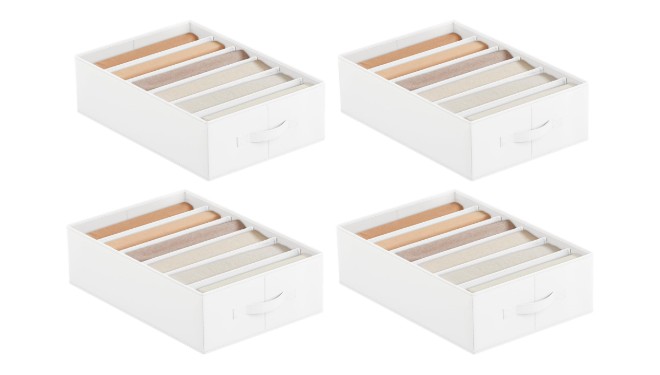
The SONGMICS model introduces a distinct internal structure not found in the other four products. Each container measures 42 by 30 by 17 centimeters and contains six vertical compartments measuring approximately seven centimeters in width.
This compartment layout is designed to hold trousers, jeans, and rolled sweaters vertically, functioning like folders in a file cabinet. Removing an item leaves adjacent garments intact rather than disturbing a stacked pile.
Built from 80-gram fabric, the containers feature cardboard reinforcement on both side walls and the base panel to prevent inward collapsing when pulling garments. A front handle enables users to pull the entire organizer off high shelves to select clothing at eye level.
The product comes in a set of four stackable, foldable units. Ros noted that SONGMICS is the only model among the five currently offering a discount, though the price reduction is modest compared to recent weeks.
RMAN Sliding Rail Wardrobe Boxes
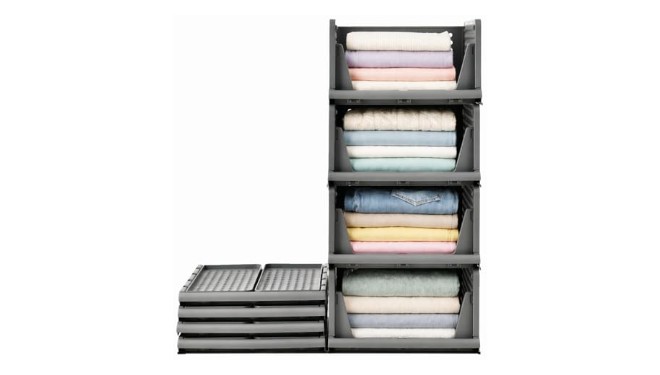
The RMAN organizer set comprises four rigid polypropylene containers measuring 40 by 30 by 17 centimeters. Each box features a base mounted on sliding rails, allowing trays to pull forward smoothly like furniture drawers even when other units are stacked above them.
This rail mechanism eliminates the need to disassemble stacked towers when accessing lower containers, which often hold lesser-used garments. The rigid, recyclable plastic structure maintains shape under heavy loads of sweaters without buckling the bottom box.
Assembly requires no tools, and surfaces clean with a cloth. When seasonal storage ends, containers fold flat. Ros noted that RMAN units require enclosure between closet walls to remain stable; on smooth parquet floors without side support, the outer frame moves when pulling the drawer tray. Available color options include grey, white, and multicolored sets.
Choosing Between Fabric and Plastic Mechanics
While all five products organize clothing, operational differences emerge during retrieval. According to Ros, the deciding factor depends on whether an organizer must support weight on top while opening.
When no weight rests on top of the container, soft fabric options provide superior flexibility. Fabric boxes adapt to drawer contours, add minimal weight, fold flat when empty, and can be removed entirely onto a bed. This category includes Vtopmart, DIMJ, and SONGMICS units, which are pulled out completely before clothing is removed.
When boxes must be stacked directly on top of one another, rigid plastic becomes necessary to prevent wall deformation. Ros noted that the key distinction between Lifewit and RMAN lies in their drawer mechanisms: Lifewit requires two hands due to its buckle-stop system, whereas RMAN's base rails allow single-handed operation.
Common Mistakes When Buying Closet Storage
The analysis identified two frequent errors made by consumers when purchasing organizer systems. The first error occurs before purchase by measuring drawer width and depth while ignoring vertical clearance height. A container two centimeters too tall may prevent drawers from closing once filled with clothes.
On open shelves, buyers frequently measure the gap between shelves but fail to account for hand clearance needed to pull out upper containers.
The second error involves improper usage. Exceeding recommended weight limits, such as Lifewit's three-kilogram maximum, gradually deforms container bases until trays rub and misalign. Furthermore, cardboard-reinforced fabric organizers like SONGMICS and DIMJ are vulnerable to high humidity, performing well in dry bedrooms but swelling in damp north-facing attics.
Ros concluded that none of the five products manufacture new physical space. Instead, they recover existing paid space on shelves and inside cluttered drawers, allowing single garments to be retrieved without disturbing remaining clothes.


