


Electric window cleaners vacuum dirty water directly into internal tanks to prevent streaks, water spots, and dripping when clearing glass across the home.
The mechanism across all models relies on a simple process. After spraying the glass, the user glides a rubber squeegee lip across the surface. Instead of pushing dirty liquid into the window frame like a traditional manual squeegee, the device suctions the water directly into a built-in reservoir.
Dirty water leaves the glass during the cleaning motion itself, preventing liquid from pooling on window sills or drying into unsightly rings.

While all electric window vacuums share this basic suction system, individual models are designed for different household challenges. Some cater to extended cleaning sessions, others operate at non-vertical angles, and others extend to reach high window frames without a stepladder.
Seesii Window Cleaner Specs
The Seesii window cleaner is built for long cleaning jobs across large properties. It features two 2,000 mAh batteries that provide up to 120 minutes of continuous runtime, roughly triple the operating time of competing devices. This allows users to clean an entire apartment without stopping to recharge.
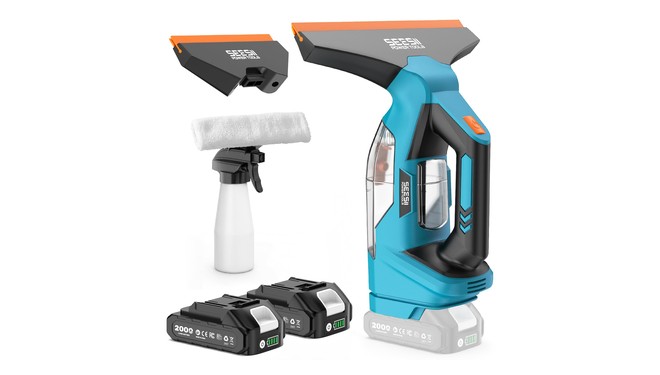
The device includes a 150 ml water tank, which is the largest capacity among the three models and reduces trips to the sink for emptying. It comes equipped with two interchangeable TPU nozzles: a 28 cm wide nozzle for large living room windows and a 17 cm narrow nozzle designed for small window panes, frames, and shower enclosure corners.
The Seesii model lacks a telescopic handle, weighing 580 g in hand. Reach is limited entirely to arm length, making it best suited for homes with extensive glass surfaces located at eye level rather than high windows.
Leifheit Dry and Clean Features
The Leifheit Dry & Clean stands out for its multi-angle operation. It functions turned at 90 degrees, working vertically, horizontally, and completely upside down. This capability allows it to clean shower screens, kitchen countertops, fogged bathroom mirrors, skylights, and glass gallery ceilings where other models fail to operate.
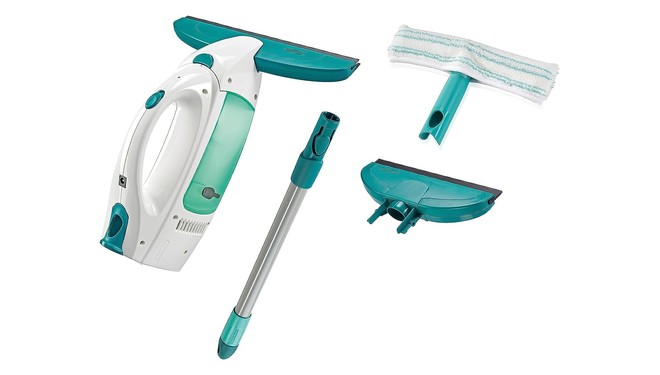
The Leifheit unit provides 38 minutes of autonomy, covering up to 110 square meters of glass surface per charge. As an established brand in the product category, Leifheit equips the cleaner with a washable fabric filter instead of disposable replacements. The device is sold as a complete set, currently offered at a discount, and weighs 1.2 kg to maintain stability when held against overhead surfaces.
One customer noted that she hesitated before buying the cleaner but did not regret the purchase at all because it saved a great deal of time when cleaning windows.
Clevich Extendable Window Cleaner
The Clevich window cleaner is the only model in the group that features an extendable telescopic handle. The handle extends from 44 cm to 75 cm, allowing users to reach the upper sections of double-hung windows, patio doors, and staircase glass without retrieving a stepladder from storage or balancing on stools.
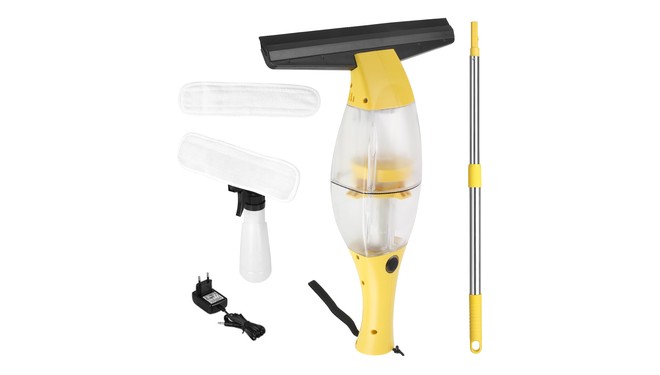
The Clevich cleaner uses a 28 cm nozzle and a 1,500 mAh lithium battery that offers 40 minutes of operation in normal mode and 30 minutes in high mode. It includes a removable tank for straightforward emptying without dismantling components. The unit weighs 1.13 kg with the extension attached, which can strain the wrist during prolonged use, but functions as a standard lightweight handheld device without the pole. It is also the most affordable option among the trio.
A buyer stated that the device was very practical with its telescopic attachment, noting its only drawback was being slightly heavier than others, though its overall utility compensated for the weight.
Choosing the Right Model for Your Home
Selecting the appropriate window cleaner depends on home layout rather than suction pressure measured in Pascals, which remains similar across all three models. Homeowners should first assess window height. If the upper frame can be reached from the floor with an extended arm, any of the three models will suffice. If reaching the top frame requires standing on a chair, a model with a telescopic handle is necessary to avoid leaving a dirty strip visible from seating areas.
Window design also dictates the choice. Sliding windows feature overlapping panes and bottom tracks where water collects, requiring a 17 cm narrow nozzle to clean hidden sections. For shower screens and horizontal glass, working position and angle take priority over battery runtime and extended reach.
Quality and Maintenance Differences
Electric window cleaners contain basic internal components, including a suction motor, battery, rubber squeegee lip, and water tank. However, specialized brands differ from generic marketplace sellers in key areas. High-quality battery cells maintain full suction power throughout each charge cycle and endure hundreds of recharges, whereas low-quality cells lose suction as power drains and experience reduced capacity over time.
Component longevity also varies. Washable fabric filters can be rinsed under water indefinitely, while paper or foam filters clog permanently without available spares. The rubber squeegee lip acts as a consumable part that can notch against frame edges; established brands with local distribution provide separate replacement lips. Established manufacturers also offer customer service support and spare parts for lost chargers or damaged nozzles.
The Seesii and Clevich models include a spray bottle and microfiber cloth in the box, while the Leifheit cleaner comes as a complete set. Specialized brand-name cleaning solutions are unnecessary, as warm water mixed with a few drops of neutral dishwashing soap effectively dissolves grease without leaving film residues. Users should keep spare rubber lips on hand as they age. For optimal results, windows should be kept damp rather than soaking wet, as excess liquid fills the tank rapidly and causes squeegee streaks. All three models deliver clear glass, with the main distinction being how high each unit can reach.


