

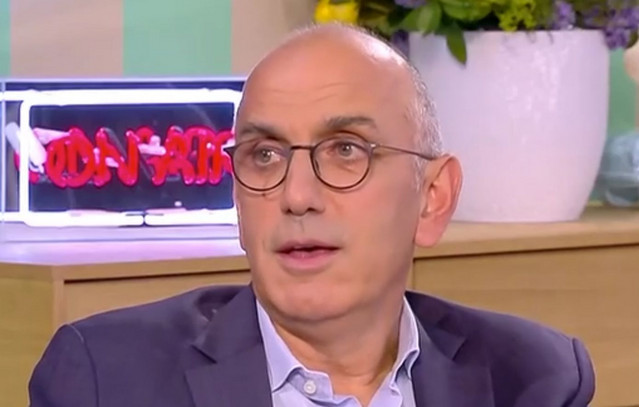
Manolis Kostidis, the Istanbul correspondent for Greek broadcaster SKAI, has described a little-known side of life for the Greek community in Istanbul, saying that despite a sharp fall in numbers, the community is living through its best years in decades under Turkish President Recep Tayyip Erdogan.
Kostidis, a journalist born in Istanbul to a Greek family, appeared on SKAI's programme "Studio at 3" to discuss his relationship with the city, Greece, his family, and the state of the Greek community that remains in Turkey.
Fewer in number, but more united
Speaking about the Greek community of Istanbul, Kostidis said the number of Greeks in the city has fallen significantly compared with previous decades, but stressed that a strong sense of cohesion remains.
He said the community is now smaller but concentrated and united, adding that despite small disagreements that can arise in daily life, it maintains its bonds and tries to keep its presence alive.
He said the presence of the Ecumenical Patriarch Bartholomew serves as a point of reference for the Greeks of Istanbul, describing him as a religious leader, and in his view a leader of the nation, whose pace the community tries to keep up with, which he said keeps them united.
Despite the dramatic fall in population, he said Greek neighbourhoods, schools and a daily life that retains elements of the old Greek community of the city still exist.
Erdogan government and the Greek community
Kostidis's comments on the Erdogan government drew particular attention, as the journalist said that, in his view, the Greeks of Istanbul have experienced a better period in recent years compared with the past.
He said that over the last 10 to 20 years, under Erdogan, however paradoxical it might sound on Greek television, the community has been living through its best years in decades.
He explained that this is linked to changes in the handling of certain issues affecting the Greek minority, such as the return of properties and the operation of schools.
He said there is a different approach now, and support, noting that many properties have been returned and schools have reopened.
At the same time, he stressed that the community's main problem remains its shrinking size.
He said they are very few now, describing the community as a species heading toward extinction, and explained that the main effort is to keep Greek schools open and to continue the community's presence.
From 10,000 Greeks to around 2,000
Kostidis also addressed the demographic decline of the Greek community.
He said that in the 1980s and 1990s, the Greeks of Istanbul numbered roughly 8,000 to 10,000 people, while today the figure is estimated at around 2,000.
He recalled the difficult decades of the past, when many families left the city.
He remembered that in the 1980s, when returning from church, his mother would tell his father each time that 30 families would leave that week, adding that families left in large numbers after the Cyprus crisis.
"For us, Greece is an idea"
The journalist also spoke about the relationship between the Greeks of Istanbul and Greece, explaining that for many in the community, the homeland was not simply a geographic place.
He said that for them, Greece is an idea.
He described relatives of his who had never visited Greece but maintained a strong emotional bond with it.
He said they listened to Greek radio, specifically from Orestiada, on an old radio set from morning until night, and that if you tried to speak to them at midday they would tell you to be quiet because they were listening to the news. He said they never came to Greece, did not know what Greece was, and loved it as much as one could possibly imagine.
Family and the return to Istanbul
Kostidis also spoke about his own path in life.
He was born in Istanbul, attended the Zappeion and Zografeion schools, studied in Greece and later returned to Istanbul for his career.
He said his family chose to remain in Istanbul for reasons connected to their life and work.
He said his father had his own business as a merchant and that there was a love for the city, explaining that when you live there you have people who know you, and a merchant has customers who all know him.
He said many people originally from Istanbul who now live in Greece continue to ask about the city, since their bond with it remains strong.
A dream first trip to Greece
The journalist also recalled his first visit to Greece, when he was still a student.
He said he travelled to Greece for the first time in 1988, at the age of around 13, for the Athens Festival with a theatre troupe.
He said it seemed magical to him, like a dream, and that he felt he was living a dream.
His account reflects the experience of someone who grew up between two worlds, carrying the history of Istanbul's Greek community along with the daily life of a community trying to preserve its memory, language and presence in a city that was once one of the most important centres of Hellenism.


