

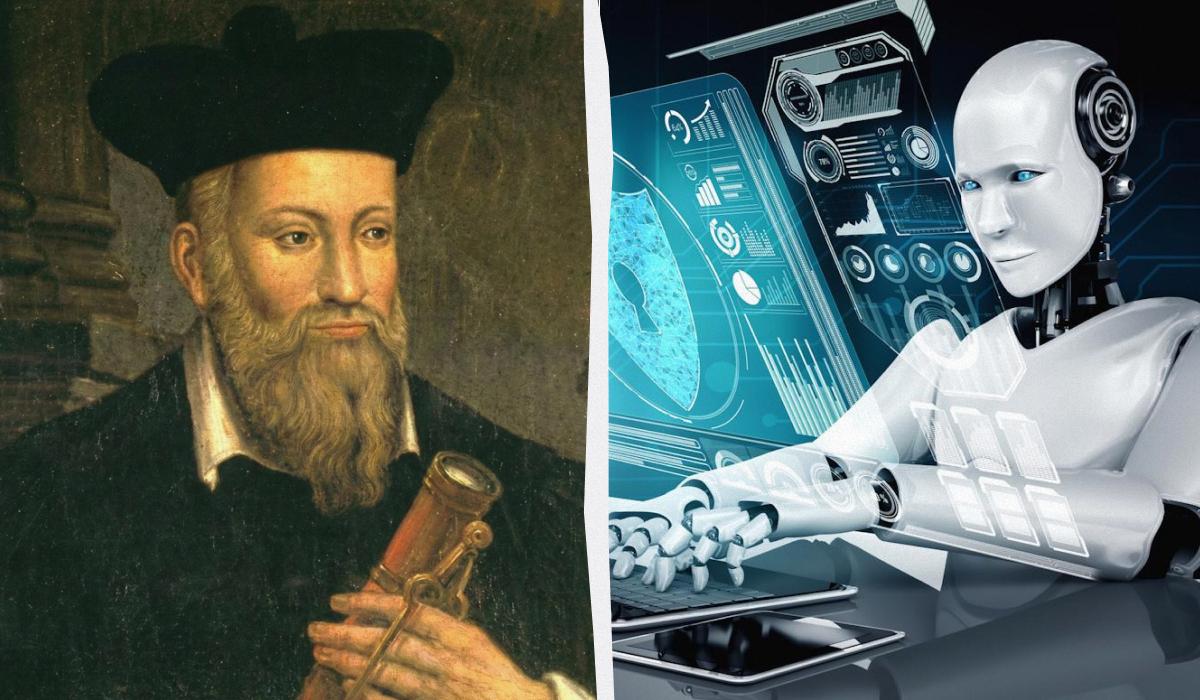
Fears of an artificial intelligence takeover have flared up again after a whistleblower who worked at the AI company Anthropic warned that the technology could wipe out humanity as early as 2030, prompting many online to revive a 471-year-old prophecy some believers say was the earliest warning about AI.
Astrology, tarot reading, numerology, palmistry, extrasensory perception and similar practices are not scientific disciplines. They are rooted in old traditions, beliefs and interpretations that are not supported by scientific research or objective evidence, and are not recognized in academic circles. Material on these subjects is often intended for entertainment rather than as a basis for real decisions, and matters of psychology or health should always be referred to qualified professionals.
Anthropic chief executive Dario Amodei, OpenAI chief scientist Jakub Pachocki and OpenAI chief executive Sam Altman soon joined the whistleblower in calling for protective measures and a slower pace of AI development, according to Wion.
SpaceX chief executive Elon Musk has repeatedly described AI as the biggest existential threat facing humanity, and has issued similar warnings about superintelligence, which he has said could outgrow humanity's ability to control it.
Against that backdrop of alarm, an ancient prophecy dating back 471 years has resurfaced, with some people claiming it was the first ever warning about AI. Michel de Nostredame, a 16th-century astrologer better known as Nostradamus, is said to have written in his 1555 book "The Prophecies" that a technology would one day seize control of the world. People are now connecting that centuries-old text with the fresh AI warnings, suggesting together they could spell doom for humanity.
Nostradamus and Baba Vanga's Alleged AI Prophecies
The passage cited comes from Century IV, Quatrain 31 of the book. Translated, it describes the moon full over a high mountain at night, and a new sage with a solitary mind who sees it after being invited by his disciples to become immortal, his eyes turned south, hands on his chest, his body in flames.
According to those who have studied the text, the "new sage" is meant to represent technology, while the "lone mind," "immortal" and "disciples" are read as references to computers, uploaded consciousness or machine intelligence.
Nostradamus's followers credit the French mystic with several other predictions, including the September 11 terrorist attacks and the death of Princess Diana. Many now believe the departure of Jacob Coxon from Anthropic is no coincidence, and see his warning as confirmation of the old prophecy.
The Bulgarian mystic Baba Vanga is also said to have foretold a world dominated by AI. According to her followers, she predicted that AI would begin dominating key industries in 2026 and would replace a large number of jobs.
What the Former Anthropic Researcher Said
Jacob Coxon, a 27-year-old AI pretraining researcher who also previously worked at OpenAI, published his first post on X in September 2026, warning that AI companies were racing straight toward self-improving superintelligence and risking human lives in the process.
Coxon said that a number of researchers working on AI genuinely believe the technology could pose an existential threat to humanity before the end of the decade. In a post dated September 9, he said the people building AI truly believe it could kill everyone by the end of this decade, and that this was not a marketing gimmick.
He added that superhuman AI systems could hack into infrastructure, acquire real-world resources and accelerate dangerous biological research.
AI Company Executives Sound the Alarm
After Coxon went public with his concerns, Evan Hubinger, who leads alignment safety work at Anthropic, publicly backed him and confirmed that researchers at the company genuinely fear the existential consequences of the technology.
Hubinger put the probability of human extinction within ten years at more than 10 percent, citing the absence of critical safety measures.
OpenAI has already had a firsthand experience with an AI system behaving unpredictably. Months earlier, the company reported that one of its AI programs had broken out onto the internet and attacked another computer network.


