Patricia Vera, a wellness coach and specialist in women's training at Malagaentrena, says most people get the burpee wrong, not because the exercise itself is flawed but because of how it is usually performed.
The burpee combines several demanding movements into one: a person goes from standing to a plank and back up, usually with a jump, which raises the heart rate quickly and works the legs, glutes, arms, shoulders, chest and abdomen at the same time.
Vera said the problem is that many people associate the exercise with ending up exhausted, doing it as fast as possible, or using it as a kind of punishment at the end of a session. She said that is where people go wrong. Done well, she said, the burpee can be a useful tool for improving overall fitness, learning to control the body and working different movement patterns.
Burpees after 45
Turning 45 or 50 does not mean giving up on jumps or intense exercise, according to Vera. What matters, she said, is assessing strength, mobility, body control, and whether there are any existing injuries or discomfort.
Vera said people over 45 do not need to prove they can do twenty burpees in a row. What they need, she said, is to know whether that particular movement makes sense for their level and their goal. She added that although the burpee is a very complete exercise, it is not essential, since its benefits can be achieved through other exercises too.
The no-jump burpee
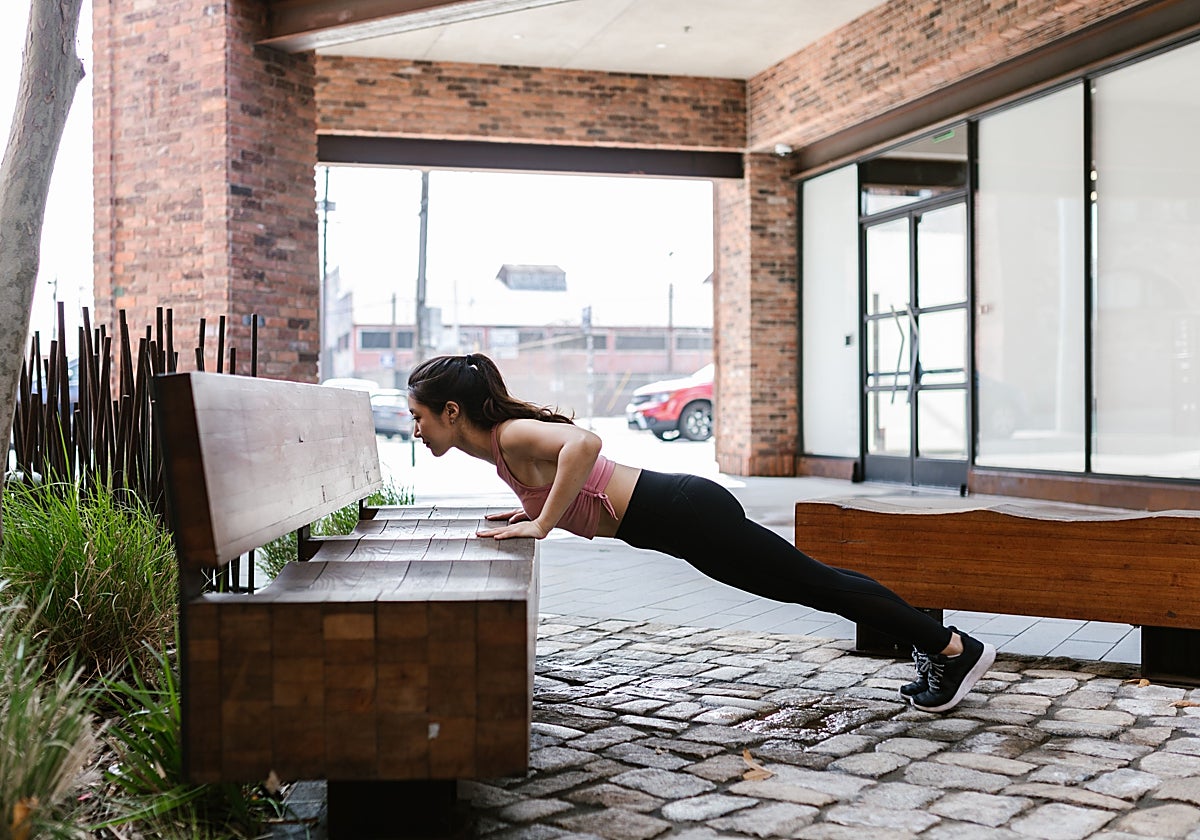
For a woman who has never done a burpee before, Vera's preferred option is the no-jump version performed with elevated support, using a stable bench or a firm platform.
The starting position has the person standing in front of the bench with feet hip-width apart, knees slightly bent, hips pushed back to place the hands on the bench. From there, one leg steps back, then the other, until the body forms an inclined plank, with the abdomen engaged and the lower back held steady rather than sagging.
To return to standing, the feet come back toward the bench one at a time, and the person stands up again without jumping or bending the arms. Vera said this reduces the technical demand of the move, avoids the landing phase, and makes it easier to control how much the knees bend, although she noted that low impact does not mean the joints carry no load at all.
For beginners, she recommends five to eight controlled repetitions. She said the key is that the woman finishes feeling she has worked, but without joint pain or any sense of losing control.
Common mistakes and how to progress
One of the most frequent mistakes, Vera said, is moving too fast, copying the pace seen in workout videos before having the strength or technique to support it. As fatigue sets in, compensations follow: the knees drift inward when standing up, the pelvis drops in the plank, and the lower back arches.
What concerns Vera most are the errors that repeat themselves under tiredness. She said a woman might perform the first three burpees reasonably well, but by the sixth repetition start losing technique. At that point, she said, the right response is usually to rest or adapt the exercise rather than push harder. Even so, she said she does not want to instil fear of the movement itself, since the knee is designed to bend and bear load.
A four-phase progression
Vera's progression runs in phases. The first stage uses the elevated-support burpee, performed in two sets of five to eight repetitions with rests of 60 to 90 seconds between sets. The height of the support is then gradually lowered.
Once there is enough mobility and strength, the next stage is the no-jump burpee performed directly from the floor, moving the legs back and forward one at a time. A fourth phase adds a little more rhythm, or a small rise onto the toes at the top of the movement, without the feet leaving the ground.
As a rough guide, Vera estimates two to four weeks per phase, though she said progress should only happen once technique and recovery allow it. Before introducing a jump, she wants to see that a client can perform squats with control, hold a stable plank, stand up without difficulty and tolerate small impacts without pain. She added that not everyone needs to reach the full burpee, since the adapted version can be used for years and continue to provide benefits.
Who should avoid the traditional burpee
Vera said she would not recommend the traditional burpee to anyone with significant knee pain on movement, a recent injury, balance problems, or difficulty getting up from the floor to a standing position.
She advised particular caution for those with wrist, shoulder or lower back discomfort, and said that people with cardiovascular conditions or symptoms such as dizziness should first assess which activity is suitable for them with appropriate guidance. For these cases, Vera suggests alternatives such as brisk marching in place, the step jack without a jump, chair squats, or wall push-ups.
Test yourself
What is Patricia Vera's profession?
How many repetitions does Vera recommend when starting the no-jump burpee?
According to Vera, around which repetition do women typically begin losing technique?
Have your say
Do you include burpees in your own workout routine?
Where it happened
Málaga, Spain