
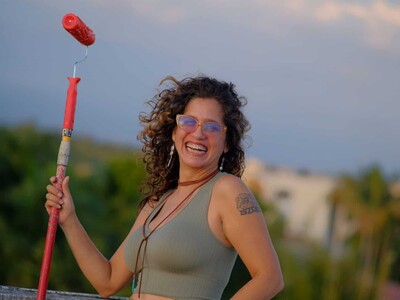
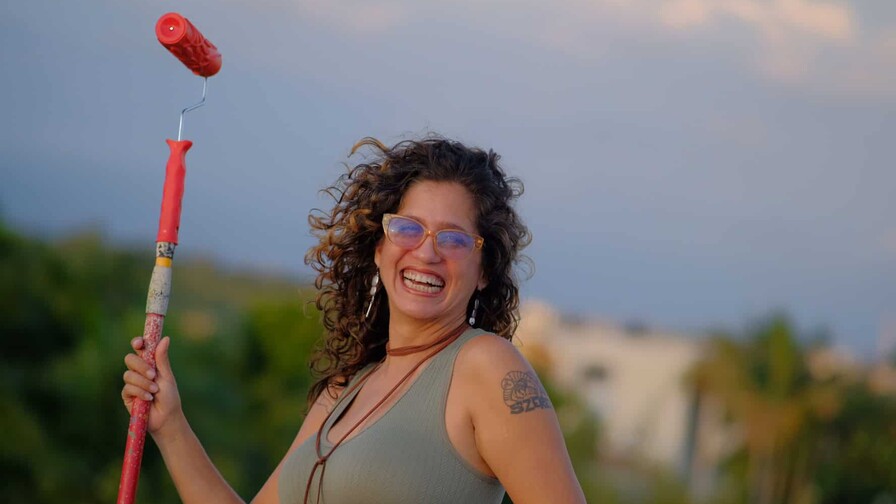
Dominican visual artist Kilia Llano creates large public murals across Caribbean communities that explore local memory, identity, and social justice through direct neighborhood collaboration.
Llano bases her public artwork on extensive territorial research and direct dialogue with local residents before painting a single brushstroke. She always seeks to incorporate light into her compositions, ensuring that a point of clarity emerges even when portions of an image remain in shadow.
The artist maintained that a mural does not belong to the painter, but rather to the community that lives alongside it. To shape each project, she gathers neighbors, introduces interactive dynamics, and invites residents to share their memories, their surrounding environment, and the key figures who have marked their locality.
Community Engagement in Guadeloupe
This collaborative process guided her work in Guadeloupe, a French Caribbean archipelago located in the Leeward Islands. After conducting research into the island's history and culture, Llano connected with a local community leader dedicated to preserving a traditional carnival rhythm.
Recognizing his role in safeguarding local musical traditions, she decided to make his face the focal point of the mural. Local residents embraced the finished artwork and recognized themselves in the large-scale portrait.
Public murals across the Caribbean frequently serve as vital community landmarks, transforming urban and rural spaces into shared visual archives. By engaging directly with residents, Llano ensures that her public paintings reflect the authentic lived experiences of each territory.
Artistic Background and Formal Training
Llano wanted to be an artist for as long as she can remember. By the age of four, she was already drawing constantly, supported by her mother who encouraged her vocation by providing brushes, paints, and building materials.
![[object HTMLTextAreaElement]](https://resources.diariolibre.com/images/2026/09/02/image003-2124dbef.jpg)
Her formal training began at the Altos de Chavón School of Design, a prominent art institute located in La Romana in the Dominican Republic. Established in 1983, the school maintains a long-standing affiliation with Parsons School of Design in New York City.
She later expanded her studies directly at Parsons School of Design, an internationally recognized college in Manhattan known for its programs in fine arts and visual communication. Rather than restricting herself to a single discipline, Llano built a versatile career that encompasses illustration, academic teaching, and editorial work.
Her background includes professional work at the Dominican newspaper Listín Diario. Founded in 1889 and based in Santo Domingo, Listín Diario is the oldest running daily publication in the Dominican Republic. Llano noted that she never felt the need to choose only one path, as her diverse professional experiences now converge into a unified artistic perspective.
Social Themes and Continuous Learning
A deep curiosity to understand the world around her drives the core themes of Llano's work. Her murals consistently address social and environmental justice, Caribbean identity, migration, decoloniality, memory, Blackness, and the place of women in society.
The artist explained that her choice of subjects does not stem from a predefined agenda. Instead, it arises from an ongoing need to research, experiment, and bring visibility to issues she considers important for public dialogue.
That enduring commitment to exploration led her to return to New York City at the age of 50 to pursue a Master of Fine Arts degree. She undertook the graduate program with the conviction that artistic learning and personal development never come to an end.
Master of Fine Arts programs offer artists advanced studio practice and critical theory to refine their visual language. For Llano, combining formal academic study with decades of practical experience allows each artistic medium to nourish the other.
Her ongoing work continues to enrich Dominican public art, creating opportunities for people who encounter her murals to see their own history and identity reflected in public space.