

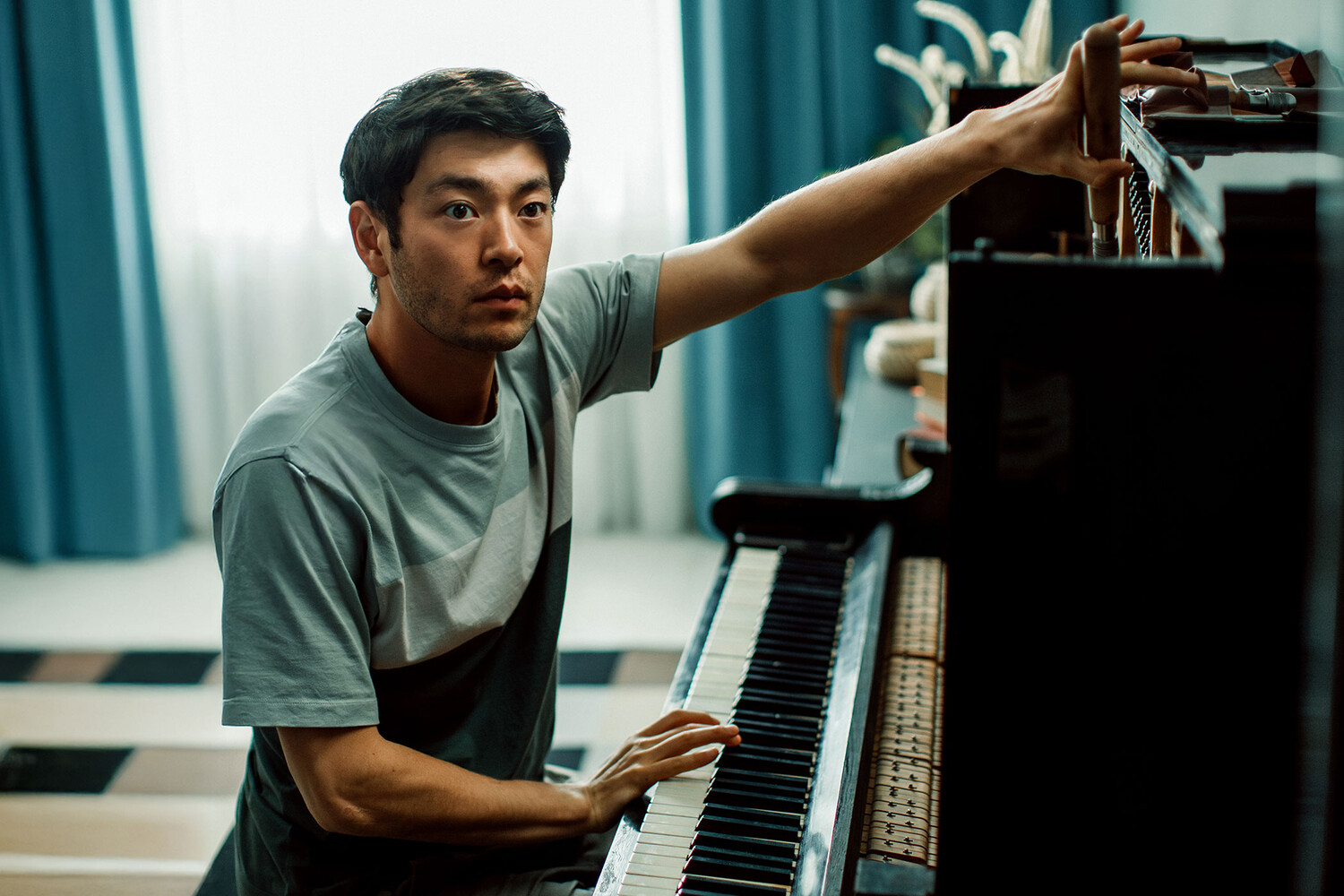
All episodes of the Russian dramedies series Pasha, starring Askar Ilyasov, are now available on the streaming platform Amediateka. Film critic Pavel Voronkov offers an assessment of the show.
Pasha Belov is a 32-year-old Muscovite who was expelled from the Gnessin Academy of Music and never built the career he once imagined. He now scrapes by tuning pianos, still lives with his mother, a former geologist who is perpetually off on hiking trips, and borrows money from a sympathetic grandmother and an older brother who runs a successful furniture workshop.
The story is set in motion when his aunt's family arrives for a visit and one of the children comes down with chickenpox. Since Pasha has never had the illness, the two households cannot share an apartment, and he is forced out to find somewhere else to stay. What follows is a chain of awkward and comic situations: a tooth pulled in an unlicensed clinic, a disastrous school reunion, an encounter with a failed actress, a night in a police station, and other misadventures that gradually push the young man toward confronting his own life.
Millennial melancholy, Moscow-style
The series was co-written by Anton Kolomeetz, whose previous work includes the debut Your Tutor and the drama Light. Kolomeetz co-wrote Pasha with his VGIK classmate and close friend Evgenia Tamakhina, marking the first time he has centered his storytelling on peers rather than exploring the tension between youth and old age.
Voronkov notes that the opening episode carries a light, wandering energy that evokes the Moscow thaw-era cinema of Georgy Daneliya and Marlen Khutsiev. The city itself receives considerable attention: the creators capture a place where people often feel isolated and guarded, yet where unexpected warmth occasionally passes between strangers.
As the series progresses it adopts a more episodic, sitcom-adjacent structure, with Pasha encountering unusual residents in the apartments where he is called to tune instruments. This format, Voronkov writes, does not prevent the creators from digging into themes of millennial self-realization and the anxiety of not knowing who you are.
Identity at the center
The question of national identity runs through the series. Pasha grew up in a Slavic family but his father, whom he has never met, is an Uzbek from Tashkent. Few around him recognize him as a native Muscovite, a situation the show uses to examine everyday racism. Yet the series does not let Pasha off the hook: during a scene at a police station he distances himself from other detainees who share his features, and the character played by Irina Gorbacheva later tells him directly that speaking about migrants as second-class people while being half-Uzbek himself is, in her words, simply awful.
Voronkov describes this as an important conversation that Russian cinema rarely allows itself to have. He also raises a casting question that has followed Ilyasov since his breakthrough in Patient Zero, where the Kazakh actor played a Kalmyk doctor. Here he plays a character with Uzbek roots, and given how central ethnic identity is to the story, the critic finds something fundamentally contradictory in that choice, however strong the performance.
After the midpoint the series shifts toward a more sustained narrative, with Pasha eventually making his way toward Tashkent to search for answers. The creators, Voronkov writes, leave him at a telling stop along that route: once again he discovers he has been looking outward for solutions to problems that are his own.
Tamakhina said the project grew from impressions and feelings that had accumulated over the years, and from giving themselves permission not to meet other people's expectations. The series ends, in Voronkov's reading, on something close to a Buddhist note, achieving a quietly therapeutic effect without feeling like a transcript from a psychoanalyst's couch.