


Judicial authorities have seized around 200 neglected horses and ponies from a breeding farm in Saint-Germain-du-Puy in the Cher department of central France.
Bourges public prosecutors intervened at the property on 20 and 21 October 2026 as part of a criminal investigation into animal mistreatment and the severe deprivation of food and care.
Officials inspecting the facility discovered emaciated horses reduced to skeletons, orphaned foals wandering the grounds, and a dying mare collapsed on the ground with her foal beside her.
Lisa Fernandez, the president and co-founder of the Les 3-Dindes farm sanctuary, described the operation as the largest legal case involving equines ever opened in France.
Saint-Germain-du-Puy is a rural commune situated just east of Bourges, the administrative capital of Cher in the Centre-Val de Loire region. Under French law, public prosecutors direct judicial police investigations when severe neglect or cruelty endangers domestic livestock.
Logistical operation to clear the herd
Judicial authorities seized the entire herd of roughly 200 equines and transported them to a dedicated reception centre equipped to hold distressed animals.
State veterinarians conducted thorough medical examinations on every horse and pony to document their physical condition and determine urgent care requirements.
The Cher Departmental Directorate for the Protection of Populations, the state agency overseeing veterinary safety and animal welfare, coordinated with animal protection charities nationwide to find suitable accommodation.
Fernandez said the preparatory work by state authorities was immense, noting the vast logistical effort required to relocate 200 horses to a depot where animal protection charities could collect them.
Following veterinary assessments, judicial officials entrusted 109 horses and ponies displaying acute signs of malnutrition, physical abuse, and lack of medical treatment to registered animal welfare associations.
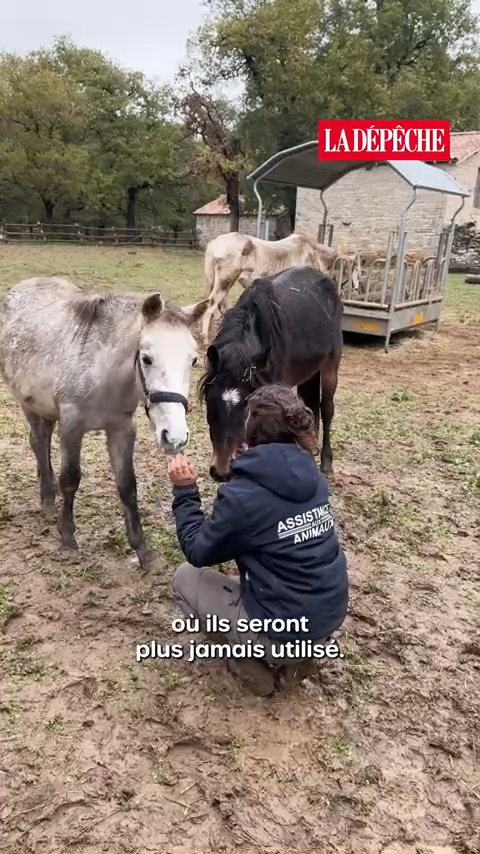
Two animal protection charities based in the south-western department of Tarn-et-Garonne travelled to the Cher depot on 27 and 28 October 2026 to assist. Les 3-Dindes took custody of seven equines, while the Fondation Assistance aux Animaux took about ten. The Brigitte Bardot Foundation also supported the operation by dispatching a heavy-goods semi-trailer to transport several animals across the country.
Catching unhandled horses in corrals
Fernandez departed for Cher on the morning of 27 October 2026 accompanied by seven members of her organisation. The convoy deployed a lorry towing a two-horse trailer, a four-wheel-drive vehicle pulling a second trailer, and an additional volunteer driving a car with a third trailer.
The collection proved exceptionally demanding because four of the seven equines assigned to Les 3-Dindes were wild horses penned in pastures that Fernandez described as impossible to catch. She noted that handling horses that had never experienced human contact was a challenging task.
Judicial officials fitted every horse with a halter and an identification tag prior to collection. Fernandez explained that the tags eased their work, allowing volunteers to construct makeshift corrals from nearby infrastructure and guide the animals safely into the trailers.
The rescue convoy reached the holding facility at 8:00 AM and departed at 2:00 PM. During the return journey between Cher and Tarn-et-Garonne, the team placed the seven equines across three undisclosed locations to guarantee their safety. Although placed with foster families, the animals remain under the formal legal guardianship of Les 3-Dindes.
History of neglect at sport horse stud
Fernandez voiced anger that the situation had persisted for years. The site operated as a breeding facility for sport and leisure horses, but reports detailing mistreatment, chronic lack of care, and poor breeding management had been lodged with French state authorities since 2018.
Fernandez said the conditions discovered at the farm deeply shocked the rescue workers. She observed that numerous heavily pregnant mares had foals suckling at their sides despite being so starved and neglected that they struggled to produce milk. She stressed that nothing justified the owner continuing to breed horses under such conditions.
In equine husbandry, broodmares require elevated nutrition during gestation and lactation to sustain foetal development and milk production. Severe malnutrition in nursing mares leaves young foals at acute risk of developmental failure, organ damage, and starvation.
Sanctuary expansion and financial strain
The arrival of the seven horses brought the equine population at Les 3-Dindes to 45, comprising horses, ponies, and donkeys. The sanctuary, located in L'Honor-de-Cos, also provides refuge to farm livestock including sheep, pigs, and goats, bringing its total resident population to 250 animals.
With 250 animals under its care, the refuge has reached saturation. Fernandez said Les 3-Dindes pledges to support every rescued animal for the rest of its natural life, refusing to offer any resident for public adoption in order to guarantee a permanent, stable home for creatures traumatised by past abuse.
This lifetime commitment creates a heavy financial burden. Fernandez acknowledged that welcoming seven additional horses generates substantial extra expenses for feed, daily maintenance, and veterinary care, prompting the charity to appeal for public donations.
Supporters can send postal cheques to Les 3-Dindes at 1145 chemin de Rossignol, 82130 L'Honor-de-Cos. The charity also accepts online contributions through its campaign page on the HelloAsso platform, as well as direct bank transfers to account IBAN FR76 1780 7000 0445 5211 6837 126, BIC CCBPFRPPTLS.
The emergency rescue coincides with an expansion project at the sanctuary. Les 3-Dindes recently purchased a six-hectare plot of land adjoining the existing farm to construct an equine education centre, where staff intend to focus specifically on geriatric care for elderly horses.
Charity partnership and criminal prosecution
Fernandez highlighted the vital support of partner organisations, notably the Fondation Assistance aux Animaux. The national charity established a major animal shelter in Tarn-et-Garonne two to three years ago and works frequently with Les 3-Dindes on regional welfare operations.
Les 3-Dindes announced its decision to join the criminal proceedings as a civil party before the court in Bourges. Fernandez stated that rescuing the animals was essential but insufficient on its own, insisting that those responsible for the abuse must answer for their actions and that the charity intends to pursue the legal process to secure a punishment commensurate with the suffering caused.
Under the French legal system, an organisation that registers as a civil party gains formal standing in criminal court, enabling legal counsel to access prosecution evidence, examine witnesses, and seek civil damages to support the long-term rehabilitation of abused animals.